 Back
BackMicrobial Genetics: Structure, Expression, Regulation, and Horizontal Gene Transfer
Study Guide - Smart Notes
 Tailored notes based on your materials, expanded with key definitions, examples, and context.
Microbial Genetics
Key Terminology
Microbial genetics explores the structure, function, and regulation of genetic material in microorganisms. Understanding these terms is foundational:
Gene: A segment of DNA encoding a functional product, usually a protein.
Chromosome: A DNA molecule containing many genes; prokaryotes typically have a single, circular chromosome.
Promoter: DNA sequence where RNA polymerase binds to initiate transcription.
Operator: DNA region that regulates gene expression by binding repressors.
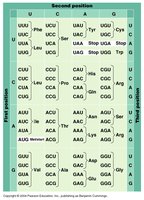
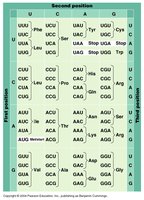
Codon: Three-nucleotide sequence in mRNA specifying an amino acid.
Mutation: Any change in DNA sequence; includes point, missense, nonsense, and frameshift mutations.
Mutagen: An agent that increases mutation rate (e.g., chemicals, radiation).
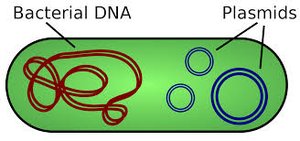
Plasmid: Small, circular, extrachromosomal DNA molecule in bacteria.
Structure of DNA
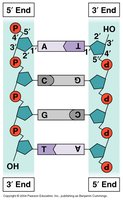
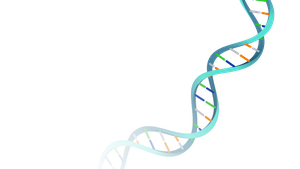
DNA is a double helix composed of nucleotides: adenine (A), thymine (T), cytosine (C), and guanine (G). The backbone consists of deoxyribose sugar and phosphate groups, with hydrogen bonds between complementary bases (A-T, C-G). Strands are antiparallel.
Base-pairing rules: A pairs with T, C pairs with G.
Antiparallel: One strand runs 5' to 3', the other 3' to 5'.
DNA Replication
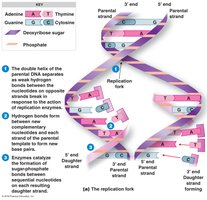
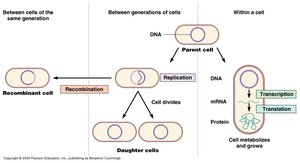
DNA replication is semiconservative: each new DNA molecule contains one parental and one daughter strand. DNA polymerase adds nucleotides according to base-pairing rules.
Replication fork: The site where DNA unwinds and replication occurs.
Enzyme: DNA polymerase catalyzes nucleotide addition.
Gene vs. Genome
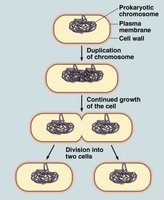
A gene is a single functional unit, while a genome is the entire genetic content of an organism. During DNA replication, the genome is copied.
Transcription: DNA to RNA
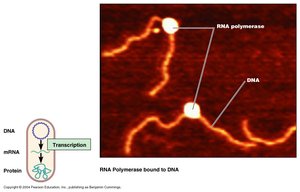
Transcription is the process by which DNA is used to synthesize RNA. RNA polymerase binds to the promoter sequence to initiate transcription. In prokaryotes, mRNA is immediately ready for translation.
Types of RNA: mRNA (messenger), rRNA (ribosomal), tRNA (transfer).
Product: mRNA is the product of transcription.
Enzyme: RNA polymerase.
Translation: RNA to Protein
Translation occurs in ribosomes, where mRNA codons are read to assemble amino acids into proteins. Each codon specifies an amino acid; translation begins at the START codon (AUG) and ends at a STOP codon (UAA, UAG, UGA).
Ribosomes: Catalyze peptide bond formation.
mRNA: Provides codon sequence.
tRNA: Brings amino acids to ribosome.
Gene Regulation: Operon Model
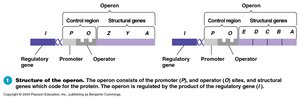
Bacterial gene expression is regulated by operons, which consist of a promoter, operator, and structural genes. Operons can be inducible (normally off, turned on as needed) or repressible (normally on, turned off as needed).
Constitutive genes: Expressed at a fixed rate.
Regulated genes: Expression varies with cellular needs.
Trp Operon (Repressible Operon)
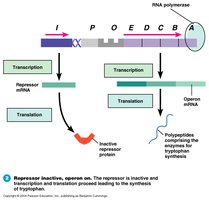
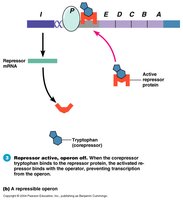
The trp operon encodes enzymes for tryptophan synthesis. When tryptophan is absent, the operon is on; when tryptophan is present, it acts as a corepressor, activating the repressor and turning the operon off.
Lac Operon (Inducible Operon)
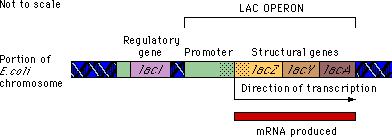
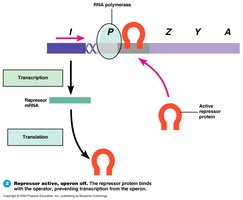
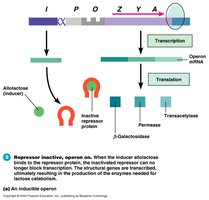
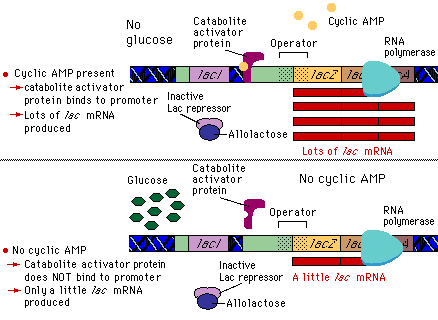
The lac operon encodes enzymes for lactose catabolism. In the absence of lactose, the repressor is active and the operon is off. When lactose is present, allolactose (an inducer) inactivates the repressor, turning the operon on.
Lac Operon Regulation by Glucose and cAMP
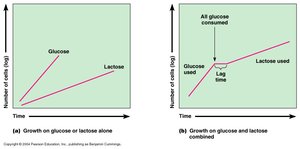
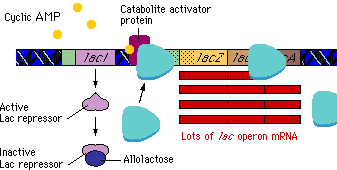
Maximal lac operon transcription occurs when lactose is present and glucose is absent. Cellular cAMP levels rise as glucose is depleted, activating the catabolite activator protein (CAP) and enhancing transcription.
Mutations and Their Types
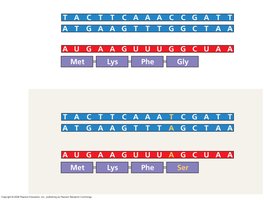
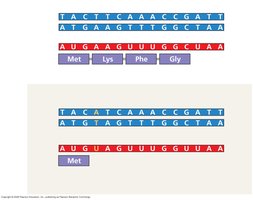
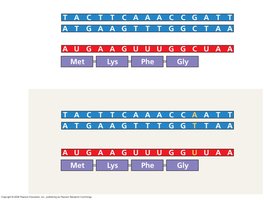
Mutations are changes in DNA sequence. They may be neutral, beneficial, or harmful, and can be inherited. Types include:
Point mutation: Single nucleotide change.
Missense mutation: Substitutes one amino acid for another.
Nonsense mutation: Introduces a premature STOP codon.
Silent mutation: No change in amino acid sequence.
Frameshift mutation: Insertion or deletion alters reading frame.
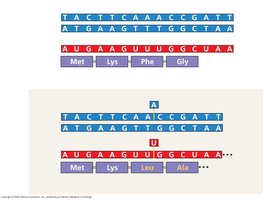
Mutation Frequency and Mutagens
Spontaneous mutations occur at a low rate due to DNA polymerase errors. Mutagens increase mutation rate by 10 to 1000 times.
Spontaneous mutation rate: replicated base pairs.
Mutagens: Radiation (UV, ionizing), chemicals.
Genetic Transfer in Bacteria
Bacteria acquire new genotypes via vertical and horizontal gene transfer.
Vertical gene transfer: DNA passed from parent to offspring during cell division.
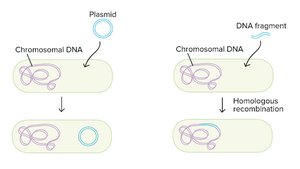
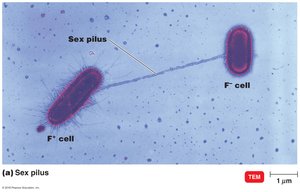
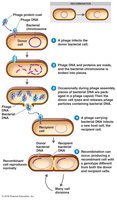
Horizontal gene transfer: DNA transferred between cells of the same generation.
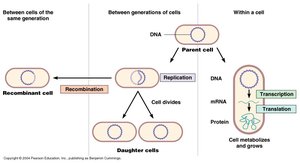
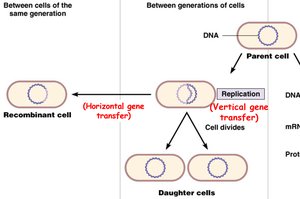
Horizontal Gene Transfer Mechanisms
Transformation: Uptake of naked DNA from environment.
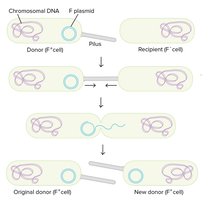
Conjugation: Direct transfer of DNA via cell-to-cell contact (sex pilus).
Transduction: DNA transfer via bacteriophage (virus).
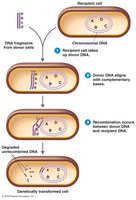
Plasmids
Plasmids are circular, extrachromosomal DNA molecules. They often carry genes for antibiotic resistance (R factors), virulence factors, or conjugation (F factor).
Conjugative plasmid: Carries genes for sex pili and plasmid transfer.
R factors: Encode antibiotic resistance.
Virulence factors: Encode toxins or pathogenicity determinants.
Summary Table: Types of Mutations
Type | Definition | Effect |
|---|---|---|
Point Mutation | Single nucleotide change | May be silent, missense, or nonsense |
Missense Mutation | Codon change results in different amino acid | Protein function may change |
Nonsense Mutation | Codon change results in STOP codon | Protein truncated |
Silent Mutation | Codon change does not alter amino acid | No effect on protein |
Frameshift Mutation | Insertion/deletion alters reading frame | Protein sequence altered downstream |
Summary Table: Horizontal Gene Transfer Mechanisms
Mechanism | Description | Key Features |
|---|---|---|
Transformation | Uptake of naked DNA | Recombination, environmental DNA |
Conjugation | Direct cell-to-cell transfer | Sex pilus, F factor plasmid |
Transduction | Virus-mediated DNA transfer | Bacteriophage, donor and recipient cells |
Additional info:
Gene regulation is essential for cellular adaptation to environmental changes.
Mutations and horizontal gene transfer drive microbial evolution and diversity.
