 Back
BackMicrobial Genetics: Structure, Function, and Expression of Genetic Material
Study Guide - Smart Notes
 Tailored notes based on your materials, expanded with key definitions, examples, and context.
Microbial Genetics
Introduction to Microbial Genetics
Microbial genetics is the study of the mechanisms of heritable information in microorganisms. The fundamental principles of genetics are shared across all three domains of life: Bacteria, Archaea, and Eukarya. The genetic material, DNA, serves as the master blueprint for all cellular functions and is organized into chromosomes, which carry genes encoding proteins and functional RNAs.
Genome: The complete set of genetic information in a cell.
Chromosomes: Structures composed of DNA and proteins that contain genes.
Genes: Segments of DNA that encode specific functional products, usually proteins or RNAs.
Structure of DNA
DNA Composition and Double Helix
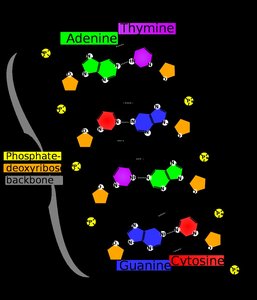
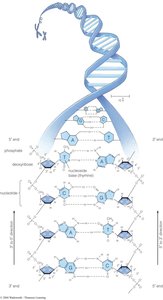
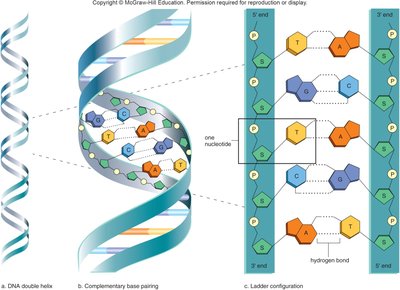
DNA (Deoxyribonucleic Acid) contains the directions to makle everything a cell needs and is a double-stranded molecule composed of nucleotides. Each nucleotide consists of a deoxyribose sugar, a phosphate group, and a nitrogenous base (adenine, thymine, guanine, or cytosine). The two strands are held together by hydrogen bonds between complementary bases: adenine pairs with thymine, and guanine pairs with cytosine. That information is carried in the sequence of nitrogenous bases-the rungs of the ladder.
Nucleotides: Building blocks of DNA, each containing a sugar, phosphate, and base.
Complementary Base Pairing: A with T, G with C.
Antiparallel Strands: One strand runs 5' to 3', the other 3' to 5'.
Hydrogen Bonds: Hold the two DNA strands together.
The Central Dogma of Molecular Biology
Flow of Genetic Information
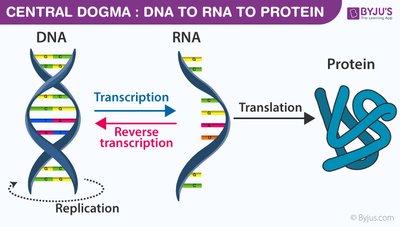
The central dogma describes the flow of genetic information within a biological system: DNA is transcribed into RNA, which is then translated into protein. This process is fundamental to gene expression and cellular function.
Transcription: Synthesis of RNA from a DNA template.
Translation: Synthesis of protein from an RNA template.
Replication: Copying of DNA to produce identical DNA molecules.

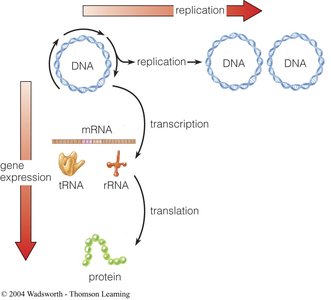
DNA Replication
Mechanism of DNA Replication
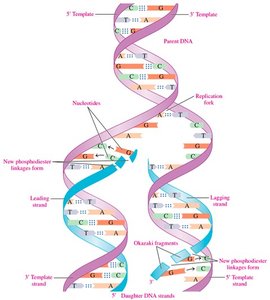
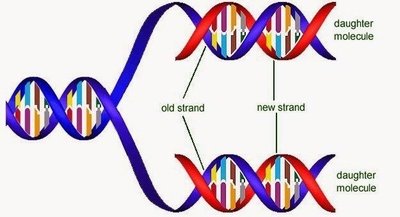
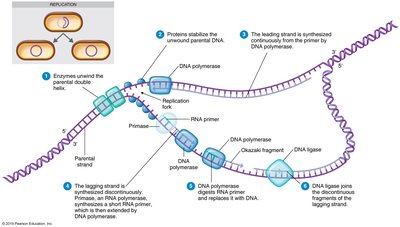
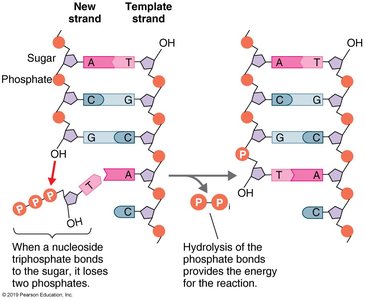
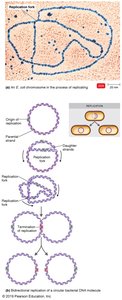
DNA replication is the process by which a cell copies its DNA before cell division. It is highly accurate due to the proofreading ability of DNA polymerase. Replication is semiconservative: each new DNA molecule consists of one old and one new strand.
Double Helix – double
stranded DNA
Origin of Replication: Specific sequence where replication begins.
DNA Helicase: Unwinds the DNA double helix.
Single-Strand Binding Proteins (ssBP): Stabilize unwound DNA.
DNA Polymerase: Synthesizes new DNA strands in the 5' to 3' direction.
Leading Strand: Synthesized continuously.
Lagging Strand: Synthesized discontinuously in Okazaki fragments, joined by DNA ligase.
Semiconservative Replication: Each daughter DNA has one parental and one new strand.
Nucleotides = building blocks
of nucleic acids
• Adenine
• Thymine (DNA only)
• Guanine
• Cytosine
• Uracil (RNA only)
• Complementary base pairing
is KEY
• G with C; A with T
Gene Expression: Transcription and Translation
Transcription
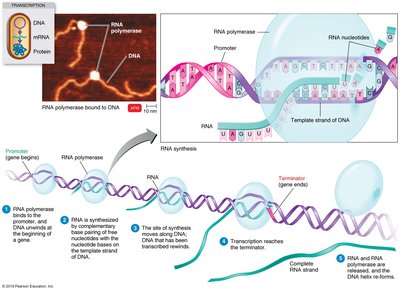
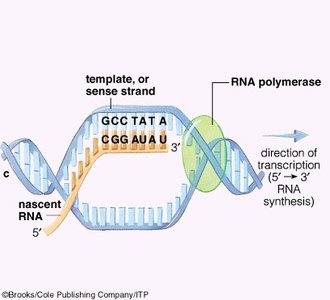
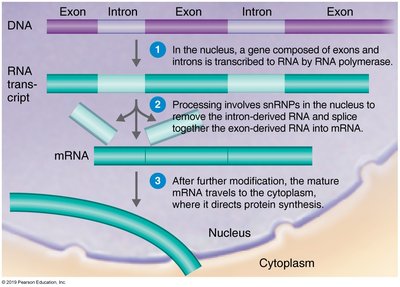
Transcription is the synthesis of RNA from a DNA template. It involves the enzyme RNA polymerase, which binds to the promoter region of a gene and synthesizes RNA in the 5' to 3' direction. In prokaryotes, transcription occurs in the nucleoid; in eukaryotes, it occurs in the nucleus.
Types of RNA: mRNA (messenger), rRNA (ribosomal), tRNA (transfer).
Promoter: DNA sequence where RNA polymerase binds.
Terminator: Sequence signaling the end of transcription.
RNA Processing (Eukaryotes): Removal of introns and joining of exons by snRNPs.
Translation
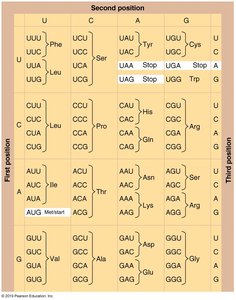
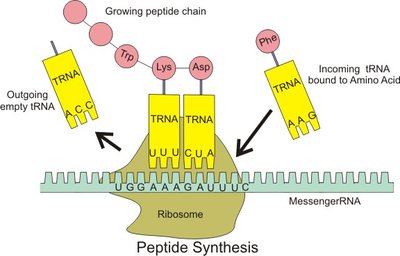
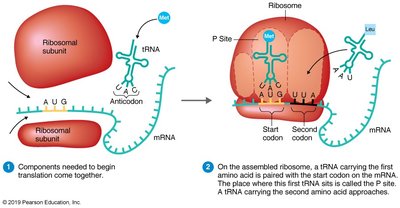
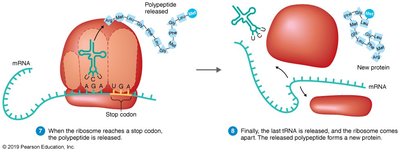
Translation is the process by which ribosomes synthesize proteins using mRNA as a template. The mRNA is read in codons (sets of three bases), each specifying an amino acid. tRNAs bring the appropriate amino acids to the ribosome, matching codons with anticodons.
Start Codon: AUG (methionine).
Stop Codons: UAA, UAG, UGA (signal termination).
tRNA: Carries specific amino acids and matches them to codons via anticodons.
Ribosome Sites: A site (aminoacyl), P site (peptidyl), where tRNAs bind and peptide bonds form.
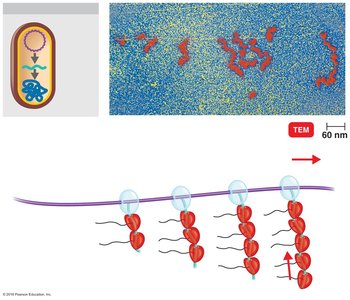
Polysome: Multiple ribosomes translating a single mRNA simultaneously (in prokaryotes).

Regulation of Gene Expression
Global and Individual Gene Regulation
Gene expression can be regulated globally or at the level of individual genes. Not all genes are expressed at all times; regulation ensures that gene products are produced only when needed, conserving energy and resources.
Constitutive Genes: Expressed continuously (e.g., glycolysis enzymes).
Inducible Genes: Expressed only when needed.
Repressible Genes: Can be turned off when not needed.
Pre-transcriptional Control: Regulation occurs before mRNA is made.
Plasmids and DNA Exchange in Bacteria
Plasmids
Plasmids are small, circular, extrachromosomal DNA molecules found in bacteria. They often carry genes that confer advantageous traits, such as antibiotic resistance, and can be transferred between cells.
Conjugative Plasmids: Carry genes for sex pili and plasmid transfer.
Dissimilation Plasmids: Encode enzymes for unusual compound catabolism.
Resistance (R) Factors: Encode antibiotic resistance.
Toxin Genes: Some plasmids carry genes for toxins, increasing pathogenicity.
Mechanisms of DNA Exchange
Bacteria can exchange genetic material through three main mechanisms, increasing genetic diversity and adaptability:
Transformation: Uptake of naked DNA from the environment.
Conjugation: Direct transfer of DNA (usually plasmids) via cell-to-cell contact using sex pili.
Transduction: Transfer of DNA by bacteriophages (viruses that infect bacteria).
These processes allow for the spread of beneficial traits, such as antibiotic resistance, within bacterial populations.
Summary Table: Key Differences Between DNA and RNA
Feature | DNA | RNA |
|---|---|---|
Strands | Double-stranded | Single-stranded |
Sugar | Deoxyribose | Ribose |
Bases | A, T, C, G | A, U, C, G |
Length | Long | Short |
Location | Nucleus/nucleoid | Cytoplasm, ribosome |
Key Equations and Concepts
Base Pairing Rule: ,
Direction of Synthesis:
Central Dogma:
Additional info: The notes above provide a comprehensive overview of microbial genetics, including the structure and function of DNA, the processes of replication, transcription, and translation, and the mechanisms of genetic exchange in bacteria. These concepts are foundational for understanding microbial physiology, evolution, and biotechnology applications.
