 Back
BackMicrobial Genetics: Structure, Function, and Regulation of Genetic Material
Study Guide - Smart Notes
 Tailored notes based on your materials, expanded with key definitions, examples, and context.
Microbial Genetics: Structure, Function, and Regulation of Genetic Material
Introduction to Microbial Genetics
Microbial genetics is the study of how microorganisms inherit traits, how their genetic information is organized, expressed, and altered. This field is foundational for understanding microbial physiology, evolution, and biotechnology applications.
Genetic Material: Structure and Organization
DNA, Chromosomes, and Plasmids
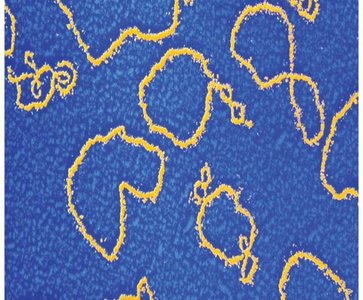
DNA (Deoxyribonucleic Acid): The hereditary material in all cellular organisms, composed of nucleotides (adenine, thymine, cytosine, guanine).
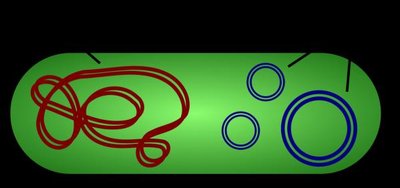
Chromosomes: Structures containing DNA that carry genetic information. In bacteria, chromosomes are typically single, circular, and supercoiled to fit within the cell.
Plasmids: Small, circular DNA molecules separate from the chromosomal DNA. They often carry genes beneficial for survival, such as antibiotic resistance.
Genome, Genes, and Genetic Code
Genome: The complete set of genetic information in a cell.
Genes: Segments of DNA that encode functional products, usually proteins.
Genetic Code: The set of rules by which information encoded in DNA is translated into proteins. It is nearly universal among organisms.
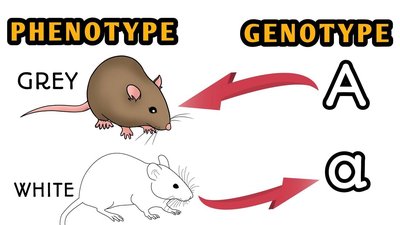
Genotype vs. Phenotype
Genotype: The genetic makeup of an organism (the alleles present).
Phenotype: The observable traits or characteristics resulting from gene expression.
The Central Dogma of Molecular Biology
Flow of Genetic Information
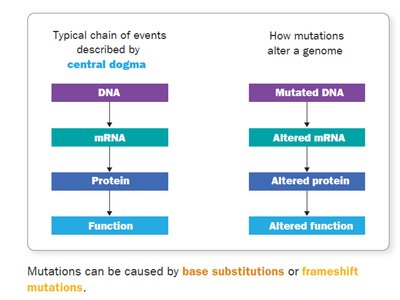
The central dogma describes the flow of genetic information from DNA to RNA to protein, which determines cellular function.
Transcription: DNA is transcribed into messenger RNA (mRNA).
Translation: mRNA is translated into a protein sequence.

Mutations and Their Effects
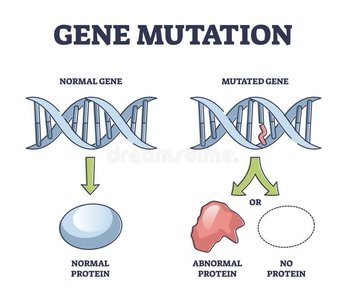
Mutations are permanent changes in the DNA sequence. They can alter the flow of genetic information, leading to changes in mRNA, protein structure, and ultimately cellular function.
Base Substitutions: One base is replaced by another, possibly altering a single amino acid (missense) or creating a stop codon (nonsense).
Frameshift Mutations: Insertions or deletions that shift the reading frame, often resulting in nonfunctional proteins.
DNA Structure and Replication
DNA Double Helix
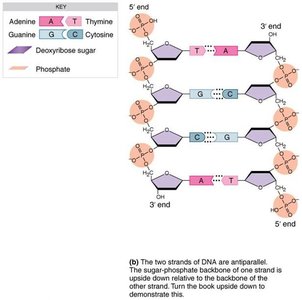
DNA consists of two antiparallel strands forming a double helix.
Base pairing: Adenine (A) pairs with Thymine (T), and Cytosine (C) pairs with Guanine (G) via hydrogen bonds.
DNA Replication
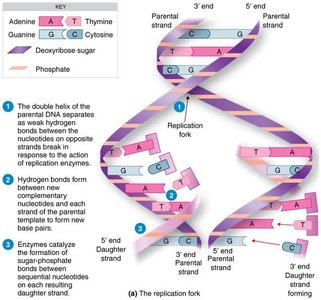
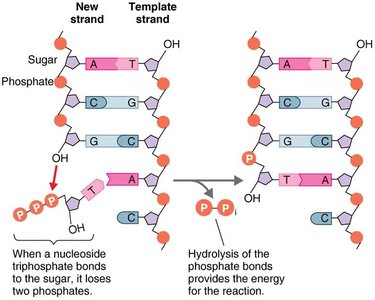
DNA replication is the process by which a cell duplicates its DNA before cell division. It is semiconservative, meaning each new DNA molecule contains one original and one new strand.
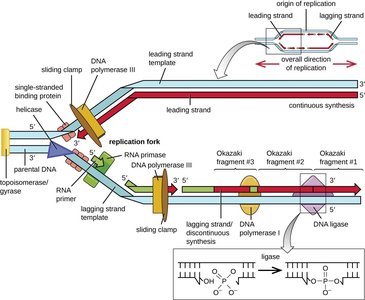
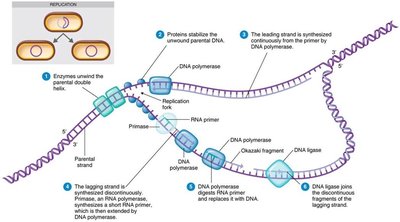
Key Enzymes: Helicase (unwinds DNA), DNA polymerase (synthesizes new DNA), Primase (synthesizes RNA primers), Ligase (joins Okazaki fragments), Gyrase/Topoisomerase (relieves supercoiling).
Leading Strand: Synthesized continuously in the 5' to 3' direction.
Lagging Strand: Synthesized discontinuously as Okazaki fragments.
Energy: Provided by the hydrolysis of nucleoside triphosphates.
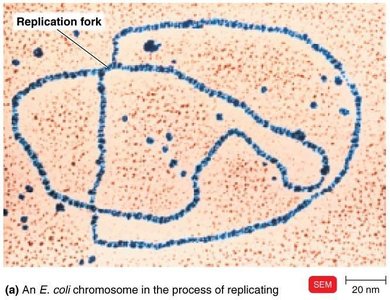
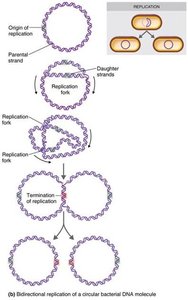
Bacterial DNA Replication
Replication is typically bidirectional from a single origin of replication.
Each daughter cell receives one complete DNA molecule.
Gene Expression: Transcription and Translation
Transcription
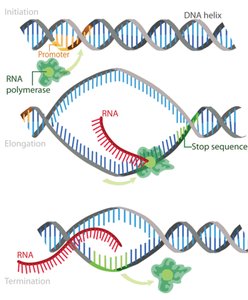
RNA polymerase synthesizes a complementary mRNA strand from a DNA template.
Transcription begins at the promoter and ends at the terminator sequence.
Types of RNA
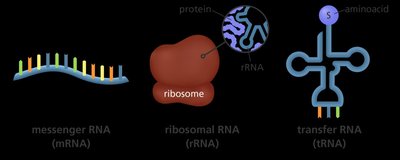
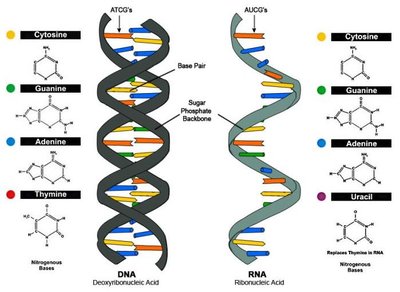
mRNA (Messenger RNA): Carries genetic code from DNA to ribosomes.
rRNA (Ribosomal RNA): Forms the core of ribosome's structure and catalyzes protein synthesis.
tRNA (Transfer RNA): Brings amino acids to the ribosome during translation.
Translation
mRNA is decoded in the ribosome to synthesize proteins.
Codons (triplets of nucleotides) specify amino acids.
Translation begins at the start codon (AUG) and ends at a stop codon (UAA, UAG, UGA).
tRNA molecules match amino acids to codons via their anticodon regions.
Regulation of Gene Expression
Operons and Gene Regulation in Bacteria
Operon: A cluster of genes under the control of a single promoter and operator, allowing coordinated regulation.
Inducible Operon: Usually off; can be turned on by an inducer (e.g., lac operon).
Repressible Operon: Usually on; can be turned off by a corepressor (e.g., trp operon).
Catabolite Repression: Inhibits the use of alternative carbon sources when glucose is present; mediated by cAMP and CAP.
Epigenetic and Post-Transcriptional Control
Epigenetic Control: Methylation of DNA can turn genes off without changing the sequence; effects can be inherited but are reversible.
Post-Transcriptional Control: Riboswitches and microRNAs can regulate translation by altering mRNA stability or accessibility.
Mutations and Genetic Variation
Types of Mutations
Base Substitution (Point Mutation): One base is replaced by another.
Missense Mutation: Changes one amino acid in a protein.
Nonsense Mutation: Creates a stop codon, truncating the protein.
Frameshift Mutation: Insertion or deletion shifts the reading frame, altering downstream amino acids.
Mutagens and DNA Repair
Mutagens: Physical or chemical agents that increase mutation rates (e.g., UV light, chemicals).
DNA Repair Mechanisms: Include proofreading by DNA polymerase, photolyase repair of thymine dimers, and nucleotide excision repair.
Mutation Frequency and Detection
Spontaneous mutation rates are low due to proofreading and repair systems.
Mutagens can increase mutation rates by 100–1000 times.
Selection Methods: Positive (direct) selection identifies mutants by their ability to grow in specific conditions; negative (indirect) selection identifies mutants by their inability to grow or perform a function.
Ames Test: Detects chemical mutagens by measuring the rate of mutation reversal in bacteria.
Genetic Transfer and Recombination in Bacteria
Vertical and Horizontal Gene Transfer
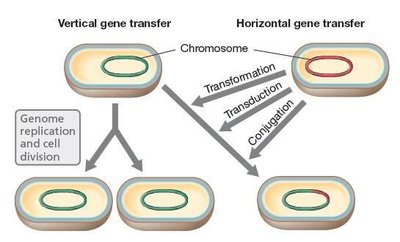
Vertical Gene Transfer: Genes are passed from parent to offspring during cell division.
Horizontal Gene Transfer (HGT): Genes are transferred between cells of the same generation via transformation, transduction, or conjugation.
Mechanisms of Genetic Transfer
Transformation: Uptake of naked DNA from the environment.
Conjugation: Transfer of plasmids via direct cell-to-cell contact (sex pili).
Transduction: Transfer of DNA by bacteriophages (viruses that infect bacteria).
Plasmids and Transposons
Plasmids: Self-replicating DNA molecules that can carry genes for antibiotic resistance, metabolism, or virulence.
Transposons: Mobile genetic elements ("jumping genes") that can move within and between DNA molecules, often carrying antibiotic resistance genes.
Genetic Variation and Evolution
Mutations and genetic recombination generate diversity within microbial populations. This diversity is the raw material for evolution, allowing natural selection to favor organisms best suited to their environment.
Summary Table: Key Terms in Microbial Genetics
Term | Definition |
|---|---|
Genome | All genetic material in a cell |
Gene | Segment of DNA encoding a functional product |
Mutation | Permanent change in DNA sequence |
Plasmid | Small, circular DNA molecule separate from chromosome |
Operon | Cluster of genes under control of a single promoter/operator |
Transformation | Uptake of naked DNA from environment |
Conjugation | Transfer of DNA via direct cell contact |
Transduction | Transfer of DNA by bacteriophage |
Additional info: This guide integrates foundational concepts from microbial genetics, including the structure and function of genetic material, mechanisms of gene expression and regulation, mutation types and repair, and genetic exchange in bacteria. These principles are essential for understanding microbial physiology, pathogenesis, and biotechnology applications.
