 Back
BackChapter 5b - Microbial Metabolism: Carbohydrate, Lipid, and Protein Catabolism
Study Guide - Smart Notes
 Tailored notes based on your materials, expanded with key definitions, examples, and context.
Carbohydrate Catabolism
Overview of Carbohydrate Catabolism
Carbohydrate catabolism is the process by which microorganisms break down carbohydrates to release energy. This process typically occurs in three main stages: glycolysis, the Krebs cycle, and the electron transport chain. The overall goal is to convert glucose into usable energy in the form of ATP, with NADH and FADH2 serving as electron carriers.
Glycolysis: The breakdown of glucose to pyruvic acid, producing ATP and NADH.
Krebs Cycle: Oxidation of acetyl CoA to produce NADH, FADH2, ATP, and CO2.
Electron Transport Chain: Electrons from NADH and FADH2 are transferred through a series of carriers, generating ATP by oxidative phosphorylation.
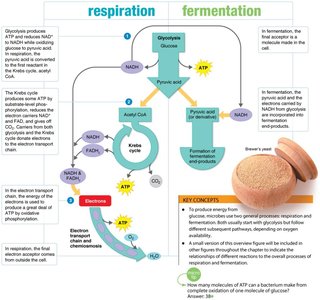
Glycolysis
Glycolysis is the first step in carbohydrate catabolism and occurs in the cytoplasm. It involves the oxidation of glucose to pyruvic acid, generating a net gain of ATP and NADH.
Site: Cytoplasm
Substrate: Glucose
Products: 2 pyruvate, 2 ATP (net), 2 NADH
Stages:
Preparatory Stage: Glucose is split into two three-carbon sugars (glyceraldehyde 3-phosphate and dihydroxyacetone phosphate).
Energy-Conserving Stage: The three-carbon sugars are oxidized to pyruvic acid, producing ATP and NADH.
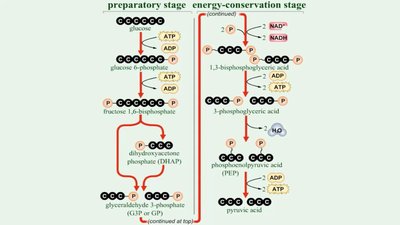
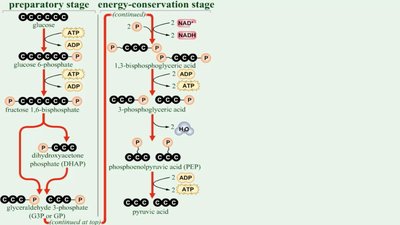
Net ATP and NADH: 2 ATP (substrate-level phosphorylation), 2 NADH (equivalent to 6 ATP in the electron transport chain).
Additional Pathways to Glycolysis
Pentose Phosphate Pathway: Breaks down five-carbon sugars and glucose, producing NADPH and intermediates for biosynthesis. Operates simultaneously with glycolysis.
Entner-Doudoroff Pathway: Produces NADPH and ATP, operates independently of glycolysis, and is found in some bacteria such as Pseudomonas and Rhizobium.
Cellular Respiration
Overview
Cellular respiration involves the oxidation of molecules to generate ATP. Electrons are transferred to an electron transport chain, with the final electron acceptor being an inorganic molecule. There are two types:
Aerobic Respiration: Oxygen is the final electron acceptor.
Anaerobic Respiration: An inorganic molecule other than oxygen is the final electron acceptor.
ATP is generated primarily by oxidative phosphorylation.
Krebs Cycle (Citric Acid Cycle)
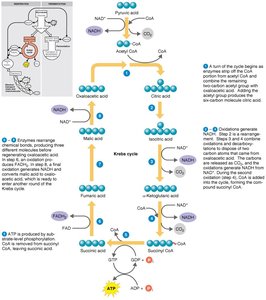
The Krebs cycle occurs in the mitochondrial matrix (eukaryotes) or cytoplasm (prokaryotes). It oxidizes acetyl CoA to produce NADH, FADH2, ATP, and CO2.
Acetyl CoA Formation: Pyruvic acid is oxidized and decarboxylated to form acetyl CoA and NADH.
Cycle Steps: Acetyl CoA combines with oxaloacetate to form citrate, which is then oxidized through a series of steps, releasing CO2 and generating NADH, FADH2, and ATP.
Net Yield (per glucose): 2 ATP, 6 NADH, 2 FADH2, 4 CO2
Electron Transport Chain (ETC) and Chemiosmosis
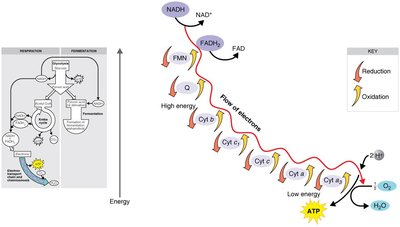
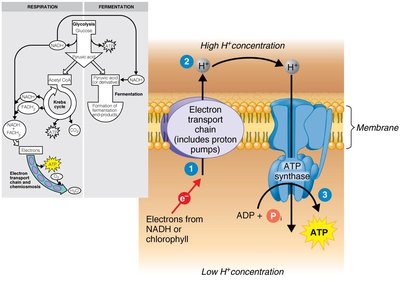
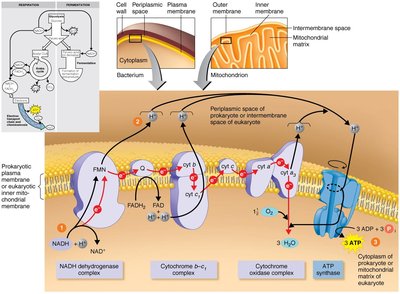
The ETC is a series of carrier molecules located in the plasma membrane (prokaryotes) or inner mitochondrial membrane (eukaryotes). Electrons from NADH and FADH2 are passed through the chain, releasing energy used to pump protons and generate ATP via chemiosmosis.
Key Carriers: Flavoproteins, cytochromes, ubiquinones
ATP Synthesis: Protons flow back through ATP synthase, driving the phosphorylation of ADP to ATP.
Final Electron Acceptor: Oxygen (aerobic respiration), forming water.
ATP Yield in Prokaryotic Aerobic Respiration
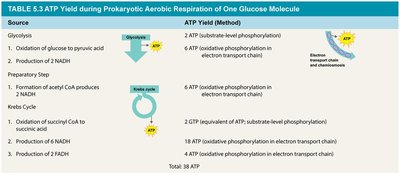
The total ATP yield from one molecule of glucose during aerobic respiration in prokaryotes is summarized below:
Source | ATP Yield (Method) |
|---|---|
Glycolysis | 2 ATP (substrate-level phosphorylation), 6 ATP (from 2 NADH via oxidative phosphorylation) |
Preparatory Step (Acetyl CoA formation) | 6 ATP (from 2 NADH via oxidative phosphorylation) |
Krebs Cycle | 2 ATP (substrate-level phosphorylation), 18 ATP (from 6 NADH via oxidative phosphorylation), 4 ATP (from 2 FADH2 via oxidative phosphorylation) |
Total | 38 ATP |
Key Equations:
Anaerobic Respiration
In anaerobic respiration, the final electron acceptor is an inorganic molecule other than oxygen (e.g., nitrate, sulfate). This process yields less energy than aerobic respiration because only part of the Krebs cycle and electron transport chain operate under anaerobic conditions.
Fermentation
Overview
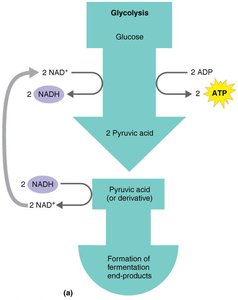
Fermentation is an anaerobic process that releases energy from the oxidation of organic molecules. It does not require oxygen, the Krebs cycle, or the electron transport chain. An organic molecule serves as the final electron acceptor, and only small amounts of ATP are produced.
Types of Fermentation
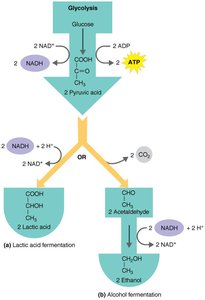
Lactic Acid Fermentation: Glucose is oxidized to pyruvic acid, which is then reduced by NADH to lactic acid. This process regenerates NAD+ for glycolysis.
Alcohol Fermentation: Glucose is oxidized to pyruvic acid, which is converted to acetaldehyde and CO2. NADH reduces acetaldehyde to ethanol.
Fermentation End-Products and Industrial Uses
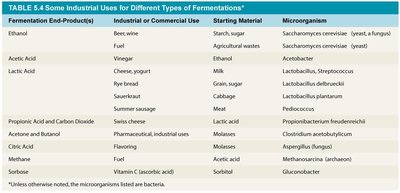
Different microorganisms produce various fermentation end-products, which have important industrial applications.
Fermentation End-Product(s) | Industrial or Commercial Use | Starting Material | Microorganism |
|---|---|---|---|
Ethanol | Beer, wine, fuel | Starch, sugar, agricultural wastes | Saccharomyces cerevisiae (yeast) |
Lactic Acid | Cheese, yogurt, sauerkraut, rye bread | Milk, grains, cabbage | Lactobacillus, Streptococcus |
Acetic Acid | Vinegar | Ethanol | Acetobacter |
Propionic Acid and CO2 | Swiss cheese | Lactic acid | Propionibacterium freudenreichii |
Acetone and Butanol | Pharmaceutical, industrial uses | Molasses | Clostridium acetobutylicum |
Methane | Fuel | Acetic acid | Methanobacterium |
Sorbose | Vitamin C (ascorbic acid) | Sorbitol | Gluconobacter |
Lipid and Protein Catabolism
Lipid Catabolism
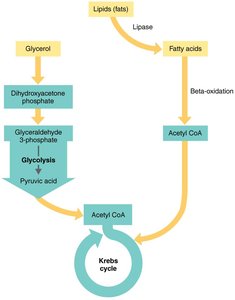
Lipids are broken down by lipases into glycerol and fatty acids. Glycerol is converted to dihydroxyacetone phosphate, which enters glycolysis, while fatty acids undergo beta-oxidation to form acetyl CoA, which enters the Krebs cycle.
Protein Catabolism
Proteins are degraded by extracellular proteases and peptidases into amino acids. These amino acids are deaminated, decarboxylated, and desulfurized to form molecules that can enter the Krebs cycle for further processing.
Catabolism of Various Organic Molecules
Carbohydrates, lipids, and proteins can all be catabolized to produce energy. Their breakdown products enter glycolysis or the Krebs cycle at various points, ultimately leading to ATP production via the electron transport chain.
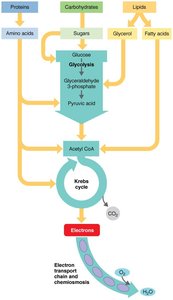
Additional info: The ATP yields for NADH and FADH2 are based on their entry points into the electron transport chain: each NADH yields 3 ATP, and each FADH2 yields 2 ATP in prokaryotes. The actual yield may vary in eukaryotes due to differences in membrane transport and compartmentalization.
