 Back
BackMicrobial Metabolism: Foundations and Pathways
Study Guide - Smart Notes
 Tailored notes based on your materials, expanded with key definitions, examples, and context.
Microbial Metabolism
Introduction to Energy
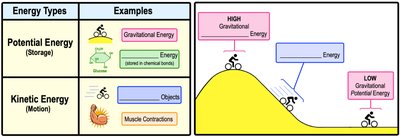
Energy is the capacity to perform work, which in biological systems involves the transfer of energy that causes changes in matter. Energy exists in two main forms: potential energy (stored energy available to do work) and kinetic energy (energy of motion). For example, a glucose molecule contains potential energy, while a moving ant demonstrates kinetic energy.
Potential Energy: Stored in chemical bonds, such as in glucose or ATP.
Kinetic Energy: Manifested in moving objects or molecules, such as muscle contractions or water flowing.
Thermodynamics in Biology
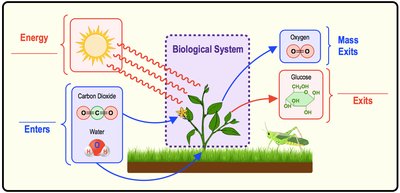
Thermodynamics is the study of energy transfers between matter. In biology, a system refers to the specific matter under study, while the surroundings are everything else. Biological systems exchange both energy and mass with their surroundings, as seen in photosynthesis and respiration.
System: The part of the universe being studied (e.g., a plant cell).
Surroundings: Everything outside the system.
Laws of Thermodynamics
First Law of Thermodynamics
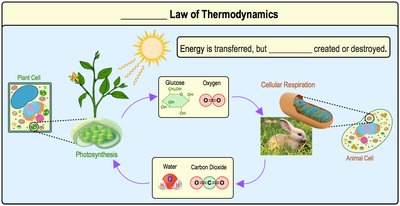
The first law states that energy can be transferred and transformed, but it cannot be created or destroyed. This is also known as the principle of conservation of energy. The total amount of energy in the universe remains constant.
Entropy and the Second Law of Thermodynamics
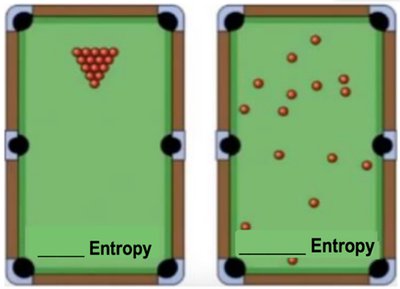
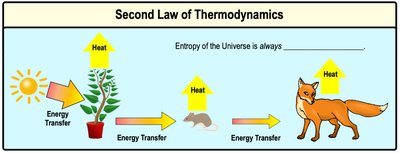
Entropy is a measure of disorder or randomness. The second law states that every energy transfer increases the entropy of the universe. Reactions tend to move toward higher entropy unless energy is input to maintain order.
Low entropy: Ordered systems (e.g., a clean room or organized molecules).
High entropy: Disordered systems (e.g., a messy room or dispersed molecules).
Chemical Reactions and Energy
Chemical Reactions
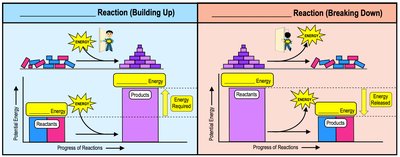
Chemical reactions involve the making and breaking of chemical bonds, transforming reactants into products. They are classified based on energy requirements:
Endergonic Reactions: Require an input of energy (energy enters the reaction).
Exergonic Reactions: Release energy (energy exits the reaction).
Adenosine Triphosphate (ATP)
Structure and Function of ATP
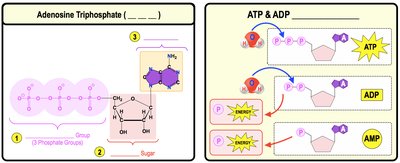
ATP (adenosine triphosphate) is the primary energy currency of the cell. It consists of three phosphate groups, a ribose sugar, and an adenine base. Hydrolysis of ATP releases energy by breaking the bond between phosphate groups, forming ADP (adenosine diphosphate) or AMP (adenosine monophosphate).
Energy Coupling and Phosphorylation
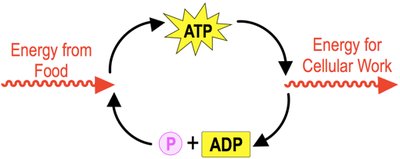
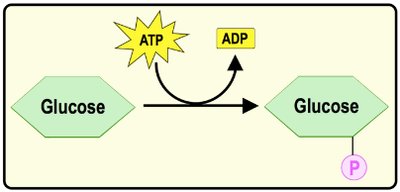
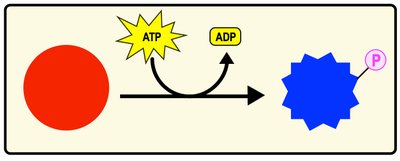
Cells couple exergonic reactions (energy-releasing) to endergonic reactions (energy-consuming) using ATP. Phosphorylation is the transfer of a phosphate group from ATP to another molecule, often activating or changing the function of the target molecule.
Metabolism: Pathways and Regulation
Metabolic Pathways
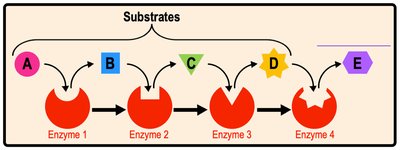
Metabolism is the sum of all chemical reactions in an organism. Metabolic pathways are series of reactions that convert substrates through multiple steps to final products. There are two main types:
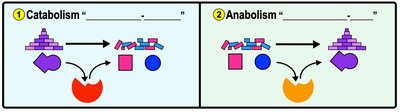
Catabolic Pathways (Catabolism): Break down molecules, releasing energy (e.g., glycolysis).
Anabolic Pathways (Anabolism): Build larger molecules from smaller ones, consuming energy (e.g., protein synthesis).
Redox Reactions and Electron Carriers
Oxidation-Reduction (Redox) Reactions
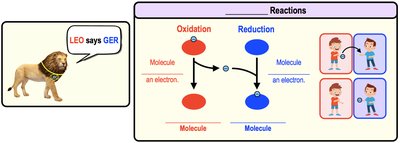
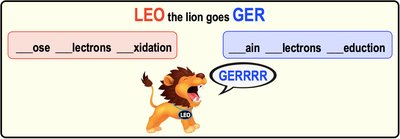
Redox reactions involve the transfer of electrons between molecules. Oxidation is the loss of electrons, while reduction is the gain of electrons. These reactions always occur together.
Mnemonic: LEO the lion says GER (Lose Electrons = Oxidation, Gain Electrons = Reduction).
Electron Carriers: NADH, FADH2, and NADPH
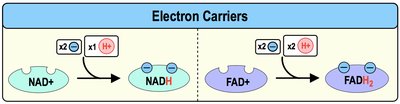
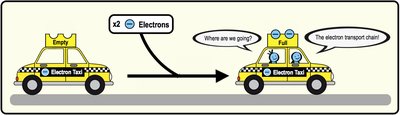
Electron carriers such as NADH and FADH2 transport electrons during cellular respiration. NADPH is used primarily in biosynthetic (anabolic) reactions, such as photosynthesis.
NAD+ and FAD are the oxidized forms; NADH and FADH2 are the reduced, electron-carrying forms.
These carriers shuttle electrons to the electron transport chain, where their energy is used to produce ATP.
Summary Table: Types of Electron Carriers
Carrier | Main Function | Pathway |
|---|---|---|
NADH | Shuttles electrons for ATP production | Cellular Respiration |
FADH2 | Shuttles electrons for ATP production | Cellular Respiration |
NADPH | Provides reducing power for biosynthesis | Photosynthesis, Anabolism |
Conclusion
Understanding energy, thermodynamics, chemical reactions, ATP, metabolic pathways, and redox reactions is foundational for studying microbial metabolism. These principles explain how microbes obtain, convert, and use energy to sustain life, grow, and reproduce.
