 Back
BackMicrobial Metabolism: Pathways, Energy, and Regulation
Study Guide - Smart Notes
 Tailored notes based on your materials, expanded with key definitions, examples, and context.
Microbial Metabolism
Introduction to Metabolism
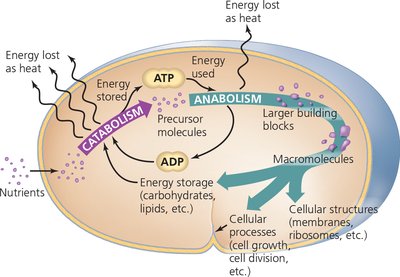
Microbial metabolism encompasses all the biochemical reactions occurring within a microorganism, enabling it to grow, reproduce, and respond to its environment. These reactions are organized into metabolic pathways that either build up (anabolism) or break down (catabolism) molecules, with energy transfer as a central theme.
Metabolism: The sum of all chemical reactions in a cell.
Anabolism: Biosynthetic processes that build complex molecules from simpler ones; these are endergonic (require energy).
Catabolism: Degradative processes that break down complex molecules into simpler ones; these are exergonic (release energy).
ATP (Adenosine Triphosphate): The main energy currency of the cell, coupling energy-releasing and energy-consuming reactions.
ATP: The Energy Currency
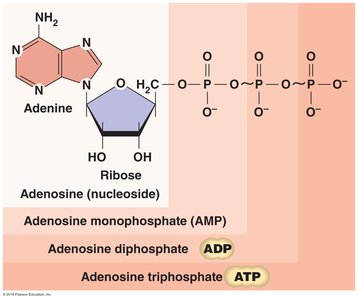
ATP is a nucleotide composed of adenine, ribose, and three phosphate groups. The high-energy bonds between phosphate groups store potential energy, which is released upon hydrolysis to drive cellular work.
ATP Synthesis: Occurs via substrate-level phosphorylation, oxidative phosphorylation, or photophosphorylation.
ATP Hydrolysis: Releases energy for cellular processes.
Redox Reactions in Metabolism
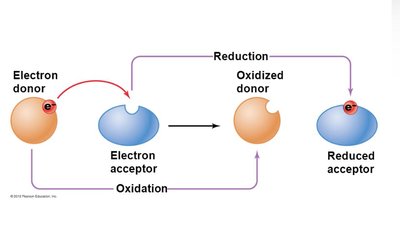
Oxidation-reduction (redox) reactions are fundamental to energy transfer in cells. Electrons are transferred from electron donors (oxidized) to electron acceptors (reduced), often coupled with the transfer of protons (H+).
Oxidation: Loss of electrons.
Reduction: Gain of electrons.
Redox reactions are catalyzed by enzymes and are central to processes like cellular respiration and fermentation.
Enzymes and Their Role in Metabolism
Enzymes are biological catalysts, usually proteins, that speed up chemical reactions by lowering the activation energy required. They are highly specific for their substrates and can be regulated by various mechanisms.
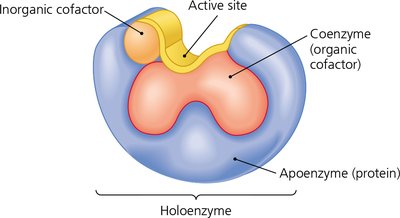
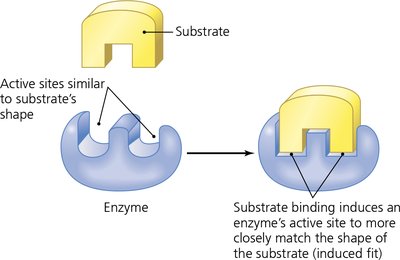
Active Site: The region on the enzyme where the substrate binds.
Holoenzyme: The complete, active enzyme including its apoenzyme (protein part) and cofactors (inorganic ions or organic coenzymes).
Induced Fit Model: Substrate binding induces a conformational change in the enzyme, optimizing the fit for catalysis.
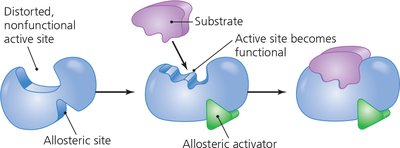
Allosteric Regulation: Enzyme activity can be increased or decreased by molecules binding to sites other than the active site.
Metabolic Pathways
Metabolic pathways are sequences of enzymatically catalyzed reactions where the product of one reaction serves as the substrate for the next. Pathways can be linear, branched, or cyclic.
Each step is catalyzed by a specific enzyme.
Pathways are regulated to meet the cell's needs and conserve resources.
Energy Acquisition in Microbes
Types of Microbial Metabolism
Microbes are classified based on their sources of carbon and energy:
Type of Organism | Carbon Source | Energy Source |
|---|---|---|
Photoautotroph | CO2 | Light |
Chemoautotroph | CO2 | Inorganic molecules |
Chemoheterotroph | Organic compounds | Organic compounds |
Photoheterotroph | Organic compounds | Light |
Catabolic Pathways: Glycolysis, Citric Acid Cycle, and Oxidative Phosphorylation
Glycolysis
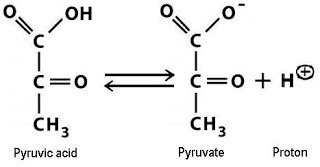
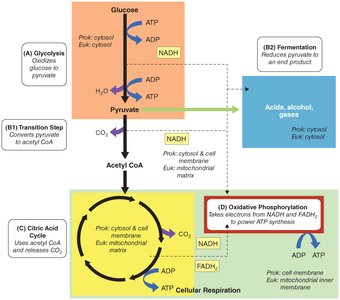
Glycolysis is a catabolic pathway that breaks down glucose (6C) into two molecules of pyruvate (3C), generating ATP and NADH in the process. It occurs in the cytoplasm and does not require oxygen.
Ten enzyme-catalyzed steps.
Net gain: 2 ATP, 2 NADH, 2 pyruvate per glucose.
Divided into energy-investment, lysis, and energy-conserving stages.
Citric Acid Cycle (Krebs Cycle)
The citric acid cycle completes the oxidation of glucose derivatives, producing NADH, FADH2, ATP, and CO2. Pyruvate is first converted to acetyl-CoA, which enters the cycle.
Each turn yields: 2 CO2, 3 NADH, 1 FADH2, 1 ATP (per acetyl-CoA).
Occurs in the cytoplasm of prokaryotes and mitochondria of eukaryotes.
Oxidative Phosphorylation and Electron Transport Chain (ETC)
Most ATP is generated through oxidative phosphorylation, where electrons from NADH and FADH2 are transferred through the ETC to a final electron acceptor (usually O2), creating a proton gradient that drives ATP synthesis via ATP synthase.
Occurs in the cell membrane (prokaryotes) or mitochondria (eukaryotes).
Up to 32 ATP molecules can be produced from one glucose molecule.
Oxygen acts as the terminal electron acceptor in aerobic respiration.
Fermentation
When oxygen is unavailable, cells may use fermentation to regenerate NAD+ from NADH, allowing glycolysis to continue. Fermentation results in the partial oxidation of glucose and the production of organic end products such as lactic acid or ethanol.
Yields less ATP than respiration.
Essential for cells in anaerobic environments.
Anabolic Pathways
Gluconeogenesis
Gluconeogenesis is the anabolic process of synthesizing glucose from non-carbohydrate precursors, essentially reversing glycolysis with some unique enzymes.
Amino Acid and Nucleic Acid Synthesis
Amino acids are synthesized via transamination reactions, while nucleic acids are built from pentose sugars and nitrogenous bases, often using intermediates from glycolysis and the pentose phosphate pathway.
Lipid Metabolism
Lipid Anabolism: Fatty acids and glycerol are synthesized and assembled into triglycerides and phospholipids.
Lipid Catabolism: Lipases hydrolyze fats into glycerol (which enters glycolysis) and fatty acids (which undergo beta-oxidation to form acetyl-CoA for the TCA cycle).
Photosynthesis in Microbes
Phototrophy and Photosynthesis
Phototrophic microbes use light energy to drive the synthesis of ATP and NADPH, which are then used to fix CO2 into organic molecules. In prokaryotes, this occurs in internal membrane systems; in eukaryotes, in chloroplasts.
Light Reactions: Convert light energy into chemical energy (ATP, NADPH), releasing O2 as a byproduct.
Carbon Fixation: Uses ATP and NADPH to convert CO2 into organic compounds.
Regulation and Integration of Metabolism
Regulation of Metabolic Pathways
Cells regulate metabolism to optimize resource use and respond to environmental changes.
Gene Expression Control: Regulates the amount and timing of enzyme production.
Metabolic Expression Control: Regulates the activity of enzymes already present (e.g., allosteric regulation, feedback inhibition).
Compartmentalization: Eukaryotic cells isolate metabolic pathways in organelles.
Amphibolic Pathways: Pathways that function in both anabolism and catabolism, regulated by different coenzymes.
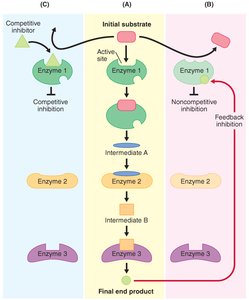
Summary Table: Key Products of Central Metabolic Pathways
Pathway | ATP (net) | NADH | FADH2 | CO2 |
|---|---|---|---|---|
Glycolysis | 2 | 2 | 0 | 0 |
Citric Acid Cycle (per glucose) | 2 | 6 | 2 | 4 |
Oxidative Phosphorylation | ~32 | - | - | - |
Additional info: The total ATP yield from aerobic respiration of one glucose molecule can reach up to 36-38 ATP, depending on the organism and conditions.
