 Back
BackMicrobiology Exam Study Guide: Metabolism, Respiration, and Biochemical Pathways
Study Guide - Smart Notes
 Tailored notes based on your materials, expanded with key definitions, examples, and context.
Q1. What is the main enzyme responsible for carbon fixation in the Calvin cycle?
Background
Topic: Photosynthesis and Carbon Fixation
This question tests your understanding of the Calvin cycle, specifically the enzyme that catalyzes the incorporation of CO2 into organic molecules.
Key Terms and Concepts:
Calvin cycle: The set of light-independent reactions in photosynthesis that convert CO2 into glucose.
Carbon fixation: The process of converting inorganic CO2 into organic compounds.
Key enzyme: The protein that catalyzes the first step of carbon fixation.
Step-by-Step Guidance
Recall that the Calvin cycle is part of the light-independent reactions in photosynthesis.
Identify the enzyme that catalyzes the first step, where CO2 is attached to a five-carbon sugar (ribulose bisphosphate).
Think about the name of the enzyme that is often considered the most abundant protein on Earth and is crucial for this process.
Try solving on your own before revealing the answer!
Q2. Which molecule is an intermediate product of glycolysis?
Background
Topic: Glycolysis
This question tests your knowledge of the steps and intermediates in the glycolytic pathway, which breaks down glucose to extract energy.
Key Terms and Concepts:
Glycolysis: The metabolic pathway that converts glucose into pyruvate, generating ATP and NADH.
Intermediate: A compound formed temporarily during a metabolic pathway.
Step-by-Step Guidance
Recall the main steps of glycolysis and the molecules produced at each stage.
Identify which molecules are produced in the middle of the pathway, not at the start or end.
Consider the breakdown of glucose into two three-carbon molecules and what those molecules are called.
Try solving on your own before revealing the answer!
Q3. Which process is an example of anaerobic respiration?
Background
Topic: Cellular Respiration
This question is about distinguishing between aerobic and anaerobic respiration, focusing on the final electron acceptor used in the process.
Key Terms and Concepts:
Anaerobic respiration: Respiration that does not use oxygen as the final electron acceptor.
Electron acceptor: The molecule that receives electrons at the end of the electron transport chain.
Step-by-Step Guidance
Recall the difference between aerobic (uses O2) and anaerobic (uses other molecules) respiration.
Think about common alternative electron acceptors in anaerobic respiration, such as nitrate or sulfate.
Identify which process in the options provided fits this definition.
Try solving on your own before revealing the answer!
Q4. Which method would be considered heterotrophic but not autotrophic?
Background
Topic: Microbial Metabolism
This question tests your understanding of the difference between autotrophs (organisms that fix CO2) and heterotrophs (organisms that use organic carbon sources).
Key Terms and Concepts:
Autotroph: Organism that uses CO2 as its carbon source.
Heterotroph: Organism that uses organic compounds as its carbon source.
Step-by-Step Guidance
Recall the definitions of autotroph and heterotroph.
Identify which metabolic process relies on organic carbon rather than CO2 fixation.
Match the correct process from the options given.
Try solving on your own before revealing the answer!
Q5. What is produced during fermentation?
Background
Topic: Fermentation
This question tests your knowledge of the end products of fermentation, a process used by cells to generate energy anaerobically.
Key Terms and Concepts:
Fermentation: Metabolic process that converts sugar to acids, gases, or alcohol in the absence of oxygen.
End products: The molecules produced at the end of fermentation.
Step-by-Step Guidance
Recall that fermentation occurs when oxygen is not available.
Think about the common products of fermentation, such as lactic acid, ethanol, and CO2.
Identify which combination of products is correct from the options provided.
Try solving on your own before revealing the answer!
Q6. What does "nitrogen metabolism" mean in nitrogen metabolism?
Background
Topic: Nitrogen Metabolism
This question is about the role of nitrogen in microbial metabolism, specifically how microbes use nitrogen in their energy and biosynthetic pathways.
Key Terms and Concepts:
Nitrogen metabolism: The processes by which organisms obtain, assimilate, and use nitrogen.
Electron acceptor: A molecule that receives electrons during cellular respiration or metabolism.
Step-by-Step Guidance
Recall the different ways microbes use nitrogen, such as assimilating it into biomolecules or using it as an electron acceptor.
Consider the difference between using nitrogen for biosynthesis versus energy generation.
Identify which definition best fits the context of nitrogen metabolism in the options provided.
Try solving on your own before revealing the answer!
Q7. Which of these metabolic pathways occurs in both heterotrophs and autotrophs?
Background
Topic: Central Metabolic Pathways
This question tests your understanding of which metabolic pathways are shared by both autotrophic and heterotrophic organisms.
Key Terms and Concepts:
Heterotroph: Uses organic carbon sources.
Autotroph: Uses CO2 as a carbon source.
Central metabolic pathways: Pathways like glycolysis, TCA cycle, and pentose phosphate pathway.
Step-by-Step Guidance
Recall which pathways are considered "central" and are used by most organisms for energy and precursor metabolites.
Think about which pathway is essential for both types of organisms, regardless of their carbon source.
Identify the correct pathway from the options provided.
Try solving on your own before revealing the answer!
Q8. What is the key difference between aerobic and anaerobic respiration?
Background
Topic: Respiration Types
This question tests your understanding of the differences between aerobic and anaerobic respiration, particularly the final electron acceptor used in each process.
Key Terms and Concepts:
Aerobic respiration: Uses oxygen as the final electron acceptor.
Anaerobic respiration: Uses other molecules (e.g., nitrate, sulfate) as the final electron acceptor.
Step-by-Step Guidance
Recall the definition of aerobic and anaerobic respiration.
Identify the molecule that acts as the final electron acceptor in each process.
Match the correct difference from the options provided.
Try solving on your own before revealing the answer!
Q9. NADH is important because it...
Background
Topic: Electron Carriers in Metabolism
This question tests your understanding of the role of NADH in cellular metabolism, especially in energy production.
Key Terms and Concepts:
NADH: Nicotinamide adenine dinucleotide (reduced form), an electron carrier.
Electron transport chain: Series of proteins that transfer electrons to generate ATP.
Step-by-Step Guidance
Recall the role of NADH in transferring electrons to the electron transport chain.
Think about how this process leads to ATP production.
Identify the correct function of NADH from the options provided.
Try solving on your own before revealing the answer!
Q10. What happens to protons in the ETC?
Background
Topic: Electron Transport Chain (ETC)
This question tests your understanding of the movement of protons during electron transport and how this relates to ATP synthesis.
Key Terms and Concepts:
ETC: A series of protein complexes in the membrane that transfer electrons and pump protons.
Proton gradient: The accumulation of protons on one side of the membrane, used to drive ATP synthesis.
Step-by-Step Guidance
Recall that the ETC pumps protons across the membrane to create a gradient.
Think about what happens to these protons after they are pumped.
Identify the fate of the protons from the options provided.
Try solving on your own before revealing the answer!
Q11. How is the energy released by the electron transport chain captured prior to ATP synthesis?
Background
Topic: Chemiosmosis and ATP Synthesis
This question tests your understanding of how the energy from electron transport is used to generate a proton gradient, which is then used to make ATP.
Key Terms and Concepts:
Electron transport chain: Transfers electrons and pumps protons.
Proton motive force: The energy stored in the proton gradient across the membrane.
Step-by-Step Guidance
Recall that as electrons move through the ETC, protons are pumped across the membrane.
Think about how this creates a gradient (proton motive force) that stores energy.
Identify the molecule or process that captures this energy before ATP is made.
Try solving on your own before revealing the answer!
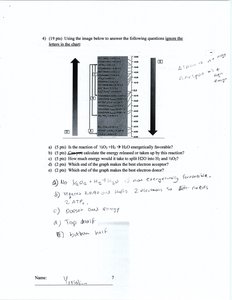
Q12. The Calvin cycle and the reverse TCA cycle are both carbon fixation pathways. Is this statement TRUE or FALSE?
Background
Topic: Carbon Fixation Pathways
This question tests your understanding of the different biochemical pathways used by autotrophs to fix carbon dioxide into organic molecules.
Key Terms and Concepts:
Calvin cycle: The main carbon fixation pathway in plants and cyanobacteria.
Reverse TCA cycle: An alternative carbon fixation pathway used by some bacteria and archaea.
Step-by-Step Guidance
Recall the definition of carbon fixation and which pathways are involved.
Think about the similarities and differences between the Calvin cycle and the reverse TCA cycle.
Decide if both pathways result in the incorporation of CO2 into organic molecules.
Try solving on your own before revealing the answer!
Q13. Lactic acid fermentation produces more ATP than aerobic respiration. Is this statement TRUE or FALSE?
Background
Topic: Fermentation vs. Respiration
This question tests your understanding of the energy yield of fermentation compared to aerobic respiration.
Key Terms and Concepts:
Fermentation: Anaerobic process that produces ATP and organic end products.
Aerobic respiration: Uses oxygen to produce much more ATP per glucose molecule.
Step-by-Step Guidance
Recall the number of ATP molecules produced by fermentation and aerobic respiration.
Compare the efficiency of both processes in terms of ATP yield.
Decide if the statement is true or false based on your comparison.
Try solving on your own before revealing the answer!
Q14. Nitrogenase is an enzyme responsible for nitrogen fixation. Is this statement TRUE or FALSE?
Background
Topic: Nitrogen Fixation
This question tests your knowledge of the enzyme responsible for converting atmospheric nitrogen (N2) into ammonia (NH3).
Key Terms and Concepts:
Nitrogenase: The enzyme complex that catalyzes nitrogen fixation.
Nitrogen fixation: The process of converting N2 gas into a biologically usable form.
Step-by-Step Guidance
Recall which enzyme is responsible for nitrogen fixation in bacteria and archaea.
Think about the importance of this process for the nitrogen cycle.
Decide if the statement is true or false based on your knowledge.
Try solving on your own before revealing the answer!
Q15. The TCA cycle has proteins that are also found in other central metabolic pathways. Is this statement TRUE or FALSE?
Background
Topic: Central Metabolism
This question tests your understanding of the overlap between the TCA cycle and other metabolic pathways.
Key Terms and Concepts:
TCA cycle: Also known as the Krebs cycle or citric acid cycle.
Central metabolic pathways: Pathways that share intermediates and enzymes.
Step-by-Step Guidance
Recall which enzymes and intermediates are shared between the TCA cycle and other pathways like glycolysis or the pentose phosphate pathway.
Think about the metabolic flexibility and efficiency this sharing provides.
Decide if the statement is true or false based on your understanding.
Try solving on your own before revealing the answer!
Q16. The Calvin cycle is used by autotrophs to fix carbon into organic molecules. Is this statement TRUE or FALSE?
Background
Topic: Autotrophy and Carbon Fixation
This question tests your understanding of the role of the Calvin cycle in autotrophic organisms.
Key Terms and Concepts:
Autotroph: Organism that fixes CO2 into organic molecules.
Calvin cycle: The main pathway for carbon fixation in autotrophs.
Step-by-Step Guidance
Recall which organisms use the Calvin cycle for carbon fixation.
Think about the importance of this pathway for biosynthesis in autotrophs.
Decide if the statement is true or false based on your knowledge.
Try solving on your own before revealing the answer!
Q17. All life requires oxygen to perform respiration. Is this statement TRUE or FALSE?
Background
Topic: Types of Respiration
This question tests your understanding of aerobic and anaerobic respiration and the diversity of metabolic strategies in microbes.
Key Terms and Concepts:
Aerobic respiration: Uses oxygen as the final electron acceptor.
Anaerobic respiration: Uses other molecules as the final electron acceptor.
Step-by-Step Guidance
Recall the definitions of aerobic and anaerobic respiration.
Think about examples of organisms that do not require oxygen for respiration.
Decide if the statement is true or false based on your understanding.
Try solving on your own before revealing the answer!
Q18. The reverse TCA cycle does not require any new enzymes relative to the standard TCA cycle. Is this statement TRUE or FALSE?
Background
Topic: Metabolic Pathways
This question tests your understanding of the differences between the standard TCA cycle and the reverse TCA cycle.
Key Terms and Concepts:
TCA cycle: Central metabolic pathway for energy production.
Reverse TCA cycle: Used for carbon fixation in some autotrophs.
Step-by-Step Guidance
Recall the enzymes involved in the standard TCA cycle.
Think about whether the reverse pathway can proceed with the same enzymes or if new ones are required.
Decide if the statement is true or false based on your knowledge.
Try solving on your own before revealing the answer!
Q19. All forms of photosynthesis generate molecular oxygen. Is this statement TRUE or FALSE?
Background
Topic: Photosynthesis Types
This question tests your understanding of oxygenic versus anoxygenic photosynthesis.
Key Terms and Concepts:
Oxygenic photosynthesis: Produces O2 as a byproduct (e.g., plants, cyanobacteria).
Anoxygenic photosynthesis: Does not produce O2 (e.g., some bacteria).
Step-by-Step Guidance
Recall which organisms perform oxygenic and anoxygenic photosynthesis.
Think about the byproducts of each type of photosynthesis.
Decide if the statement is true or false based on your understanding.
Try solving on your own before revealing the answer!
Q20. You would expect deep-sea microbes to make heavy use of aerobic respiration. Is this statement TRUE or FALSE?
Background
Topic: Microbial Ecology and Respiration
This question tests your understanding of the environmental conditions in deep-sea habitats and the metabolic strategies of microbes living there.
Key Terms and Concepts:
Aerobic respiration: Requires oxygen.
Deep-sea environment: Often low in oxygen, favoring anaerobic processes.
Step-by-Step Guidance
Recall the oxygen availability in deep-sea environments.
Think about which types of respiration are favored under low-oxygen conditions.
Decide if the statement is true or false based on your understanding.
Try solving on your own before revealing the answer!
Q21. (Short Answer) Create ONE question about the content that you studied as part of this class, on a content covered in this class' lectures or readings.
Background
Topic: Critical Thinking and Application
This task asks you to demonstrate your understanding by creating a question relevant to the course material.
Key Terms and Concepts:
Critical thinking: Ability to synthesize and apply knowledge.
Question design: Creating questions that test understanding of key concepts.
Step-by-Step Guidance
Think about a major topic or concept you found interesting or challenging in the course.
Formulate a question that tests understanding of that topic (e.g., multiple choice, TRUE/FALSE, short answer).
Write your question clearly and concisely, making sure it is relevant to microbiology.
Try creating your own question before moving on!
Q22. (Short Answer) Compare AND contrast the terms below. Remember to use 2–3 sentences explaining the similarities and differences.
Background
Topic: Comparative Analysis in Microbiology
This question tests your ability to compare and contrast two related concepts, highlighting both similarities and differences.
Key Terms and Concepts:
Compare: Identify similarities between two concepts.
Contrast: Identify differences between two concepts.
Step-by-Step Guidance
Read the two terms or concepts you are asked to compare and contrast.
Identify at least one similarity and one difference between them.
Write 2–3 sentences clearly explaining both the similarities and differences.
Try writing your comparison before checking the answer!
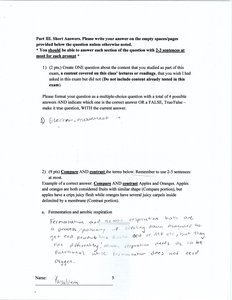
Q23. (Image-Based) Using the image below, answer the following questions (ignore the letters in the chart):
Background
Topic: Redox Reactions and Electron Transport
This question asks you to interpret a redox tower diagram, which shows the reduction potentials of various electron donors and acceptors.
Key Terms and Concepts:
Redox tower: Diagram showing the tendency of molecules to donate or accept electrons.
Reduction potential: A measure of the tendency of a chemical species to acquire electrons and be reduced.
Step-by-Step Guidance
Examine the redox tower and identify the positions of the relevant molecules (e.g., O2, H2O, NAD+, NADH).
Recall that molecules higher on the tower are better electron donors, while those lower are better electron acceptors.
Use the diagram to answer questions about which reactions are energetically favorable and which molecules have the highest or lowest energy.
Try interpreting the diagram and answering the questions before checking the answer!
