Back
Molecules of Microbiology: Structure, Function, and Classification of Biomolecules
Study Guide - Smart Notes
 Tailored notes based on your materials, expanded with key definitions, examples, and context.
5. Molecules of Microbiology
Concept: Carbon
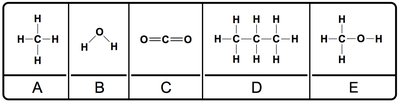
Carbon is the most abundant element in living systems (excluding water) and serves as the main component of organic molecules such as carbohydrates, proteins, nucleic acids, and lipids. Organic molecules are defined as compounds containing covalently linked carbon and hydrogen atoms. Hydrocarbons are a subset of organic molecules composed solely of carbon and hydrogen.
Key Point 1: Organic molecules must contain both carbon and hydrogen atoms covalently bonded.
Key Point 2: Hydrocarbons are organic molecules made exclusively of carbon and hydrogen.
Example: Identifying organic molecules and hydrocarbons among chemical structures.
Carbon as a Building Block
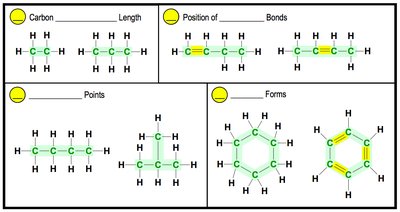
Carbon's ability to form four covalent bonds makes it a versatile atomic building block, allowing for a wide variety of molecular structures. The carbon backbone of organic molecules can vary in length, position of double bonds, branch points, and can exist in linear or ring forms.
Key Point 1: Carbon backbones can be straight, branched, or form rings.
Key Point 2: The diversity of carbon skeletons underlies the diversity of organic molecules in biology.
Example: Variations in carbon backbone structure.
Concept: Functional Groups
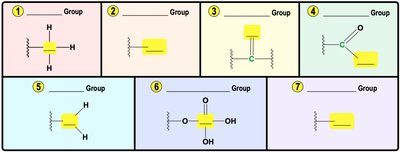
Functional groups are specific groups of atoms within molecules that are responsible for the characteristic chemical reactions of those molecules. They typically extend from the carbon backbone and are commonly found together in biological molecules.
Key Point 1: Functional groups confer specific chemical properties to organic molecules.
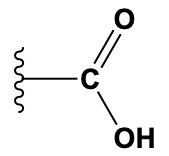
Key Point 2: Common functional groups in biology include hydroxyl, carbonyl, carboxyl, amino, sulfhydryl, phosphate, and methyl groups.
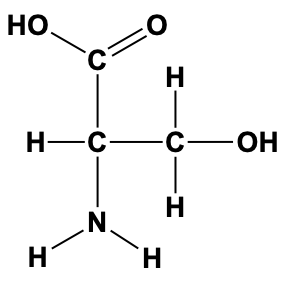
Example: Identifying functional groups in molecular structures.
Introduction to Biomolecules
Classes of Biomolecules
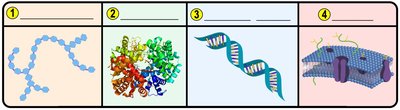
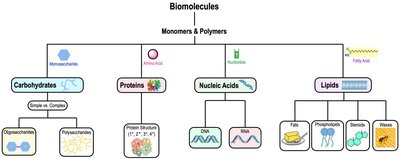
Biomolecules are organic molecules essential to living organisms. There are four primary classes: carbohydrates, proteins, nucleic acids, and lipids. Each class has unique structures and functions in cells.
Key Point 1: Carbohydrates, proteins, nucleic acids, and lipids are the four main classes of biomolecules.
Key Point 2: Each class is built from characteristic monomers (except lipids, which are not true polymers).
Example: Overview of biomolecule classes and their monomers.
Monomers and Polymers
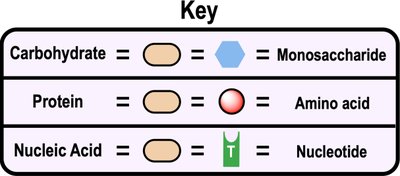
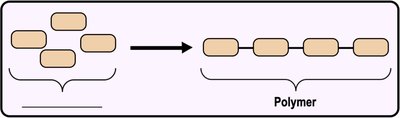
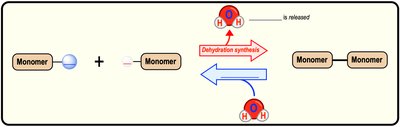
Monomers are small, individual building blocks that can be repetitively linked to form polymers. Polymers are long chains of monomers. Carbohydrates, proteins, and nucleic acids are polymers, while lipids are not true polymers.
Key Point 1: Monomers join to form polymers via covalent bonds.
Key Point 2: The process of building polymers is called dehydration synthesis, while breaking them down is called hydrolysis.
Example: Formation and breakdown of polymers.
Carbohydrates
Structure and Classification
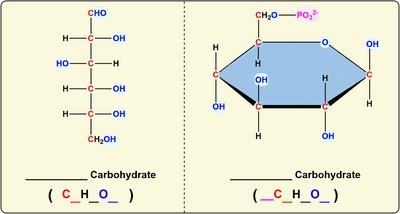
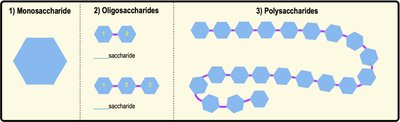
Carbohydrates are carbon-based molecules hydrated with many hydroxyl groups (-OH). They are also called saccharides (from the Greek word for sugar). Carbohydrates can be classified by size: monosaccharides (single units), oligosaccharides (2–20 units), and polysaccharides (more than 20 units).
Key Point 1: Simple carbohydrates fit the formula Cn(H2O)n (e.g., glucose: C6H12O6).
Key Point 2: Complex carbohydrates may contain additional elements such as nitrogen or sulfur.
Example: Simple vs. complex carbohydrates and their formulas.
Formation and Breakdown of Polysaccharides
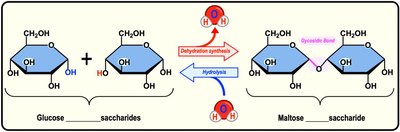
Polysaccharides are formed by linking monosaccharides via dehydration synthesis, creating glycosidic bonds. Hydrolysis breaks these bonds, releasing monosaccharides and energy.
Key Point 1: Glycosidic bonds are covalent bonds that link monosaccharides in polysaccharides.
Key Point 2: Hydrolysis of glycosidic bonds releases energy and monosaccharide units.
Example: Formation of maltose from two glucose molecules.
Functions of Carbohydrates
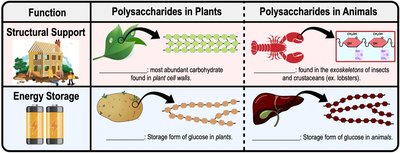
Carbohydrates serve two main functions: structural support (e.g., cellulose in plants, chitin in animals) and energy storage (e.g., starch in plants, glycogen in animals).
Key Point 1: Structural polysaccharides provide rigidity to cell walls and exoskeletons.
Key Point 2: Storage polysaccharides serve as energy reserves.
Example: Comparison of polysaccharide functions in plants and animals.
Proteins
Structure and Formation
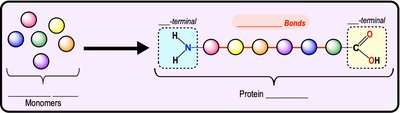
Proteins are polymers made of amino acid monomers linked by peptide bonds. Proteins have directionality, with an N-terminal (amino group) and a C-terminal (carboxyl group).
Key Point 1: Amino acids are the building blocks of proteins.
Key Point 2: Peptide bonds form between the amino group of one amino acid and the carboxyl group of another.
Example: Formation of proteins from amino acid monomers.
Amino Acid Structure
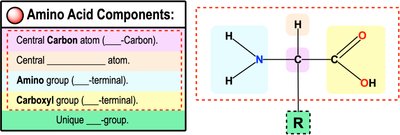
Each amino acid contains a central carbon atom, an amino group, a carboxyl group, a hydrogen atom, and a unique R-group. There are 20 different amino acids, each with a distinct R-group.
Key Point 1: The R-group determines the properties and function of each amino acid.
Key Point 2: Amino acids are linked by peptide bonds to form polypeptides.
Example: Structure of an amino acid.
Protein-Related Terms
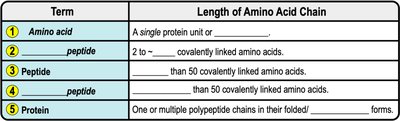
Proteins and peptides are classified by the length of their amino acid chains. Terms include amino acid, dipeptide, peptide, polypeptide, and protein.
Key Point 1: A peptide is a short chain of amino acids; a polypeptide is a longer chain.
Key Point 2: A protein is one or more polypeptides folded into a functional form.
Example: Table of protein-related terms and chain lengths.
Term | Length of Amino Acid Chain |
|---|---|
Amino acid | A single protein unit or monomer |
Dipeptide | 2 covalently linked amino acids |
Peptide | Less than 50 covalently linked amino acids |
Polypeptide | More than 50 covalently linked amino acids |
Protein | One or multiple polypeptide chains in their folded/functional forms |
Protein Structure
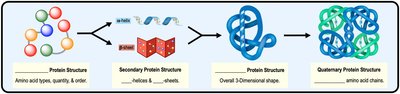
Proteins have four levels of structure: primary (amino acid sequence), secondary (alpha-helices and beta-sheets), tertiary (overall 3D shape), and quaternary (association of multiple polypeptide chains).
Key Point 1: The primary structure determines all higher levels of protein structure.
Key Point 2: Secondary structures are stabilized by hydrogen bonds; tertiary and quaternary structures involve various interactions.
Example: The four levels of protein structure.
Denatured Proteins and Chaperones
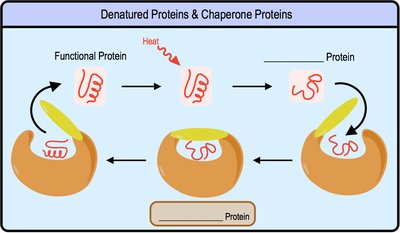
A protein's structure is critical for its function. Denatured proteins lose their functional shape due to environmental changes (e.g., pH, temperature). Chaperone proteins assist in the proper folding or refolding of proteins.
Key Point 1: Denaturation is often reversible with the help of chaperone proteins.
Key Point 2: Proper protein folding is essential for biological activity.
Example: Protein denaturation and the role of chaperones.
Nucleic Acids
Structure and Formation
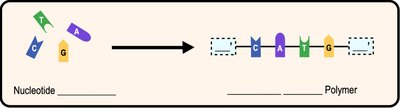
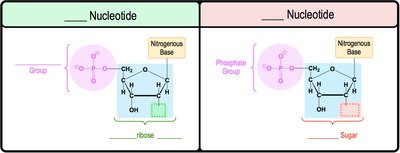
Nucleic acids are polymers that store and transmit genetic information. Their monomers are nucleotides, each consisting of a phosphate group, a pentose sugar, and a nitrogenous base. Nucleic acids have directionality (5' to 3' ends).
Key Point 1: DNA and RNA are the two main types of nucleic acids.
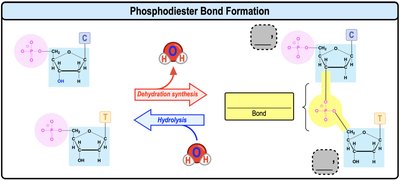
Key Point 2: Nucleotides are linked by phosphodiester bonds to form the sugar-phosphate backbone.
Example: Formation of nucleic acids from nucleotide monomers.
Nitrogenous Bases
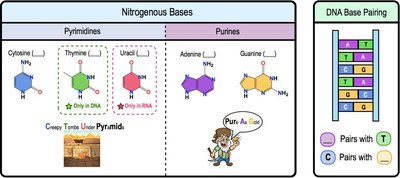
There are five nitrogenous bases, grouped as pyrimidines (single-ring: cytosine, thymine, uracil) and purines (double-ring: adenine, guanine). In DNA, bases pair via hydrogen bonds: A with T, C with G.
Key Point 1: DNA contains adenine, thymine, cytosine, and guanine; RNA contains uracil instead of thymine.
Key Point 2: Base pairing is essential for the double-helix structure of DNA.
Example: Nitrogenous base classification and DNA base pairing.
Formation and Structure of DNA and RNA
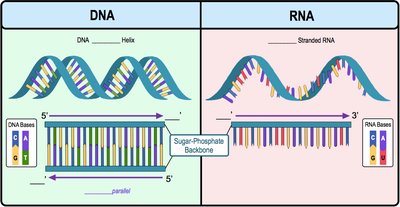
Dehydration synthesis links nucleotides via phosphodiester bonds, forming the sugar-phosphate backbone. DNA is typically double-stranded and forms a double helix, while RNA is usually single-stranded.
Key Point 1: DNA strands are antiparallel and held together by hydrogen bonds between bases.
Key Point 2: RNA serves various roles, including as a template for protein synthesis.
Example: Structure of DNA and RNA.
Lipids
Structure and Types
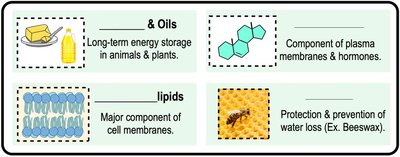
Lipids are hydrophobic biomolecules insoluble in water and highly diverse in structure and function. They are not true polymers. Lipids include fats and oils, phospholipids, steroids, and waxes.
Key Point 1: Lipids can be amphipathic, containing both hydrophobic and hydrophilic regions.
Key Point 2: Major types of lipids include triglycerides, phospholipids, steroids, and waxes.
Example: Types of lipids and their functions.
Fatty Acids
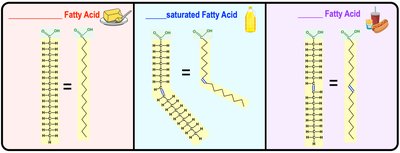
Fatty acids are hydrocarbon chains with a carboxylic acid group. Saturated fatty acids have only single bonds and are solid at room temperature. Unsaturated fatty acids have one or more double bonds, causing kinks and making them liquid at room temperature. Trans fats are artificially produced unsaturated fats that are linear.
Key Point 1: Saturated fatty acids contain only single C–C bonds; unsaturated contain at least one C=C double bond.
Key Point 2: The presence of double bonds affects the physical properties of fats.
Example: Comparison of saturated, unsaturated, and trans fats.
Triglycerides
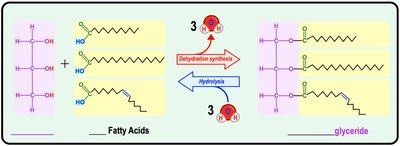
Triglycerides are lipids with three fatty acid chains covalently linked to a single glycerol molecule via dehydration synthesis. They serve as long-term energy storage molecules in animals and plants.
Key Point 1: Triglycerides are formed by esterification of fatty acids to glycerol.
Key Point 2: Hydrolysis of triglycerides releases fatty acids and glycerol.
Example: Formation of triglycerides from fatty acids and glycerol.
Phospholipids
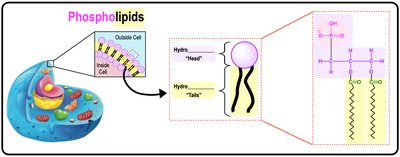
Phospholipids are a major class of lipids containing a phosphate group. They are the main component of all cell membranes, with amphipathic properties (hydrophilic head and hydrophobic tails).
Key Point 1: Phospholipids form bilayers in aqueous environments, creating cell membranes.
Key Point 2: The amphipathic nature of phospholipids is critical for membrane structure and function.
Example: Structure and function of phospholipids in membranes.
Steroids and Waxes
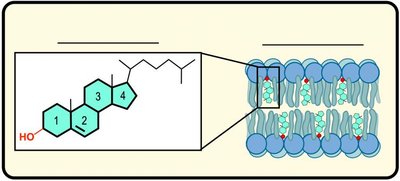
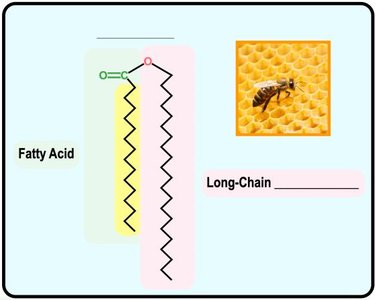
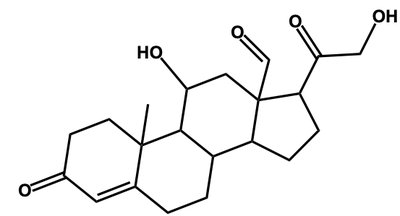
Steroids are lipids made of four fused carbon rings. Cholesterol is a common steroid important for animal cell membrane structure. Waxes are another class of lipids used for protection and prevention of water loss (e.g., beeswax).
Key Point 1: Steroids have a characteristic four-ring structure.
Key Point 2: Waxes are long-chain fatty acids bound to alcohols, making them hydrophobic and protective.
Example: Structure of steroids and waxes.