 Back
BackPathogenic DNA Viruses: Structure, Classification, and Human Diseases
Study Guide - Smart Notes
 Tailored notes based on your materials, expanded with key definitions, examples, and context.
Pathogenic DNA Viruses
Overview of DNA Viruses
Pathogenic DNA viruses are a diverse group of viruses that cause a variety of diseases in humans. They are classified based on their genome structure, capsid symmetry, presence or absence of an envelope, and the diseases they cause. Most DNA viruses possess double-stranded DNA (dsDNA) genomes, but some, such as parvoviruses, have single-stranded DNA (ssDNA).
dsDNA viruses: Most DNA viruses have double-stranded DNA genomes and replicate in the nucleus of host cells, using host machinery for transcription and assembly.
ssDNA viruses: Parvoviruses are notable for their single-stranded DNA genomes, which are transcribed to mRNA in the host cell.
Replication site: Most DNA viruses replicate in the nucleus, except for poxviruses, which replicate in the cytoplasm.
Classification of Pathogenic DNA Viruses
Pathogenic DNA viruses are grouped into seven families, each with distinct characteristics and representative genera that cause human diseases.
Family | Strand Type | Enveloped/Naked | Capsid Symmetry | Size (nm) | Representative Genera (Disease) |
|---|---|---|---|---|---|
Poxviridae | Double | Enveloped | Complex | 200–300 | Orthopoxvirus (smallpox, cowpox), Molluscipoxvirus (molluscum contagiosum) |
Herpesviridae | Double | Enveloped | Icosahedral | 150–200 | Simplexvirus (HHV-1, HHV-2), Varicellovirus, Lymphocryptovirus (Epstein-Barr virus), Cytomegalovirus, Roseolovirus |
Papillomaviridae | Double | Naked | Icosahedral | 45–55 | Papillomavirus (warts, cancers) |
Polyomaviridae | Double | Naked | Icosahedral | 45–55 | Polyomavirus (PML) |
Adenoviridae | Double | Naked | Icosahedral | 60–90 | Mastadenovirus (conjunctivitis, respiratory infections) |
Hepadnaviridae | Partial single and double | Enveloped | Icosahedral | 42 | Orthohepadnavirus (hepatitis B) |
Parvoviridae | Single | Naked | Icosahedral | 18–26 | Erythrovirus (fifth disease) |
Additional info: This table summarizes the main families, their genome types, and representative diseases.
Poxviridae
Structure and Replication
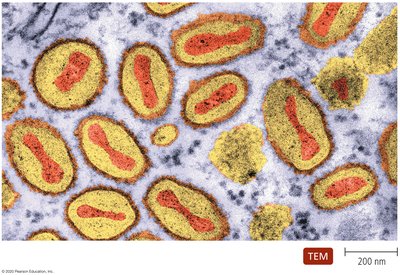
Poxviridae are large, complex, double-stranded DNA viruses with an envelope. They are the largest human pathogenic viruses and have a unique structure, including a core and lateral bodies. Unlike most DNA viruses, poxviruses replicate in the cytoplasm and carry their own enzymes for mRNA synthesis, such as DNA-dependent RNA polymerase.
Complex capsid and envelope
Replicate in the cytoplasm
Contain enzymes for transcription
Diseases Caused by Poxviridae
Poxviruses infect many mammals, but most animal poxviruses are species-specific. Four genera cause human disease: Orthopoxvirus (smallpox, cowpox, monkeypox), Parapoxvirus (orf), Molluscipoxvirus (molluscum contagiosum), and Yantapoxvirus (tanapox). Transmission is primarily by inhalation or close contact. All poxvirus infections produce characteristic lesions that progress through defined stages.
Smallpox and molluscum contagiosum are the main human diseases.
Lesions progress through macule, papule, vesicle, pustule, crust, and scar stages.

Smallpox (Variola)
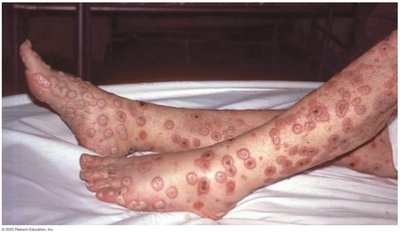
Smallpox is caused by Orthopoxvirus variola and is transmitted by inhalation. It exists in two forms: variola major (severe, ~20% mortality) and variola minor (milder). The virus infects internal organs, causing fever and malaise, then spreads to the skin, producing pox lesions.
First human disease to be eradicated (1980)
Eradication factors: effective vaccine, no animal reservoirs, obvious symptoms, no asymptomatic cases, close-contact transmission only
Stocks remain in select laboratories
Molluscum Contagiosum
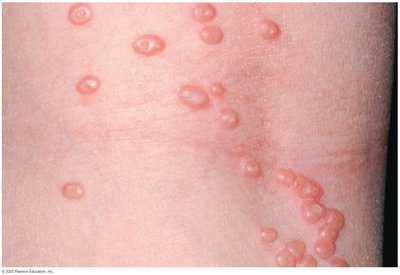
Caused by Molluscipoxvirus, this skin disease is characterized by smooth, waxy papules, typically on the face, trunk, and external genitalia. It spreads by direct contact, especially among children, sexually active individuals, and immunocompromised patients. Treatment involves removal of nodules, but healthy individuals often recover without intervention.
Prevention: sexual abstinence prevents genital form
Immunocompetent individuals usually recover spontaneously
Other Poxvirus Infections
Other poxvirus infections can occur in humans after contact with infected animals. These infections are usually mild, causing pox and scars but little other damage. Monkeypox cases in humans have increased in recent years.
Papillomaviridae and Polyomaviridae
Structure and General Features
Both families have small, naked, icosahedral capsids and contain a single molecule of double-stranded DNA. They were once classified as a single family due to their structural similarities.
Papillomavirus Infections
Papillomaviruses cause papillomas, commonly known as warts, which are benign growths of the epithelium on skin or mucous membranes. Warts can appear on various body surfaces, including fingers, toes (seed warts), soles of feet (plantar warts), trunk, face, elbows, knees (flat warts), and external genitalia (genital warts, caused by HPV). Genital warts are associated with an increased risk of cancers such as cervical, penile, throat, and oral cancers.
HPV is the most common sexually transmitted infection (STI) in the United States.
Polyomavirus Infections
Polyomaviruses can cause tumors in animals and humans, as well as other diseases. BK and JC viruses are endemic worldwide. The outcome of infection depends on the host's immune system. In immunocompromised individuals, latent infections can be established in the kidneys (BK virus) or central nervous system (JC virus).
BK virus: Can cause severe urinary tract infections.
JC virus: Can cause progressive multifocal leukoencephalopathy (PML), a fatal demyelinating disease of the CNS.
Beta interferon may prevent kidney damage by BK virus.
Diagnosis of JC virus infection is often too late for effective treatment.
Review Questions and Key Facts
Which human disease is caused by poxviruses? Molluscum contagiosum
Where on the body are flat warts located? Elbows or knees
What is the most common STI in the United States? HPV (Human Papillomavirus)
