 Back
BackPathogenic RNA Viruses: Togaviridae, Flaviviridae, and Coronaviridae
Study Guide - Smart Notes
 Tailored notes based on your materials, expanded with key definitions, examples, and context.
Pathogenic RNA Viruses
Overview of Enveloped, Positive ssRNA Viruses
Enveloped, positive single-stranded RNA (+ssRNA) viruses are a diverse group responsible for numerous human diseases. The main families discussed here are Togaviridae, Flaviviridae, and Coronaviridae. These viruses are often transmitted by arthropod vectors and can cause both mild and severe illnesses.
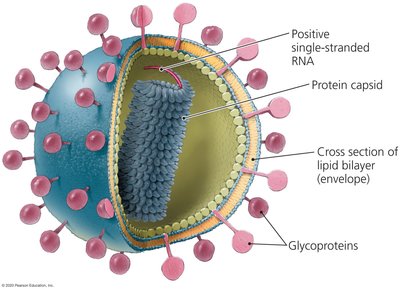
Togaviridae and Flaviviridae: Enveloped, icosahedral +ssRNA viruses; many are arboviruses (arthropod-borne viruses).
Coronaviridae: Enveloped, helical +ssRNA viruses; notable for causing respiratory syndromes.
Arboviruses: Transmission and Disease
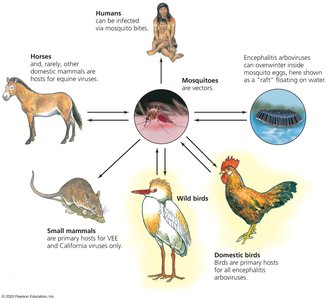
Arboviruses are zoonotic viruses transmitted by arthropods such as mosquitoes and ticks. They infect animal hosts and occasionally humans, who are typically dead-end hosts. Most infections are mild, but some can progress to severe diseases.
Zoonoses: Diseases that originate in animals and can be transmitted to humans.
Vectors: Mosquitoes and ticks transmit arboviruses among animal hosts and remain infected, serving as a continual source of new infections.
Second-stage infections: Can result in encephalitis, dengue fever, and yellow fever.
Diseases Caused by Arboviruses
Encephalitis
Several togaviruses and flaviviruses cause encephalitis in humans and animals. The normal hosts are birds or rodents, and transmission occurs via mosquito bites.
Eastern Equine Encephalitis (EEE): Most severe in humans.
Western Equine Encephalitis (WEE) & Venezuelan Equine Encephalitis (VEE): Also cause encephalitis.
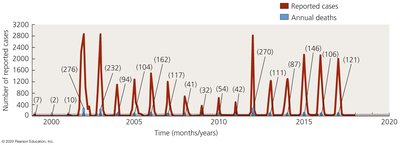
West Nile Virus: Introduced to the U.S. in 1999; mostly asymptomatic, but severe cases can cause encephalitis.
Dengue Fever
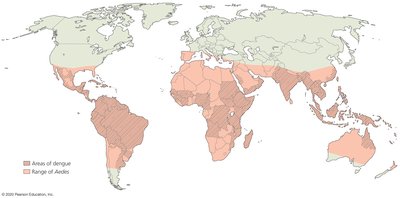
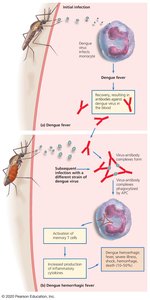
Dengue fever is caused by a flavivirus transmitted by Aedes mosquitoes. It is endemic in Asia, South America, and Mexico, and occurs in two phases.
Phase 1: Fever, weakness, edema, severe pain.
Phase 2: Bright rash and return of fever.
Dengue hemorrhagic fever: Can occur after reinfection, causing internal bleeding, shock, and possibly death.
Prevention: Mosquito control is key; no treatment is available.
Yellow Fever
Yellow fever is caused by the yellow fever virus and transmitted by Aedes mosquitoes. It results in degeneration of the liver, kidneys, and heart, with hemorrhaging and a mortality rate approaching 20%.
Prevention: Vaccination and mosquito control have eliminated yellow fever in the U.S., but it remains a significant cause of death worldwide.

Zika Fever
Zika fever is caused by the Zika virus, transmitted by Aedes mosquitoes, and can also be transmitted transplacentally and sexually. Often asymptomatic, but fetal infections may cause microcephaly.
Prevention: Avoiding mosquitoes and endemic regions; no specific treatment available.
Table: Arbovirus Diseases by Viral Family
The following table summarizes key arbovirus diseases, their vectors, hosts, distribution, and symptoms.
Family | Disease | Vector | Natural Host(s) | Distribution | Symptoms |
|---|---|---|---|---|---|
Togaviridae | EEE, WEE, VEE | Aedes, Culex, Culiseta mosquitoes | Birds, rodents | Americas | Flulike symptoms, encephalitis |
Flaviviridae | Japanese Encephalitis, West Nile, St. Louis Encephalitis, Dengue, Yellow Fever, Zika | Aedes, Culex, Anopheles mosquitoes | Birds, pigs, monkeys, humans | Asia, Africa, Americas, Europe | Flulike symptoms, encephalitis, hemorrhagic fever, rash, joint pain |
Bunyaviridae | La Crosse Encephalitis, Rift Valley Fever, Colorado Tick Fever | Aedes mosquitoes, Dermacentor ticks | Rodents, sheep, goats, cattle, small mammals | North America, Africa, Asia | Fever, rash, encephalitis, hemorrhagic fever |
Reoviridae | Sand Fly Fever, Crimean-Congo Hemorrhagic Fever | Phlebotomus flies, Hyalomma ticks | Sheep, cattle, horses, goats, seabirds | Africa, Crimea | Hemorrhagic fever, encephalitis |

Diagnosis, Treatment, and Prevention of Arboviruses
Diagnosis of arbovirus infections relies on serological tests. Supportive care is the only treatment for most arboviral diseases. Prevention focuses on vector control, and vaccines are available for some viruses, recommended for travelers to endemic areas.

Other Diseases of Enveloped +RNA Viruses
Rubella (German Measles)
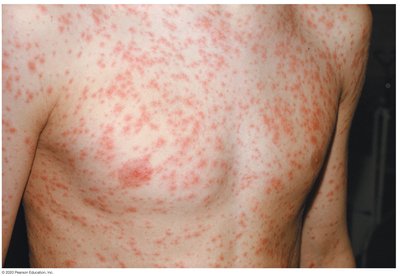
Rubella virus causes one of the five childhood diseases with skin lesions. Infection begins in the respiratory system and spreads throughout the body, producing a macular rash. Vaccination has significantly reduced incidence.
Symptoms: Flat, pink to red spots, primarily on the torso; usually mild in children, but adults may develop arthritis or encephalitis.
Congenital rubella: Infection during pregnancy can cause birth defects.
Diagnosis: Observation and serological testing.
Hepatitis C
Hepatitis C virus (HCV) is responsible for about 20% of hepatitis cases in the U.S. It is spread through needles, organ transplants, and sexual activity. Chronic infection can lead to severe liver damage and failure.
Treatment: Sofosbuvir cures most people with HCV within 12 weeks.
No vaccine is available.
Diseases of Coronaviruses
Coronaviruses are named for their corona-like envelope. They are the second most common cause of colds and can cause severe respiratory syndromes such as SARS, MERS, and COVID-19.
Symptoms: High fever, respiratory distress.
Transmission: Large droplets from the upper respiratory tract.
Prevention: Quarantine, face masks; vaccines available for COVID-19.

Quiz Questions and Answers
West Nile Virus Reservoir
The primary reservoir of the West Nile Virus is birds.

Togavirus Causing Severe Birth Defects
Rubella is the togavirus that can cause severe birth defects.

Vector for Zika, Yellow Fever, and Dengue Viruses
The vector for Zika fever, yellow fever, and dengue viruses is the Aedes aegypti mosquito.

Summary Table: Arbovirus Diseases
Disease | Vector | Natural Host(s) | Distribution | Symptoms |
|---|---|---|---|---|
EEE, WEE, VEE | Aedes, Culex mosquitoes | Birds, rodents | Americas | Flulike symptoms, encephalitis |
Dengue, Yellow Fever, Zika | Aedes mosquitoes | Monkeys, humans | Worldwide, tropics | Severe pain, hemorrhaging, hepatitis, shock |
West Nile | Aedes, Anopheles, Culex mosquitoes | Birds | Africa, Europe, Asia, North America | Flulike symptoms, potentially fatal encephalitis |
