 Back
BackProkaryotic and Eukaryotic Cell Structures and Functions
Study Guide - Smart Notes
 Tailored notes based on your materials, expanded with key definitions, examples, and context.
Prokaryotic and Eukaryotic Cells
Cell Size
Cell size is a fundamental characteristic distinguishing prokaryotic and eukaryotic cells. Prokaryotic cells are generally smaller (0.5–5 µm) compared to eukaryotic cells (10–100 µm). This size difference impacts cellular complexity, metabolic rates, and the ability to compartmentalize functions.
Cell Shape and Arrangement
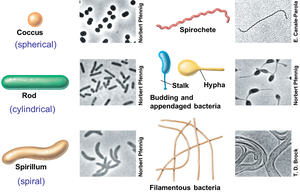
Prokaryotic cells exhibit diverse shapes and arrangements, which are important for identification and classification.
Coccus: Spherical shape
Rod (Bacillus): Cylindrical shape
Spirillum: Spiral shape
Spirochete: Flexible, spiral-shaped
Budding and appendaged bacteria: Cells with stalks or hyphae
Filamentous bacteria: Long, thread-like cells
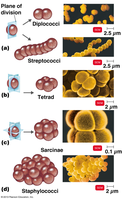
Arrangement depends on the plane of division and can include diplococci, streptococci, tetrads, sarcinae, and staphylococci.
Prokaryotic Cell Structure
Molecular Composition
Bacterial cells are composed of water, proteins, nucleic acids, lipids, polysaccharides, and small molecules. The cell envelope (membrane and wall) is critical for protection and interaction with the environment.
The Cell Membrane
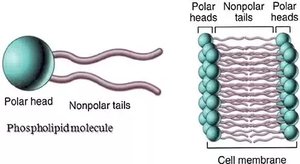
The cell membrane separates the cytoplasm from the external environment and regulates transport. It is composed of a phospholipid bilayer, proteins, and sometimes steroids (e.g., hopanoids in bacteria).
Phospholipid bilayer: Provides structural integrity
Proteins: Support protruding structures, signaling, export of toxins, transport, and energy transfer
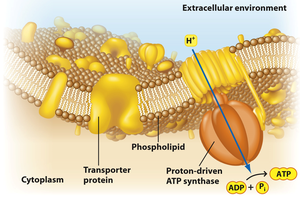
Key formula: The cell membrane maintains concentration gradients essential for energy transfer, such as ATP synthesis:
The Cell Wall
The cell wall prevents osmotic lysis and protects the cell membrane. It is a single, interlinked molecule that encloses the entire cell.
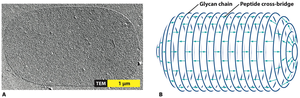
Peptidoglycan Structure
Composed of glycan chains cross-linked by peptides
Provides rigidity and shape
Bacterial Cell Wall Types
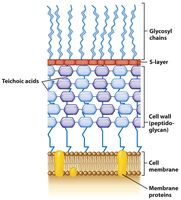
Gram-positive: Thick, multilayered peptidoglycan wall with teichoic acids
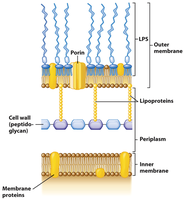
Gram-negative: Thin peptidoglycan layer, outer membrane with lipopolysaccharide (LPS)
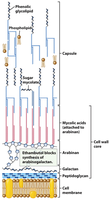
Acid-fast: Complex wall with peptidoglycan and mycolic acid
Mollicutes: Lack a true cell wall
Gram-Positive Cell Wall
Contains teichoic acids that bind ions and provide flexibility.
Gram-Negative Cell Wall
Features an outer membrane with LPS, a thin peptidoglycan layer, and murein lipoprotein.
Acid-Fast Cell Wall
Contains mycolic acids attached to peptidoglycan, characteristic of Mycobacterium tuberculosis.
Flagella
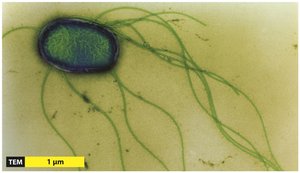
Flagella are filamentous appendages made of flagellin protein. They allow bacteria to move toward or away from stimuli (taxis) and can be distributed over the cell surface (peritrichous) or at the poles.
Glycocalyx
The glycocalyx is a viscous, gelatinous layer surrounding the cell wall, made of polysaccharide and/or polypeptide. It promotes attachment and protects from environmental harm.
Capsule: Organized, firmly attached, prevents phagocytosis
Slime layer: Unorganized, loose, aids in biofilm formation
Pili
Pili are proteinaceous appendages. Fimbriae (attachment pili) adhere cells to surfaces, while conjugation (sex) pili facilitate DNA transfer between cells.
Nucleoid and Plasmids
Bacterial DNA is organized in a nucleoid, which stores genetic information. Plasmids are small, circular DNA molecules outside the nucleoid, often carrying genes for antibiotic resistance or virulence.
Ribosomes
Prokaryotic ribosomes consist of two subunits (30S and 50S), forming a 70S ribosome. They are composed of 60% rRNA and 40% protein and are responsible for protein synthesis.
Inclusions in the Cytoplasm
Gas vesicles: Provide buoyancy in aquatic bacteria
Storage granules: Store nutrients (sulfur, phosphate, PHA)
Magnetosomes: Store magnetite for magnetotaxis
Eukaryotic Cell Structure
Cell Types
Eukaryotic cells include fungi, protozoa, algae, plants, and animals. They are larger and more complex than prokaryotic cells.
The Cell Membrane
Similar to prokaryotes, the eukaryotic cell membrane is a phospholipid bilayer with embedded proteins and steroids. It separates the cytoplasm from the environment and regulates transport.
The Nucleus
The nucleus is a membrane-bound organelle that stores DNA and controls genetic information.
Ribosomes
Eukaryotic ribosomes consist of two subunits (40S and 60S), forming an 80S ribosome. They are found scattered in the cytoplasm, attached to the rough ER, and within mitochondria and chloroplasts.
The Endomembrane System
Plasma membrane
Nuclear envelope
Rough ER: Tubular network with ribosomes, site of protein synthesis and transport
Smooth ER: Tubular network without ribosomes, involved in nutrient processing and lipid storage
Lysosomes: Vesicles with digestive enzymes for food digestion, protection, and debris removal
Golgi apparatus: Modifies and ships proteins, consists of cisternae
Mitochondria
Mitochondria evolved through endosymbiosis, contain bacterial genomes and ribosomes, and are responsible for ATP synthesis.
Cytoskeleton
The cytoskeleton modulates cell shape, provides mechanical strength, enables movement, facilitates intracellular transport, and participates in cell division.
Summary Table: Prokaryotic vs. Eukaryotic Cell Features
Feature | Prokaryotic Cell | Eukaryotic Cell |
|---|---|---|
Size | 0.5–5 µm | 10–100 µm |
Nucleus | Absent | Present |
Cell Wall | Peptidoglycan (bacteria), variable (archaea) | Cellulose (plants), chitin (fungi), absent (animals) |
Ribosomes | 70S | 80S |
Membrane-bound organelles | Absent | Present |
DNA | Circular, nucleoid | Linear, nucleus |
Flagella | Made of flagellin | Made of microtubules |
Additional info: The notes expand on brief points to provide academic context, definitions, and examples for each cell structure and function, ensuring completeness and clarity for microbiology students.
