 Back
BackViruses and Virus-like Particles: Structure, Classification, and Pathogenesis
Study Guide - Smart Notes
 Tailored notes based on your materials, expanded with key definitions, examples, and context.
Viruses and Virus-like Particles
Introduction to Viruses
Viruses are acellular infectious agents that require a host cell for replication. They are obligate intracellular parasites, meaning they cannot reproduce or carry out metabolic processes outside a host cell. Viruses are responsible for a wide range of diseases in animals, plants, fungi, protozoa, and bacteria.
Definition: A virus is a non-living, acellular particle that infects host cells and disrupts normal cellular function.
Key Features:
Filterable disease-causing agents
Acellular (no plasma membrane)
Contain either DNA or RNA (never both)
Surrounded by a protein coat called a capsid
May have an additional lipid/protein envelope
Few or no own enzymes; rely on host enzymes
Host Range and Specificity
Viruses can infect a variety of hosts, but most are specific to a single host species. Host specificity is determined by the virus's ability to recognize and bind to specific receptors on the host cell surface.
Example: HIV recognizes the CD4 receptor on human immune cells.
Viral Size
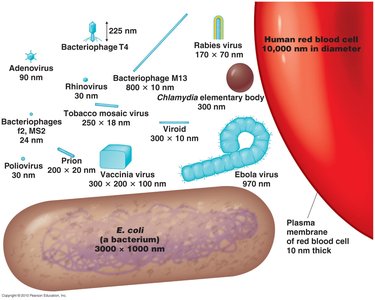
Viruses are among the smallest infectious agents, typically ranging from 20 to 1000 nm in length. They are much smaller than bacteria and can only be visualized with an electron microscope.
Structure of Viruses
Nucleic Acids
The viral genome consists of either DNA or RNA, which may be single-stranded or double-stranded, linear or circular, and segmented or non-segmented. The genome size varies from a few thousand to 250,000 base pairs.
Types: dsDNA, ssDNA, dsRNA, ssRNA
Comparison:
E. coli chromosome: ~4,000,000 base pairs
Virus genome: 1,000–250,000 base pairs
Capsid and Capsomeres
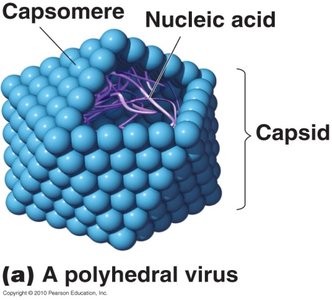
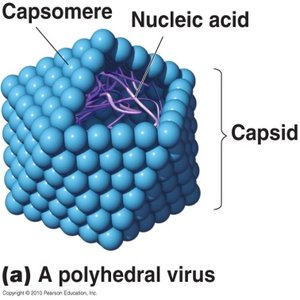
The capsid is a protein shell that surrounds and protects the viral nucleic acid. It is composed of subunits called capsomeres, which determine the virus's shape. The combination of nucleic acid and capsid is called the nucleocapsid.
Envelope and Spikes
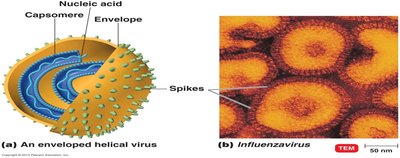
Some viruses possess an envelope, a lipid bilayer derived from the host cell membrane. Embedded in the envelope are viral proteins called spikes, which facilitate attachment to host cells. Viruses without an envelope are termed naked or non-enveloped.
Virus Morphology
Viruses are classified based on capsid shape:
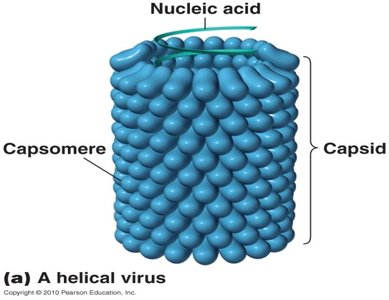
Helical Viruses: Long, rod-shaped; may be rigid or flexible.
Polyhedral Viruses: Usually icosahedral (20 triangular faces).
Enveloped Viruses: Roughly spherical, shape dictated by the envelope.
Complex Viruses: Possess additional structures; common in bacteriophages.
Classification and Naming of Viruses
Classification Criteria
Nucleic Acid Type: DNA or RNA; single or double stranded; segmented or single molecule
Capsid Structure: Polyhedral or helical
Envelope Presence: Enveloped or non-enveloped
Naming Conventions
Family: Ends with -viridae (e.g., Retroviridae)
Genus: Ends with -virus (e.g., Lentivirus)
Species: Descriptive names (e.g., Human Immunodeficiency Virus)
Multiplication of Animal Viruses
Steps in Viral Replication
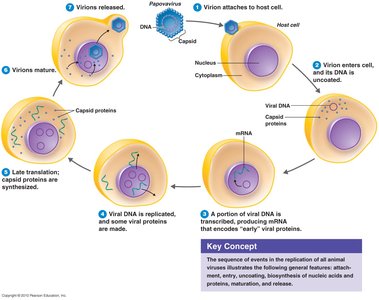
Adsorption: Virus attaches to host cell via specific receptors.
Penetration: Entry into host cell by endocytosis (naked viruses) or fusion (enveloped viruses).
Uncoating: Separation of viral nucleic acid from capsid.
Biosynthesis: Replication of viral genome and synthesis of viral proteins using host machinery.
DNA viruses replicate in the nucleus; RNA viruses in the cytoplasm.
Maturation and Assembly: Assembly of new virions from nucleic acids and capsomeres.
Release:
Naked viruses: Host cell ruptures (lysis).
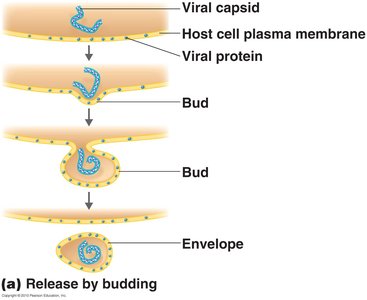
Enveloped viruses: Bud out, acquiring envelope from host membrane.
Interactions Between Viruses and Animal Hosts
Host Defenses and Infection Outcomes
The immune system plays a crucial role in controlling viral infections. Most healthy individuals carry both viruses and antibodies against them. Transmission from immune to non-immune individuals can result in disease.
Types of Viral Infections
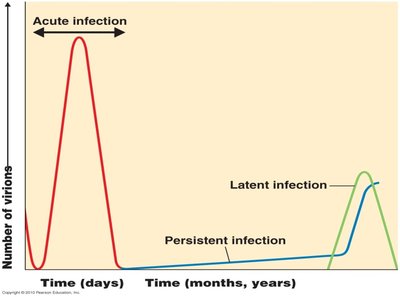
Acute Infections: Short duration, rapid onset, symptoms due to tissue damage, host may develop immunity (e.g., measles, mumps, influenza).
Persistent Infections: Virus remains in the body for extended periods; may be asymptomatic or symptomatic. Subtypes include:
Acute infection with late complications
Chronic infection
Slow infection
Latent infection
Subtypes of Persistent Infections
Acute Infection with Late Complications: Initial acute phase followed by a long asymptomatic period, then severe disease (e.g., measles leading to SSPE).
Chronic Infection: Infectious virus always present; disease may be continuous or intermittent (e.g., Hepatitis B).
Slow Infection: Gradual increase in virus over years, leading to progressive disease (e.g., HIV/AIDS).
Latent Infection: Virus remains dormant after initial infection, can reactivate later (e.g., Varicella Zoster Virus: chickenpox → shingles).
Viruses and Cancer
Oncogenic Viruses
Some viruses can induce cancer by integrating their DNA into host chromosomes, potentially activating oncogenes (mutated proto-oncogenes) and causing uncontrolled cell growth.
Examples of Oncogenic Viruses:
Human Papilloma Virus (HPV): Causes cervical cancer
Epstein-Barr Virus (EBV): Causes lymphoma, nasopharyngeal cancers
Hepatitis B Virus (HBV): Causes liver cancer
Virus-like Infectious Particles
Viroids
Small, circular, single-stranded RNA molecules
Lack a protein coat
Cause plant diseases; not found in animals
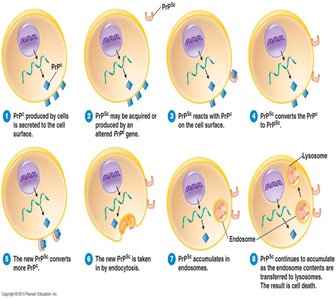
Prions
Infectious proteins with no nucleic acid
Cause neurodegenerative diseases (e.g., Creutzfeldt-Jakob Disease, Mad Cow Disease)
Highly resistant to heat and standard sterilization
Transmission often via contaminated food
Mechanism of Prion Infection
Normal cellular proteins (NP) are converted into the pathogenic prion form (PP), which accumulates and causes cell death, leading to spongiform changes in brain tissue.
Additional info: Prion diseases are always fatal and currently have no cure.
