Table of contents
- 1. Introduction to Macroeconomics
- 2. Introductory Economic Models
- 3. Supply and Demand
- Introduction to Supply and Demand
- The Basics of Demand
- Individual Demand and Market Demand
- Shifting Demand
- The Basics of Supply
- Individual Supply and Market Supply
- Shifting Supply
- Overview of Supply and Demand Shifts
- Supply and Demand Together: Equilibrium, Shortage, and Surplus
- Supply and Demand Together: One-sided Shifts
- Supply and Demand Together: Both Shift
- Supply and Demand: Quantitative Analysis
- 4. Elasticity
- Percentage Change and Price Elasticity of Demand
- Elasticity and the Midpoint Method
- Price Elasticity of Demand on a Graph
- Determinants of Price Elasticity of Demand
- Total Revenue Test
- Total Revenue Along a Linear Demand Curve
- Income Elasticity of Demand
- Cross-Price Elasticity of Demand
- Price Elasticity of Supply
- Price Elasticity of Supply on a Graph
- Elasticity Summary
- 5. Consumer and Producer Surplus; Price Ceilings and Price Floors
- Willingness to Pay and Consumer Surplus
- Willingness to Sell and Producer Surplus
- Economic Surplus and Efficiency
- Quantitative Analysis of Consumer and Producer Surplus at Equilibrium
- Price Ceilings, Price Floors, and Black Markets
- Quantitative Analysis of Price Ceilings and Price Floors: Finding Points
- Quantitative Analysis of Price Ceilings and Price Floors: Finding Areas
- 6. Introduction to Taxes and Subsidies
- 7. Externalities
- 8. The Types of Goods
- 9. International Trade
- 10. The Costs of Production
- 11. Perfect Competition
- Introduction to the Four Market Models
- Characteristics of Perfect Competition
- Revenue in Perfect Competition
- Perfect Competition Profit on the Graph
- Short Run Shutdown Decision
- Long Run Entry and Exit Decision
- Individual Supply Curve in the Short Run and Long Run
- Market Supply Curve in the Short Run and Long Run
- Long Run Equilibrium
- Perfect Competition and Efficiency
- Four Market Model Summary: Perfect Competition
- 12. Monopoly
- 13. Monopolistic Competition
- 14. Oligopoly
- 15. Markets for the Factors of Production
- 16. Income Inequality and Poverty
- 17. Asymmetric Information, Voting, and Public Choice
- 18. Consumer Choice and Behavioral Economics
12. Monopoly
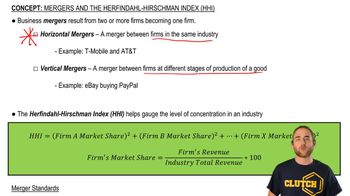
Mergers and the Herfindahl-Hirschman Index (HHI)
12. Monopoly
Mergers and the Herfindahl-Hirschman Index (HHI)
 04:42
04:42

Practice this topic
- Open Question
Calculate HHI in the following industries:
One firm with 100% market share
Two firms with 50% market share
Four firms with market shares of 30%, 30%, 20%, and 20%
Ten firms with 10% market share
789views5rank - Multiple Choice
The HHI for this industry is:
994views1rank - Multiple Choice
The monkey smoking a cigar industry is:
918views1rank - Multiple Choice
The HHI for this industry is:
1012views2rank - Multiple ChoiceWhich of the following best describes the difference between mergers and acquisitions in the context of market structure analysis using the Herfindahl-Hirschman Index (HHI)?145views