Skip to main content
Microeconomics
My Course
Learn
Exam Prep
AI Tutor
Study Guides
Flashcards
Explore
Try the app
My Course
Learn
Exam Prep
AI Tutor
Study Guides
Flashcards
Explore
Try the app
Back
Fractions Review definitions
You can tap to flip the card.
Fraction
You can tap to flip the card.
👆
Fraction
A numerical expression representing a part of a whole, written with a top and bottom number separated by a line.
Track progress
Control buttons has been changed to "navigation" mode.
1/15
Related flashcards
Related practice
Recommended videos
Fractions Review quiz
Fractions Review
15 Terms
Fractions Review
1. Reading and Understanding Graphs
10 problems
Topic
Areas of Shapes
1. Reading and Understanding Graphs
10 problems
Topic
1. Reading and Understanding Graphs
9 topics
15 problems
Chapter
Guided course
02:40
Comparing Fractions
2660
views
34
rank
Guided course
09:52
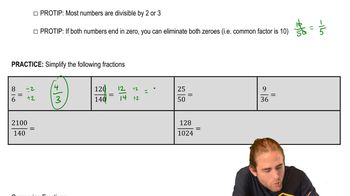
Simplifying Fractions
2292
views
18
rank
Terms in this set (15)
Hide definitions
Fraction
A numerical expression representing a part of a whole, written with a top and bottom number separated by a line.
Numerator
The upper value in a fraction, indicating how many parts are considered out of the total.
Denominator
The lower value in a fraction, showing the total number of equal parts in the whole.
Common Factor
A number that divides both the top and bottom of a fraction without leaving a remainder.
Simplification
The process of reducing a fraction to its lowest terms by removing common factors from both parts.
Decimal
A numerical form using a point to separate whole numbers from fractional parts, useful for comparing sizes.
Divisibility
A property that determines if one number can be evenly divided by another, often used to find common factors.
Even Number
A value divisible by 2, often signaling an opportunity to reduce both parts of a fraction.
Whole Number
A value without fractional or decimal parts, sometimes resulting from fully simplified fractions.
Lowest Terms
A state where a fraction cannot be reduced further because no common factors remain.
Comparison
A method for determining which of two fractions represents a larger or smaller value, often using decimals.
Calculator
A tool used to perform arithmetic operations, especially useful for division and decimal conversion.
Zero
A digit that, when present at the end of both parts of a fraction, can be removed to simplify the expression.
Dividing
An arithmetic operation used to convert fractions to decimals or to reduce fractions by common factors.
Equal Value
A situation where two fractions represent the same quantity, often revealed through decimal conversion.
 BackBack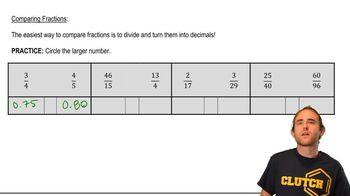
 02:40
02:40