Skip to main content
Microeconomics
My Course
Learn
Exam Prep
AI Tutor
Study Guides
Flashcards
Explore
Try the app
My Course
Learn
Exam Prep
AI Tutor
Study Guides
Flashcards
Explore
Try the app
Back
Fractions Review quiz
You can tap to flip the card.
What is the numerator in a fraction?
You can tap to flip the card.
👆
What is the numerator in a fraction?
The numerator is the top part of the fraction, representing the number of parts being considered.
Track progress
Control buttons has been changed to "navigation" mode.
1/15
Related flashcards
Related practice
Recommended videos
Fractions Review definitions
Fractions Review
15 Terms
Fractions Review
1. Reading and Understanding Graphs
10 problems
Topic
Areas of Shapes
1. Reading and Understanding Graphs
10 problems
Topic
1. Reading and Understanding Graphs
9 topics
15 problems
Chapter
Guided course
02:40
Comparing Fractions
2660
views
34
rank
Guided course
09:52
Simplifying Fractions
2293
views
18
rank
Terms in this set (15)
Hide definitions
What is the numerator in a fraction?
The numerator is the top part of the fraction, representing the number of parts being considered.
What is the denominator in a fraction?
The denominator is the bottom part of the fraction, representing the total number of equal parts.
What is the first step in simplifying a fraction?
The first step is to find a common factor that both the numerator and denominator can be divided by.
What should you do if both the numerator and denominator are even numbers?
You should divide both by 2, since 2 is a common factor of even numbers.
How can you quickly simplify fractions where both numbers end in zero?
You can remove the zeros, which is equivalent to dividing both numbers by 10 or another power of 10.
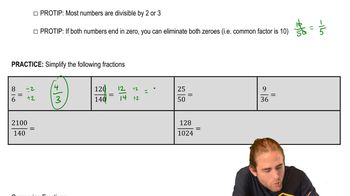
What is the simplified form of 8/6?
The simplified form is 4/3 after dividing both by 2.
How do you simplify 120/140?
First remove the zeros to get 12/14, then divide by 2 to get 6/7.
What is the final simplified form of 25/50?
The final simplified form is 1/2 after dividing by 5 and then by 5 again.
How do you simplify 9/36?
Divide both by 3 to get 3/12, then by 3 again to get 1/4.
What is the simplified result of 21100/140?
The simplified result is 15, since 21100 divided by 140 equals 15.
What is a quick way to check if a fraction can be simplified further?
Check if both numbers share a common factor like 2, 3, or 5, and keep dividing until no further simplification is possible.
How do you compare two fractions to see which is larger?
Convert each fraction to a decimal by dividing the numerator by the denominator, then compare the decimal values.
Which is larger: 3/4 or 4/5?
4/5 is larger because 0.8 is greater than 0.75.
What is the decimal value of 2/17 and 3/29, and which is larger?
2/17 is approximately 0.118 and 3/29 is about 0.103; 2/17 is larger.
What happens if two fractions have the same decimal value when compared?
If their decimal values are equal, the fractions are equal in size.
 BackBack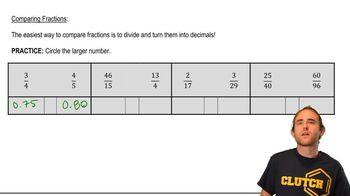
 02:40
02:40