Skip to main content
Microeconomics
My Course
Learn
Exam Prep
AI Tutor
Study Guides
Flashcards
Explore
Try the app
My Course
Learn
Exam Prep
AI Tutor
Study Guides
Flashcards
Explore
Try the app
Back
Positive and Normative Analysis definitions
You can tap to flip the card.
Positive Statement
You can tap to flip the card.
👆
Positive Statement
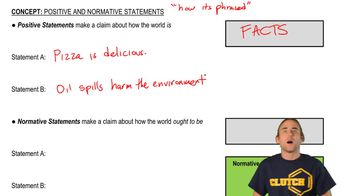
A claim about reality, phrased as a fact, which can be tested or verified regardless of its truth.
Track progress
Control buttons has been changed to "navigation" mode.
1/14
Related flashcards
Related practice
Recommended videos
Positive and Normative Analysis quiz #1
Positive and Normative Analysis
37 Terms
Positive and Normative Analysis quiz #2
Positive and Normative Analysis
39 Terms
Positive and Normative Analysis quiz #3
Positive and Normative Analysis
10 Terms
Positive and Normative Analysis
0. Basic Principles of Economics
8 problems
Topic
Microeconomics vs. Macroeconomics
0. Basic Principles of Economics
10 problems
Topic
0. Basic Principles of Economics
13 topics
14 problems
Chapter
Guided course
02:48
Identifying Statements
5097
views
252
rank
Guided course
04:35
Positive Statements vs. Normative Statements
7245
views
146
rank
Terms in this set (14)
Hide definitions
Positive Statement
A claim about reality, phrased as a fact, which can be tested or verified regardless of its truth.
Normative Statement
An expression of opinion about how things should be, often using words like 'should' or 'ought to.'
Fact
Information presented as reality, not necessarily true, but phrased to describe the world as it is.
Opinion
A personal belief or value judgment about what ought to happen, not verifiable as true or false.
Verifiability
The ability to test or check a claim scientifically to determine its truthfulness.
Scientific Process
A method used to evaluate claims by testing and observation, relevant for assessing positive statements.
Truthfulness
The quality of being accurate or correct, which positive statements can be evaluated for.
Phrasing
The way a statement is constructed, crucial for distinguishing between positive and normative claims.
Keywords
Specific words such as 'should' or 'ought to' that signal a statement is normative.
Economic Discussion
A conversation or argument in economics where distinguishing between positive and normative statements is essential.
Value Judgment
An assessment based on personal values, often found in normative statements.
Current State
The existing condition of the world, described by positive statements.
Descriptive Analysis
An approach focused on explaining how things are, characteristic of positive statements.
Prescriptive Analysis
An approach focused on suggesting how things ought to be, characteristic of normative statements.
 BackBack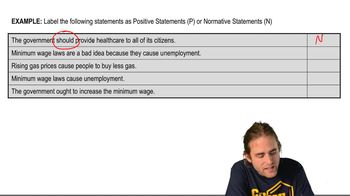
 02:48
02:48