Skip to main content
Nutrition
My Course
Learn
Exam Prep
AI Tutor
Study Guides
Flashcards
Try the app
My Course
Learn
Exam Prep
AI Tutor
Study Guides
Flashcards
Try the app
Back
Breastfeeding definitions
You can tap to flip the card.
Lactation
You can tap to flip the card.
👆
Lactation
Process involving hormonal control for producing and releasing milk to nourish infants, primarily regulated by prolactin and oxytocin.
Track progress
Control buttons has been changed to "navigation" mode.
1/15
Related flashcards
Related practice
Recommended videos
Breastfeeding quiz
Breastfeeding
15 Terms
Breastfeeding
14. Nutrition: Pregnancy Through Infancy
10 problems
Topic
Nutritional Needs for Infants
14. Nutrition: Pregnancy Through Infancy
10 problems
Topic
14. Nutrition: Pregnancy Through Infancy
5 topics
15 problems
Chapter
Guided course
02:18
Breastfeeding
96
views
2
rank
Guided course
01:28
Breastfeeding Example 1
69
views
2
rank
Guided course
02:13
Breastfeeding Example 2
79
views
1
rank
Terms in this set (15)
Hide definitions
Lactation
Process involving hormonal control for producing and releasing milk to nourish infants, primarily regulated by prolactin and oxytocin.
Prolactin
Hormone secreted by the pituitary gland that stimulates the synthesis of milk in mammary glands after childbirth.
Oxytocin
Hormone released by the pituitary gland that triggers the letdown response, causing milk ejection from the breast.
Letdown Response
Reflex initiated by oxytocin, causing milk to be released from the mammary glands in response to infant suckling.
Colostrum
Thick, yellowish initial milk produced in early days postpartum, rich in antibodies and micronutrients for newborn immunity.
Foremilk
Watery, lower-fat portion of breast milk delivered at the start of a feeding session, primarily quenching infant thirst.
Hindmilk
Creamier, higher-fat portion of breast milk delivered later in a feeding session, providing energy and satiety for the infant.
Bioavailability
Degree to which nutrients in breast milk are absorbed and utilized by the infant, surpassing that of infant formula.
Antibodies
Immune proteins present in breast milk that help protect infants from infections, diseases, and allergies.
Infant Formula
Commercially prepared substitute for breast milk, designed to meet basic nutritional needs but lacking dynamic adaptation and immune factors.
Hypothalamus
Brain region acting as a control center, initiating hormonal signals for milk production and release in response to suckling.
Pituitary Gland
Endocrine gland stimulated by the hypothalamus to secrete prolactin and oxytocin during breastfeeding.
Macronutrients
Nutrients required in large amounts—carbohydrates, proteins, and fats—essential for milk production and infant growth.
Micronutrients
Vitamins and minerals needed in small quantities, crucial for maternal health and optimal breast milk composition.
Menstruation Suppression
Temporary halt of menstrual cycles postpartum, reducing maternal iron loss and lowering iron requirements during breastfeeding.
 BackBack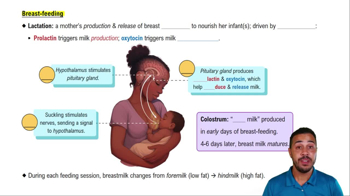
 02:18
02:18