Skip to main content
Nutrition
My Course
Learn
Exam Prep
AI Tutor
Study Guides
Flashcards
Try the app
My Course
Learn
Exam Prep
AI Tutor
Study Guides
Flashcards
Try the app
Back
Carbohydrate Digestion exam
You can tap to flip the card.
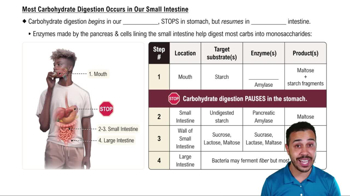
Where does carbohydrate digestion begin?
You can tap to flip the card.
👆
Where does carbohydrate digestion begin?
In the mouth, with the enzyme salivary amylase.
Track progress
Control buttons has been changed to "navigation" mode.
1/30
Related flashcards
Related practice
Recommended videos
Carbohydrate Digestion definitions
Carbohydrate Digestion
15 Terms
Carbohydrate Digestion quiz
Carbohydrate Digestion
15 Terms
Carbohydrate Digestion
4. Carbohydrates
10 problems
Topic
Dietary Guidelines for Carbohydrates
4. Carbohydrates
10 problems
Topic
4. Carbohydrates
9 topics
15 problems
Chapter
Guided course
03:12
Carbohydrate Digestion Example 2
254
views
3
rank
Guided course
03:50
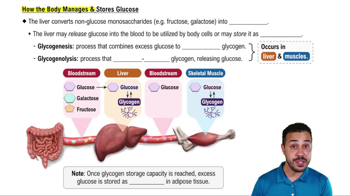
How the Body Manages & Stores Glucose
305
views
8
rank
Guided course
04:58
Most Carbohydrate Digestion Occurs in Our Small Intestine
508
views
5
rank
Terms in this set (30)
Hide definitions
Where does carbohydrate digestion begin?
In the mouth, with the enzyme salivary amylase.
Salivary amylase
An enzyme in saliva that begins the chemical breakdown of starch into maltose.
What happens to carbohydrate digestion in the stomach?
It temporarily stops because salivary amylase is inactivated by stomach acid.
Pancreatic amylase
An enzyme produced by the pancreas that continues starch digestion in the small intestine.
What is the main site of carbohydrate digestion and absorption?
The small intestine.
Enterocytes
Cells lining the small intestine that produce enzymes for final carbohydrate digestion.
Which enzymes break down disaccharides in the small intestine?
Sucrase, lactase, and maltase.
What are the end products of carbohydrate digestion?
Monosaccharides: glucose, fructose, and galactose.
How are monosaccharides absorbed?
They are absorbed into the bloodstream from the small intestine.
What happens to fructose and galactose after absorption?
They are converted to glucose in the liver.
Glycogenesis
The process of converting excess glucose into glycogen for storage.
Glycogenolysis
The breakdown of glycogen to release glucose.
Where is glycogen stored in the body?
In the liver and skeletal muscles.
How does the liver use its glycogen stores?
It releases glucose into the bloodstream for use by the whole body.
How do skeletal muscles use their glycogen stores?
They use glycogen only for their own energy needs during muscle contraction.
What happens to excess glucose after glycogen stores are full?
It is converted to fat and stored in adipose tissue.
Lactose intolerance
A condition caused by insufficient lactase, leading to difficulty digesting lactose.
What symptoms are associated with lactose intolerance?
Gas, bloating, discomfort, and diarrhea.
How can lactose intolerance be managed?
By limiting lactose intake, using lactose-free products, or taking lactase supplements.
Is lactose intolerance the same as a milk allergy?
No, lactose intolerance is due to enzyme deficiency, while milk allergy is an immune response.
What happens to undigested carbohydrates (fiber)?
They move to the large intestine, where some are fermented by bacteria and most are excreted.
Maltose
A disaccharide made of two glucose molecules.
What is the primary goal of carbohydrate digestion?
To break down complex carbohydrates into monosaccharides for absorption.
Sucrase
An enzyme that breaks down sucrose into glucose and fructose.
Lactase
An enzyme that breaks down lactose into glucose and galactose.
Maltase
An enzyme that breaks down maltose into two glucose molecules.
What is glycogen?
An animal-based polysaccharide made of glucose, used for energy storage.
What is the fate of monosaccharides after absorption?
They travel to the liver via the bloodstream.
What is the difference between soluble and insoluble fiber?
Soluble fiber can be fermented by bacteria in the large intestine; insoluble fiber is mostly excreted.
Why does carbohydrate digestion pause in the stomach?
Because the acidic environment inactivates salivary amylase.
 BackBack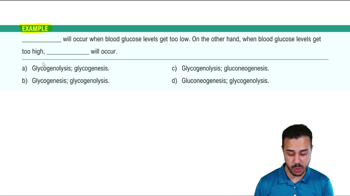
 03:12
03:12