Skip to main content
Nutrition
My Course
Learn
Exam Prep
AI Tutor
Study Guides
Flashcards
Try the app
My Course
Learn
Exam Prep
AI Tutor
Study Guides
Flashcards
Try the app
Back
Dietary Guidelines for Proteins exam
You can tap to flip the card.
What is the Recommended Dietary Allowance (RDA) for protein in adults?
You can tap to flip the card.
👆
What is the Recommended Dietary Allowance (RDA) for protein in adults?
0.8 grams per kilogram of body weight per day.
Track progress
Control buttons has been changed to "navigation" mode.
1/30
Related flashcards
Related practice
Recommended videos
Dietary Guidelines for Proteins definitions
Dietary Guidelines for Proteins
17 Terms
Dietary Guidelines for Proteins quiz
Dietary Guidelines for Proteins
15 Terms
Dietary Guidelines for Proteins
6. Proteins
10 problems
Topic
Protein-Related Disorders
6. Proteins
10 problems
Topic
6. Proteins
7 topics
15 problems
Chapter
Guided course
03:02
Dietary Guidelines for Proteins Example 1
202
views
Guided course
05:16
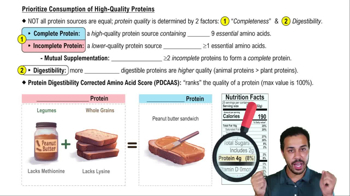
Prioritize Consumption of High-Quality Proteins
212
views
2
rank
Guided course
04:23
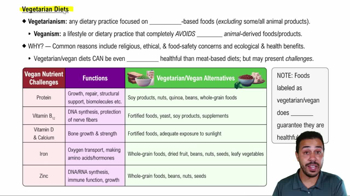
Vegetarian Diets
240
views
Terms in this set (30)
Hide definitions
What is the Recommended Dietary Allowance (RDA) for protein in adults?
0.8 grams per kilogram of body weight per day.
Nitrogen balance
A state where nitrogen intake equals nitrogen excretion, indicating adequate protein intake.
What groups of people may need more protein than the RDA?
Physically active individuals, pregnant women, children, adolescents, older adults, vegetarians, and vegans.
Essential amino acids
Amino acids that cannot be synthesized by the body and must be obtained from the diet.
What is a limiting amino acid?
The essential amino acid in shortest supply, limiting protein synthesis.
Nonessential amino acids
Amino acids that the body can synthesize and do not need to be obtained from the diet.
How is protein quality determined?
By completeness (all essential amino acids present) and digestibility.
Complete protein
A protein source that contains all nine essential amino acids in sufficient amounts.
What is mutual supplementation?
Combining two or more incomplete protein sources to provide all essential amino acids.
Positive nitrogen balance
A state where nitrogen intake exceeds excretion, common during growth, pregnancy, or muscle building.
What is the Acceptable Macronutrient Distribution Range (AMDR) for protein?
10-35% of total daily calories from protein.
Conditionally essential amino acids
Amino acids that are usually nonessential but become essential in certain conditions like illness or growth.
What is the main protein challenge for vegans?
Obtaining enough vitamin B12, as it is mostly found in animal products.
Protein Digestibility Corrected Amino Acid Score (PDCAAS)
A scoring system that evaluates protein quality based on amino acid content and digestibility.
What is negative nitrogen balance?
A state where nitrogen excretion exceeds intake, indicating protein loss, often during illness or starvation.
Transamination
The process of transferring an amino group to synthesize nonessential amino acids.
Why might vegetarians and vegans need to plan their diets carefully?
To avoid nutrient deficiencies, especially vitamin B12 and some essential amino acids.
What are some high-quality plant-based protein sources?
Soy, legumes, and some whole grains.
What is the significance of protein digestibility?
More digestible proteins are higher quality and better utilized by the body.
What is an incomplete protein?
A protein source lacking one or more essential amino acids.
Why is it unnecessary to mutually supplement proteins at every meal?
Mutual supplementation can occur across meals throughout the day to meet amino acid needs.
What is the main source of nitrogen excretion in the body?
Urea in the urine.
What is veganism?
A dietary practice that excludes all animal-derived foods and products.
How can vegetarians and vegans obtain vitamin B12?
Through fortified foods or supplements.
What is the role of protein supplements?
They may help increase muscle mass and strength in athletes but should not replace a balanced diet.
Why should lean and less processed meats be prioritized?
They contain less saturated fat, which is healthier.
What is the minimum protein intake for a 70 kg adult according to the RDA?
56 grams per day.
Why are plant proteins sometimes less digestible?
Plant proteins often contain fiber, which can interfere with protein digestion.
What is vegetarianism?
A dietary practice focused on plant-based foods, excluding some or all animal products.
What is the maximum PDCAAS value and what does it indicate?
100%, indicating the highest quality protein source.
 BackBack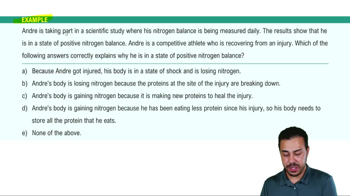
 03:02
03:02