Skip to main content
Nutrition
My Course
Learn
Exam Prep
AI Tutor
Study Guides
Flashcards
Try the app
My Course
Learn
Exam Prep
AI Tutor
Study Guides
Flashcards
Try the app
Back
Disorders of the Digestive System exam
You can tap to flip the card.
What is the function of the esophageal (cardiac) sphincter?
You can tap to flip the card.
👆
What is the function of the esophageal (cardiac) sphincter?
It separates the esophagus and stomach, preventing stomach contents from moving back up into the esophagus.
Track progress
Control buttons has been changed to "navigation" mode.
1/29
Related flashcards
Related practice
Recommended videos
Disorders of the Digestive System definitions
Disorders of the Digestive System
15 Terms
Disorders of the Digestive System quiz
Disorders of the Digestive System
15 Terms
Disorders of the Digestive System quiz #1
Disorders of the Digestive System
10 Terms
Disorders of the Digestive System
3. The Human Body & Digestion
10 problems
Topic
The Gut Microbiome
3. The Human Body & Digestion
10 problems
Topic
3. The Human Body & Digestion
7 topics
15 problems
Chapter
03:30
Disorders of the Digestive System Example 1
318
views
4
rank
04:46
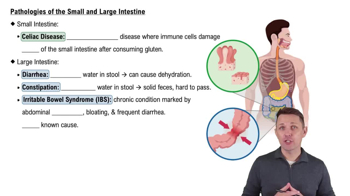
Pathologies of the Small and Large Intestine
342
views
8
rank
04:19
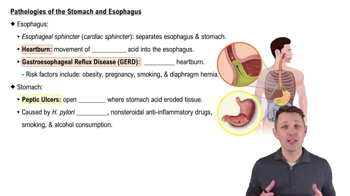
Pathologies of the Stomach and Esophagus
392
views
10
rank
Terms in this set (29)
Hide definitions
What is the function of the esophageal (cardiac) sphincter?
It separates the esophagus and stomach, preventing stomach contents from moving back up into the esophagus.
Gastroesophageal Reflux Disease (GERD)
A chronic condition where stomach acid frequently flows back into the esophagus, causing heartburn and potential tissue damage.
What are common triggers for heartburn?
Spicy foods, fatty foods, overeating, obesity, pregnancy, smoking, and diaphragm hernia.
Peptic Ulcer
A sore in the stomach lining caused mainly by H. pylori infection or long-term use of NSAIDs.
What is the main cause of peptic ulcers?
Infection with Helicobacter pylori (H. pylori) bacteria.
How does stress relate to peptic ulcers?
Stress can complicate ulcers but is not a direct cause; H. pylori and NSAIDs are primary causes.
Celiac Disease
An autoimmune disorder where gluten triggers immune damage to the villi of the small intestine, impairing nutrient absorption.
What is gluten?
A protein found in wheat that gives bread its doughy texture.
What happens to the villi in celiac disease?
The immune system attacks and damages the villi, reducing nutrient absorption.
Diarrhea
A condition characterized by excess water in the stool, which can lead to dehydration if severe.
What is a major risk of severe diarrhea?
Dehydration due to loss of water and electrolytes.
Constipation
A condition where too much water is absorbed from the stool, making it hard, dry, and difficult to pass.
What can cause constipation?
Slow movement of feces through the large intestine or excessive water absorption.
Irritable Bowel Syndrome (IBS)
A chronic disorder marked by abdominal cramping, bloating, and alternating diarrhea and constipation, with no known single cause.
What are common triggers for IBS symptoms?
Certain foods and stress can trigger IBS symptoms.
Colorectal Cancer
Cancer of the colon or rectum, the third most common and deadly cancer type.
What are symptoms of colorectal cancer?
Persistent changes in bowel habits, blood in the stool, and abdominal pain.
What are risk factors for colorectal cancer?
Obesity, sedentary lifestyle, smoking, alcohol consumption, and high red meat intake.
How does dietary fiber help prevent colorectal cancer?
Fiber bulks up stool, speeds its passage, and supports a healthy gut microbiome, reducing cancer risk.
What is a colonoscopy?
A procedure using a camera to examine the large intestine for abnormalities like polyps.
Polyp
A small growth in the colon that can be precancerous and is often removed during colonoscopy.
What is the main concern with polyps in the colon?
Some polyps can develop into colorectal cancer if not removed.
What is the role of the large intestine in water absorption?
It absorbs water from the digestive contents, forming solid feces.
How does obesity contribute to digestive disorders?
Obesity increases pressure on the stomach, raising the risk for GERD and colorectal cancer.
What is the difference between heartburn and GERD?
Heartburn is occasional acid reflux; GERD is chronic, frequent reflux causing tissue damage.
What is the effect of NSAIDs on the stomach?
Long-term NSAID use can damage the stomach lining and cause peptic ulcers.
Why is blood in the stool a warning sign?
It may indicate colorectal cancer or other serious digestive disorders.
What is the function of villi in the small intestine?
Villi increase surface area for nutrient absorption.
How does a healthy gut microbiome relate to cancer prevention?
A healthy microbiome may help protect against colorectal cancer.
 BackBack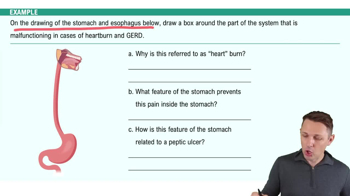
 03:30
03:30