Skip to main content
Nutrition
My Course
Learn
Exam Prep
AI Tutor
Study Guides
Flashcards
Try the app
My Course
Learn
Exam Prep
AI Tutor
Study Guides
Flashcards
Try the app
Back
Energy in Food definitions
You can tap to flip the card.
Macronutrients
You can tap to flip the card.
👆
Macronutrients
Nutrients in food that provide energy, including carbohydrates, proteins, and fats, each with distinct calorie values per gram.
Track progress
Control buttons has been changed to "navigation" mode.
1/15
Related flashcards
Related practice
Recommended videos
Energy in Food quiz
Energy in Food
15 Terms
Energy in Food exam
Energy in Food
29 Terms
Energy in Food quiz #1
Energy in Food
30 Terms
Energy in Food
1. Science of Nutrition
10 problems
Topic
Nutrition as a Science
1. Science of Nutrition
10 problems
Topic
1. Science of Nutrition
8 topics
15 problems
Chapter
04:10
Defining Calories
655
views
30
rank
04:06
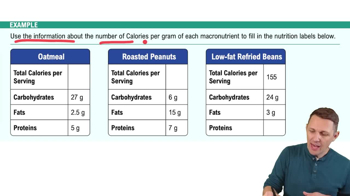
Energy in Food Example 1
508
views
16
rank
03:18
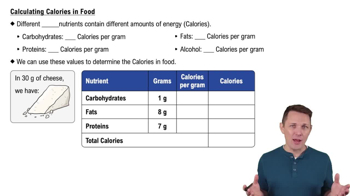
Calculating Calories in Food
616
views
27
rank
Terms in this set (15)
Hide definitions
Macronutrients
Nutrients in food that provide energy, including carbohydrates, proteins, and fats, each with distinct calorie values per gram.
Calorie
Unit of energy; technically, the amount needed to heat 1 gram of water by 1°C, but often refers to a larger unit in nutrition.
Kilocalorie
Equivalent to 1,000 small calories; the standard unit for measuring food energy on nutrition labels.
Carbohydrates
Macronutrient yielding 4 calories per gram, commonly found in foods like bread, rice, and fruits.
Proteins
Macronutrient providing 4 calories per gram, essential for body structure and function.
Fats
Macronutrient delivering 9 calories per gram, making it the most energy-dense among the macronutrients.
Metabolism
Set of chemical reactions in cells that break down and utilize food molecules to release energy.
Nutrition Label
Information panel on food packaging that lists macronutrient content and total energy, typically in kilocalories.
Energy Balance
Relationship between energy intake from food and energy expenditure by the body.
Gram
Metric unit of mass used to quantify macronutrients in food and calculate energy content.
Water
Component of food that adds weight but does not contribute to caloric content.
Alcohol
Non-macronutrient substance providing 7 calories per gram, sometimes included in energy calculations.
Calorie Calculation
Process of multiplying grams of each macronutrient by their respective calorie values and summing the results.
Kcal
Abbreviation for kilocalorie, commonly used on nutrition labels to indicate food energy.
Two Liter Bottle
Visual reference used to illustrate the amount of energy in food by comparing it to the energy needed to heat water.
 BackBack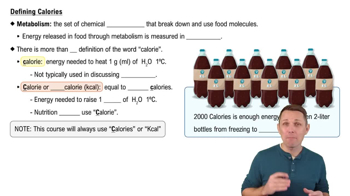
 04:10
04:10