Skip to main content
Nutrition
My Course
Learn
Exam Prep
AI Tutor
Study Guides
Flashcards
Try the app
My Course
Learn
Exam Prep
AI Tutor
Study Guides
Flashcards
Try the app
Back
Fat-Soluble Vitamins exam
You can tap to flip the card.
What are the four fat-soluble vitamins?
You can tap to flip the card.
👆
What are the four fat-soluble vitamins?
Vitamins A, D, E, and K.
Track progress
Control buttons has been changed to "navigation" mode.
1/30
Related flashcards
Related practice
Recommended videos
Fat-Soluble Vitamins definitions
Fat-Soluble Vitamins
15 Terms
Fat-Soluble Vitamins quiz
Fat-Soluble Vitamins
15 Terms
Fat-Soluble Vitamins quiz #1
Fat-Soluble Vitamins
14 Terms
Fat-Soluble Vitamins
7. Vitamins
10 problems
Topic
Water-Soluble Vitamins
7. Vitamins
10 problems
Topic
7. Vitamins
5 topics
15 problems
Chapter
Guided course
01:33
Storage of Fat-Soluble Vitamins
290
views
4
rank
Guided course
03:22
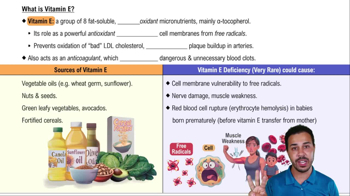
What is Vitamin E?
330
views
2
rank
Guided course
03:45
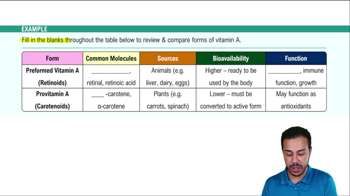
Fat-Soluble Vitamins Example 1
286
views
3
rank
Terms in this set (30)
Hide definitions
What are the four fat-soluble vitamins?
Vitamins A, D, E, and K.
Micelles
Structures formed during fat digestion that help absorb fat-soluble vitamins.
How are fat-soluble vitamins absorbed?
They require dietary fat, are absorbed via micelles, packaged into chylomicrons, and enter the lymphatic system.
Chylomicrons
Lipoprotein particles that transport absorbed fat-soluble vitamins from the intestine via the lymphatic system.
Where are fat-soluble vitamins stored in the body?
Mainly in the liver, muscles, and fatty tissues.
What is a risk of excessive intake of fat-soluble vitamins?
Toxicity due to accumulation in body tissues.
Vitamin A
A group of fat-soluble micronutrients essential for vision, gene expression, immunity, and skin and bone health.
What are the two main forms of vitamin A?
Retinoids (from animals) and carotenoids (from plants).
Retinol
The most usable, preformed form of vitamin A found in animal products.
Beta-carotene
A provitamin A carotenoid found in orange, yellow, and dark leafy green vegetables.
What is a major symptom of vitamin A deficiency?
Night blindness and xerophthalmia (corneal damage).
Vitamin D
A fat-soluble vitamin vital for bone health and immune function, also known as the sunshine vitamin.
How is vitamin D activated in the body?
Vitamin D2 and D3 are converted to calcitriol, the active hormone, by the liver and kidneys.
What is the main function of vitamin D?
Regulation of calcium and phosphorus absorption for bone health.
What are common sources of vitamin D?
Sunlight, fatty fish, egg yolks, fortified foods, and UV-exposed mushrooms.
What diseases are associated with severe vitamin D deficiency?
Rickets in children and osteomalacia in adults.
Vitamin E
A group of eight fat-soluble micronutrients, mainly alpha-tocopherol, that act as antioxidants.
What is the primary function of vitamin E?
Acts as a powerful antioxidant protecting cell membranes from free radicals.
What foods are rich in vitamin E?
Vegetable oils, nuts, seeds, green leafy vegetables, avocados, and fortified cereals.
What can vitamin E deficiency cause?
Cell membrane damage, nerve damage, muscle weakness, and hemolysis in premature infants.
Vitamin K
A group of fat-soluble micronutrients essential for blood clotting and bone health.
What are the two main forms of vitamin K?
Vitamin K1 (phylloquinone, from plants) and K2 (menaquinone, from animals and gut bacteria).
What is the most critical function of vitamin K?
Vital for blood clotting (coagulation).
How does vitamin K contribute to bone health?
Enables osteocalcin to bind calcium, strengthening bones.
What foods are high in vitamin K?
Green leafy vegetables, vegetable oils, margarine, meats, egg yolks, hard cheeses, and fermented foods.
How can gut bacteria affect vitamin K status?
They can synthesize vitamin K2, helping reduce deficiency risk.
What happens if you have a vitamin K deficiency?
Impaired blood clotting and increased risk of osteoporosis.
Why are fat-soluble vitamin deficiencies less common than water-soluble vitamin deficiencies?
Because fat-soluble vitamins are stored in the body and can be used when intake is low.
Which fat-soluble vitamins are most likely to cause toxicity?
Vitamins A and D.
What is the main difference in absorption between fat-soluble and water-soluble vitamins?
Fat-soluble vitamins require dietary fat and lymphatic transport; water-soluble vitamins are absorbed directly into the bloodstream.
 BackBack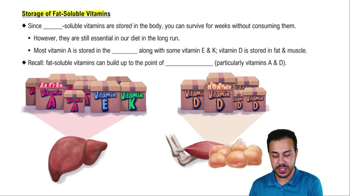
 01:33
01:33