Skip to main content
Nutrition
My Course
Learn
Exam Prep
AI Tutor
Study Guides
Flashcards
Try the app
My Course
Learn
Exam Prep
AI Tutor
Study Guides
Flashcards
Try the app
Back
Introduction to Lipids exam
1 student found this helpful
You can tap to flip the card.
What is the defining characteristic of all lipids?
You can tap to flip the card.
👆
What is the defining characteristic of all lipids?
They are hydrophobic (do not mix well with water).
Track progress
Control buttons has been changed to "navigation" mode.
1/29
Related flashcards
Related practice
Recommended videos
Introduction to Lipids definitions
Introduction to Lipids
15 Terms
Introduction to Lipids quiz
Introduction to Lipids
15 Terms
Introduction to Lipids quiz #1
Introduction to Lipids
10 Terms
Introduction to Lipids
5. Lipids
10 problems
Topic
Why do we need Lipids?
5. Lipids
10 problems
Topic
5. Lipids
6 topics
15 problems
Chapter
Guided course
01:36
Introduction to Lipids Example 2
393
views
9
rank
Guided course
02:05
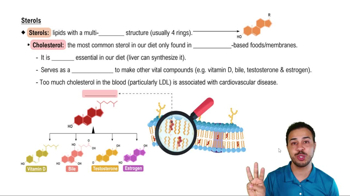
Sterols
368
views
9
rank
Guided course
02:55
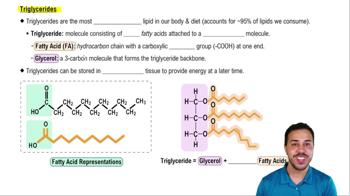
Triglycerides
470
views
16
rank
Terms in this set (29)
Hide definitions
What is the defining characteristic of all lipids?
They are hydrophobic (do not mix well with water).
Triglyceride
A lipid made of three fatty acids attached to a glycerol molecule; main form of stored energy in adipose tissue.
What are the three main types of dietary lipids?
Triglycerides, phospholipids, and sterols.
Phospholipid
A lipid with two fatty acids and a phosphate group attached to glycerol; forms cell membranes.
Sterol
A lipid with a multi-ring structure; cholesterol is the most common example.
What does amphipathic mean?
Having both hydrophobic (water-fearing) and hydrophilic (water-loving) parts.
What is the most abundant lipid in the body and diet?
Triglycerides.
What is the function of triglycerides in the body?
They store energy in adipose tissue for later use.
What is the structure of a fatty acid?
A hydrocarbon chain with a carboxylic acid (COOH) group at one end.
Are the fatty acids in a triglyceride always identical?
No, they can differ in length and number of double bonds.
What is the backbone of a triglyceride molecule?
Glycerol.
What is the main role of phospholipids in cells?
They form the structure of cell membranes.
Why are phospholipids able to form membranes?
Because they are amphipathic, with hydrophilic heads and hydrophobic tails.
Is it necessary to consume phospholipids in the diet?
No, the body can synthesize them.
What dietary component in phospholipids is essential?
Phosphorus (in the phosphate group).
Cholesterol
A sterol found in animal membranes; regulates membrane fluidity and is a precursor for vitamin D, bile, and hormones.
Where is cholesterol found?
Only in animal-based foods and animal cell membranes.
Is cholesterol essential in the diet?
No, the liver can synthesize all needed cholesterol.
What is the function of cholesterol in cell membranes?
It regulates membrane fluidity and rigidity.
What are some compounds synthesized from cholesterol?
Vitamin D, bile, testosterone, and estrogen.
What is LDL and why is it important?
Low-density lipoprotein; high levels are associated with cardiovascular disease.
What is the difference between fats and oils?
Fats are solid at room temperature; oils are liquid.
What does hydrophobic mean?
Water-fearing; does not mix or dissolve well in water.
What does hydrophilic mean?
Water-loving; dissolves well in water.
What are common dietary sources of lipids?
Butter, oils, fatty meats, fish, dairy, nuts, seeds, and processed foods.
What is the general structure of a phospholipid?
Two fatty acids and a phosphate group attached to glycerol.
What is the role of phospholipids in lipoproteins?
They help form structures like chylomicrons for lipid transport in blood.
What is the main function of adipose tissue?
To store triglycerides for energy.
What is the chemical symbol for phosphorus?
P
 BackBack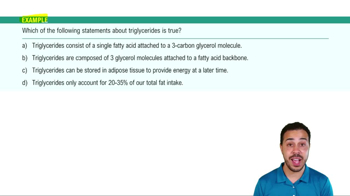
 01:36
01:36