Skip to main content
Nutrition
My Course
Learn
Exam Prep
AI Tutor
Study Guides
Flashcards
Try the app
My Course
Learn
Exam Prep
AI Tutor
Study Guides
Flashcards
Try the app
Back
Introduction to Lipids quiz
You can tap to flip the card.
What characteristic do all lipids share regardless of their diversity?
You can tap to flip the card.
👆
What characteristic do all lipids share regardless of their diversity?
All lipids are hydrophobic, meaning they do not mix well with water.
Track progress
Control buttons has been changed to "navigation" mode.
1/15
Related flashcards
Related practice
Recommended videos
Introduction to Lipids definitions
Introduction to Lipids
15 Terms
Introduction to Lipids exam
Introduction to Lipids
29 Terms
Introduction to Lipids quiz #1
Introduction to Lipids
10 Terms
Introduction to Lipids
5. Lipids
10 problems
Topic
Why do we need Lipids?
5. Lipids
10 problems
Topic
5. Lipids
6 topics
15 problems
Chapter
Guided course
01:36
Introduction to Lipids Example 2
395
views
9
rank
Guided course
02:05
Sterols
370
views
9
rank
Guided course
02:55
Triglycerides
473
views
16
rank
Terms in this set (15)
Hide definitions
What characteristic do all lipids share regardless of their diversity?
All lipids are hydrophobic, meaning they do not mix well with water.
What does it mean for a molecule to be amphipathic?
An amphipathic molecule has both hydrophobic (water-fearing) and hydrophilic (water-loving) parts.
What are the three main types of lipids found in our diet?
The three main types are triglycerides, phospholipids, and sterols.
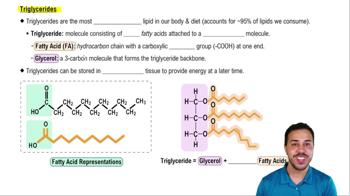
What is the structural composition of a triglyceride?
A triglyceride consists of three fatty acids attached to a glycerol molecule.
Where are triglycerides primarily stored in the body?
Triglycerides are stored in adipose tissue, where they serve as an energy reserve.
What is the main function of triglycerides in the body?
Triglycerides function as the primary form of energy storage.
What is the basic structure of a phospholipid?
A phospholipid is made up of two fatty acids and a phosphate group attached to a glycerol molecule.
Why are phospholipids important for cell membranes?
Their amphipathic nature allows them to form the bilayer structure of cell membranes.
Are phospholipids essential in the human diet? Why or why not?
No, because the body can synthesize phospholipids on its own.
What dietary component found in phospholipids is essential for humans?
Phosphorus, which is part of the phosphate group, is essential in the diet.
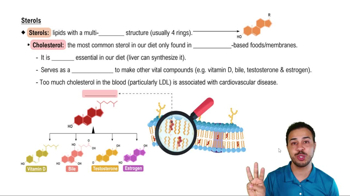
What is the defining structural feature of sterols?
Sterols have a multi-ring structure, typically consisting of four rings.
What is the most common sterol in the human diet?
Cholesterol is the most common sterol in the diet.
What are two major functions of cholesterol in the body?
Cholesterol helps regulate membrane fluidity and serves as a precursor for vitamin D, bile, and sex hormones.
Is cholesterol an essential nutrient? Why or why not?
No, because the liver can synthesize all the cholesterol the body needs.
Why does cholesterol have a bad reputation in public health?
High levels of cholesterol in the blood, especially in LDL form, are associated with cardiovascular disease.
 BackBack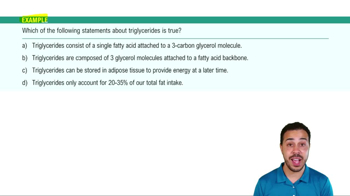
 01:36
01:36