Skip to main content
Nutrition
My Course
Learn
Exam Prep
AI Tutor
Study Guides
Flashcards
Try the app
My Course
Learn
Exam Prep
AI Tutor
Study Guides
Flashcards
Try the app
Back
Maintaining Weight exam
You can tap to flip the card.
Basal Metabolic Rate (BMR)
You can tap to flip the card.
👆
Basal Metabolic Rate (BMR)
The number of calories your body needs to maintain basic physiological functions at rest.
Track progress
Control buttons has been changed to "navigation" mode.
1/26
Related flashcards
Related practice
Recommended videos
Maintaining Weight definitions
Maintaining Weight
15 Terms
Maintaining Weight quiz
Maintaining Weight
15 Terms
Maintaining Weight
10. Energy Balance: Body Weight, Obesity, & Eating Disorders
10 problems
Topic
Gaining Weight
10. Energy Balance: Body Weight, Obesity, & Eating Disorders
10 problems
Topic
10. Energy Balance: Body Weight, Obesity, & Eating Disorders
8 topics
15 problems
Chapter
04:22
Maintaining Weight
149
views
02:16
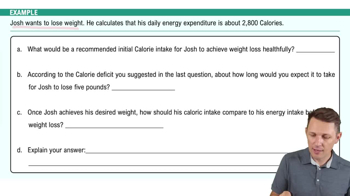
Maintaining Weight Example 1
130
views
1
rank
Terms in this set (26)
Hide definitions
Basal Metabolic Rate (BMR)
The number of calories your body needs to maintain basic physiological functions at rest.
Why does BMR decrease after weight loss?
Because a smaller body requires fewer calories to maintain basic functions.
Mindful Eating
Paying attention to what and why you are eating, avoiding distractions to prevent overeating.
What is weight cycling?
The repeated loss and regain of body weight, often called yo-yo dieting.
Set Point Theory
The idea that the body tends to maintain a certain weight by adjusting BMR and appetite.
How does regular physical activity help maintain weight loss?
It increases calorie expenditure and helps preserve lean muscle mass.
Behavioral Modification
Changing habits and behaviors to support healthy eating and weight maintenance.
What is the risk of fad diets in weight maintenance?
They often lack sustainable nutrition plans, increasing the risk of weight cycling.
Energy Balance
A state where calorie intake equals calorie expenditure, maintaining current body weight.
Why is keeping a food journal helpful?
It helps identify eating patterns and triggers, supporting mindful eating.
Environmental Triggers
External cues or situations that prompt eating, often leading to overeating.
How does stress affect weight maintenance?
Stress can trigger overeating and may alter BMR, making weight maintenance harder.
Lean Body Mass
The weight of muscles, bones, and organs, excluding fat; important for a higher BMR.
Why is shopping while full recommended?
It helps prevent impulse purchases driven by hunger, supporting healthier food choices.
Chronic Disease Risk
The likelihood of developing long-term health conditions, which decreases with lower BMI.
What is the main goal after weight loss?
To maintain the new, lower BMI and reduce chronic disease risk.
How does muscle mass affect BMR?
Muscle tissue burns more calories at rest than fat, increasing BMR.
Why is ongoing strategy important after weight loss?
To prevent weight regain and avoid unhealthy weight cycling.
Negative Energy Balance
Consuming fewer calories than expended, leading to weight loss.
What is the effect of not maintaining weight loss strategies?
It increases the risk of regaining weight and experiencing weight cycling.
BMI (Body Mass Index)
A measure of body fat based on height and weight.
How can stress management help with weight maintenance?
It reduces the likelihood of stress-induced overeating.
Why is it important to recognize and celebrate weight loss achievements?
It reinforces positive behavior and motivates continued healthy habits.
What happens to calorie needs after weight loss?
They decrease because the body is smaller and requires less energy.
Fad Diet
A diet that promises quick weight loss but is often unsustainable and nutritionally unbalanced.
What role does physical activity play in energy balance?
It increases calories out, helping maintain weight loss.
 BackBack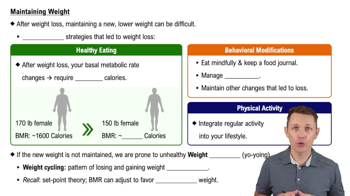
 04:22
04:22