Skip to main content
Nutrition
My Course
Learn
Exam Prep
AI Tutor
Study Guides
Flashcards
Try the app
My Course
Learn
Exam Prep
AI Tutor
Study Guides
Flashcards
Try the app
Back
Protein Synthesis exam
You can tap to flip the card.
What are the two main steps of gene expression?
You can tap to flip the card.
👆
What are the two main steps of gene expression?
Transcription and translation.
Track progress
Control buttons has been changed to "navigation" mode.
1/28
Related flashcards
Related practice
Recommended videos
Protein Synthesis definitions
Protein Synthesis
15 Terms
Protein Synthesis quiz
Protein Synthesis
15 Terms
Protein Synthesis
6. Proteins
10 problems
Topic
Why Do We Need Protein?
6. Proteins
10 problems
Topic
6. Proteins
7 topics
15 problems
Chapter
Guided course
03:42
Epigenetics & Nutrigenomics
269
views
5
rank
Guided course
03:00
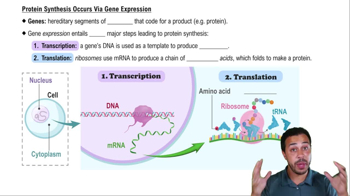
Protein Synthesis Occurs Via Gene Expression
327
views
7
rank
Guided course
02:45
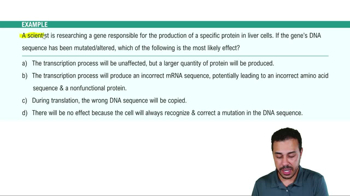
Protein Synthesis Example 1
211
views
2
rank
Terms in this set (28)
Hide definitions
What are the two main steps of gene expression?
Transcription and translation.
Gene
A hereditary segment of DNA that codes for a product, usually a protein.
Where does transcription occur in the cell?
In the nucleus.
Transcription
The process where DNA is used as a template to produce messenger RNA (mRNA).
What is the role of mRNA in protein synthesis?
It carries the genetic code from DNA to the ribosome for translation.
Translation
The process where ribosomes use mRNA to synthesize a chain of amino acids into a protein.
What is the function of tRNA during translation?
tRNA delivers amino acids to the ribosome.
Ribosome
A cell structure that synthesizes proteins by linking amino acids together during translation.
What determines the type and amount of proteins a cell makes?
The collection of genes and their expression.
Epigenetics
The study of chemical modifications that alter gene expression without changing the DNA sequence.
How does epigenetics affect cell differentiation?
By activating or suppressing genes, leading to different proteins being produced in different cell types.
Nutrigenomics
A branch of epigenetics that studies how diet influences gene expression.
What is the potential future application of nutrigenomics?
Personalized nutrition to reduce chronic disease risk.
What is the primary structure of a protein?
A chain of amino acids linked together.
How can the same DNA result in different cell types?
Different genes are expressed in different cells due to epigenetic modifications.
Messenger RNA (mRNA)
A type of RNA that carries genetic information from DNA to the ribosome.
What happens to mRNA after it is produced in the nucleus?
It is processed and moves to the cytoplasm for translation.
Transfer RNA (tRNA)
A type of RNA that brings amino acids to the ribosome during protein synthesis.
What is gene expression?
The process of producing the product that a gene encodes, often a protein.
How can epigenetics increase protein production?
By activating genes, leading to increased gene expression.
What is the role of ribosomes in protein synthesis?
They assemble amino acids into proteins using the sequence provided by mRNA.
How does diet potentially influence gene expression?
Through nutrigenomics, certain nutrients can modify gene expression.
What is the significance of chemical modifications in epigenetics?
They can turn genes on or off without altering the DNA sequence.
Why is nutrigenomics considered a promising field?
It may help tailor diets to individual genetic profiles to prevent disease.
What is the cytoplasm's role in protein synthesis?
It is where translation and protein assembly occur.
How do ribosomes know which amino acids to link together?
They read the sequence of codons on the mRNA.
What allows cells with identical DNA to have different functions?
Differences in gene expression regulated by epigenetics.
What is the end result of protein synthesis?
A functional protein with a specific structure and function.
 BackBack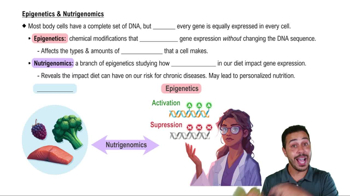
 03:42
03:42