Skip to main content
Nutrition
My Course
Learn
Exam Prep
AI Tutor
Study Guides
Flashcards
Try the app
My Course
Learn
Exam Prep
AI Tutor
Study Guides
Flashcards
Try the app
Back
Why do we need Lipids? exam
You can tap to flip the card.
What percentage of daily energy intake should come from fats according to the AMDR?
You can tap to flip the card.
👆
What percentage of daily energy intake should come from fats according to the AMDR?
20-35% of total daily energy intake should come from fats.
Track progress
Control buttons has been changed to "navigation" mode.
1/26
Related flashcards
Related practice
Recommended videos
Why do we need Lipids? definitions
Why Do We Need Lipids?
15 Terms
Why do we need Lipids? quiz
Why Do We Need Lipids?
15 Terms
Why do we need Lipids?
5. Lipids
10 problems
Topic
Fatty Acids
5. Lipids
10 problems
Topic
5. Lipids
6 topics
15 problems
Chapter
Guided course
01:27
Lipids Are Required in Our Diet
310
views
5
rank
Guided course
01:58
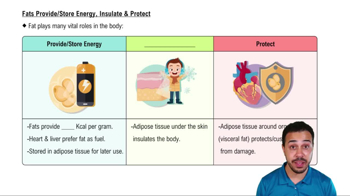
Fats Provide/Store Energy, Insulate & Protect
281
views
2
rank
Guided course
01:49
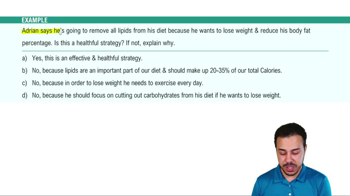
Why Do We Need Lipids? Example 1
241
views
3
rank
Terms in this set (26)
Hide definitions
What percentage of daily energy intake should come from fats according to the AMDR?
20-35% of total daily energy intake should come from fats.
Adipose tissue
A type of tissue that stores fat and insulates the body.
How many kilocalories per gram do fats provide?
Fats provide 9 kilocalories per gram.
Phospholipids
Lipids that form cell membranes and regulate material passage in and out of cells.
Why are fats considered an energy-dense nutrient?
Because they provide more than double the energy per gram compared to carbohydrates and proteins.
Cholesterol
A lipid that serves as a precursor for vitamin D, bile, and sex hormones.
What is the main function of visceral fat?
To protect and cushion internal organs from damage.
Satiety
The feeling of fullness or satisfaction after eating.
How do fats contribute to food?
They enhance flavor, texture, and satiety.
What is the role of fats in vitamin transport?
Fats help transport fat-soluble vitamins (A, D, E, K) in the blood.
AMDR
Acceptable Macronutrient Distribution Range; recommended intake range for macronutrients.
Why is fat storage in the body considered practically unlimited?
Because adipose cells can enlarge greatly and new cells can be added as needed.
What organs prefer fat as a fuel source?
The heart and liver prefer fat as a fuel source.
Insulation
The process by which adipose tissue under the skin helps keep the body warm.
What is the difference between fat and glycogen storage?
Fat storage is practically unlimited, while glycogen storage is limited.
Why do we need to consume fats daily?
Because they provide energy, store energy, insulate, protect organs, form membranes, and aid in vitamin transport.
What is the function of cell membranes formed by phospholipids?
They regulate the passage of materials into and out of cells.
How do fats aid digestion?
They facilitate the digestion, absorption, and transport of other lipids and fat-soluble vitamins.
What is the energy value of carbohydrates and proteins per gram?
Both provide 4 kilocalories per gram.
What is the role of cholesterol in hormone production?
It is a precursor for sex hormones like testosterone and estrogen.
Why do fats have a bad reputation?
They have been demonized in the public due to misconceptions about their health effects.
What is the function of adipose tissue under the skin?
It insulates the body and helps maintain body temperature.
How do fats affect the texture of foods?
They often create a crispy texture and improve mouthfeel.
What is the importance of consuming fats healthfully?
To ensure overall well-being and avoid disease while benefiting from fats' vital functions.
What are fat-soluble vitamins?
Vitamins A, D, E, and K, which require fats for absorption and transport.
What is the main takeaway about lipids from the lesson?
Lipids are essential for many vital functions and should be consumed in appropriate amounts.
 BackBack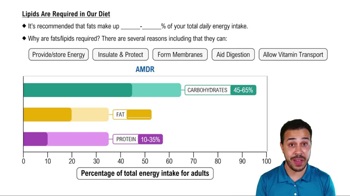
 01:27
01:27