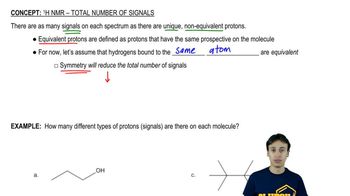
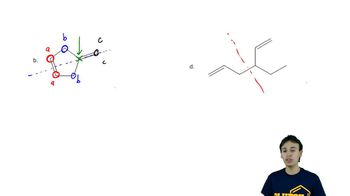
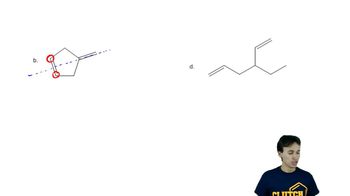
How do you determine the number of signals expected in the 1H NMR spectrum of a molecule?
Count the number of unique, non-equivalent types of protons in the molecule. Equivalent protons share the same environment, while non-equivalent protons do not. Symmetry reduces the number of signals by making protons equivalent.
What factors influence the number of signals in a 1H NMR spectrum?
The number of signals is influenced by the number of unique proton environments, molecular symmetry, and the presence of electronegative atoms that create non-equivalent environments.
How does molecular symmetry affect the number of 1H NMR signals?
Molecular symmetry reduces the number of 1H NMR signals because protons on either side of a symmetry plane are equivalent and produce the same signal.
How do you identify equivalent and non-equivalent protons in a molecule for NMR analysis?
Equivalent protons have the same environment and are often related by symmetry. Non-equivalent protons are in different environments, such as being attached to different atoms or being influenced by nearby electronegative atoms.
How many signals would you expect in the 1H NMR spectrum of a molecule with three methyl groups attached to different carbons?
If each methyl group is attached to a different environment, each will produce a separate signal. If they are in equivalent environments due to symmetry, they will produce fewer signals.
How many signals would you expect in the 13C NMR spectrum of a molecule with four different carbon environments?
You would expect four signals in the 13C NMR spectrum, one for each unique carbon environment.
Which type of molecule would exhibit only one singlet in its 1H NMR spectrum?
A molecule in which all protons are equivalent, such as methane (CH4) or a highly symmetrical compound, would exhibit only one singlet in its 1H NMR spectrum.
How do you determine the number of signals in both 1H and 13C NMR spectra for a given molecule?
Count the number of unique proton environments for 1H NMR and the number of unique carbon environments for 13C NMR, considering molecular symmetry and the influence of electronegative atoms.
What is the general approach to matching a compound to its 1H NMR spectrum based on the number of signals?
Identify the number of unique proton environments in the compound and match it to the number of signals observed in the spectrum.
How many signals would you expect in the 13C NMR spectrum of a molecule with no symmetry and five different carbon atoms?
You would expect five signals in the 13C NMR spectrum, one for each unique carbon atom.
How do you determine the number of 13C NMR signals for a molecule?
Count the number of unique carbon environments in the molecule, considering symmetry and the presence of different substituents.
How many proton NMR signals will be observed for a molecule with four unique types of protons?
Four signals will be observed in the 1H NMR spectrum, one for each unique type of proton.
How do you predict the number of 1H NMR signals for a molecule with an oxygen atom and three different carbon atoms?
Identify the unique environments: the proton on oxygen, and the protons on each carbon, considering their proximity to the oxygen. Each unique environment gives a separate signal.
What 1H NMR spectral data is expected for a molecule with no symmetry and four different types of protons?
The spectrum will show four signals, each corresponding to a unique type of proton in the molecule.
How many different kinds of proton signals would be observed in the 1H NMR spectrum of 2-methylcyclohexanol?
Count the number of unique proton environments, considering the effects of the methyl and hydroxyl groups and any molecular symmetry.
How do you determine the number of signals in the alkene/aromatic region of a 13C NMR spectrum?
Count the number of unique carbon environments in the alkene or aromatic region, considering symmetry and substituents.
How many 1H NMR signals would you expect from a molecule with three unique proton environments?
You would expect three signals in the 1H NMR spectrum.
How many signals would you expect in the 1H NMR spectrum of CH3OCH2CH2OCH3?
Identify the unique proton environments: methyl protons, methylene protons, and any others, considering symmetry. Each unique environment gives a separate signal.
How is 1H NMR spectroscopy used to determine the number of unique proton environments in a molecule?
1H NMR spectroscopy reveals the number of signals, each corresponding to a unique proton environment. Equivalent protons produce the same signal, while non-equivalent protons produce separate signals.
How do you determine the number of peaks present in the NMR signal of each labeled proton in a molecule?
Each labeled proton will produce a peak if it is in a unique environment. Equivalent protons share a peak; non-equivalent protons have separate peaks.
How do you determine the number of unique 1H and 13C NMR signals for a compound?
Count the number of unique environments for protons and carbons, considering symmetry and the influence of substituents.
How many peaks would you expect to see in the 13C NMR spectrum of a molecule with three unique carbon environments?
You would expect three peaks in the 13C NMR spectrum.
What factors affect the 1H NMR chemical shift value (in ppm) of a hydrogen atom?
The chemical shift is affected by the hydrogen's environment, especially its proximity to electronegative atoms, which cause deshielding and shift the signal downfield.
How many singlets are expected in the 1H NMR spectrum of a molecule where all protons are equivalent?
One singlet is expected in the 1H NMR spectrum if all protons are equivalent.
How many signals would you expect in the 1H NMR spectrum of (CH3)2CHCH2CH2CH3?
Identify the unique proton environments: methyl, methylene, and methine protons, considering symmetry. Each unique environment gives a separate signal.
How do you determine the number of 1H NMR signals for a molecule with multiple methyl groups and a straight chain?
Count the number of unique environments for the methyl and other protons, considering symmetry and the position of each group.
How do you determine the number of 13C NMR signals for each compound in a set?
For each compound, count the number of unique carbon environments, considering symmetry and substituents.
How many singlets are expected in the 1H NMR spectrum of 2,2,4,4-tetramethylpentane?
Count the number of unique proton environments. If all methyl groups are equivalent due to symmetry, a single singlet is expected.
How do you determine the number of signals in the 1H NMR spectrum of a molecule with several different types of protons?
Identify each unique proton environment in the molecule. Each environment produces a separate signal in the 1H NMR spectrum.
How do you determine the expected number of signals in the proton NMR spectrum for a given molecule?
Count the number of unique proton environments, considering symmetry and the influence of electronegative atoms.
How do you predict which compound matches a given 1H NMR spectrum based on the number of signals?
Match the number of unique proton environments in the compound to the number of signals observed in the spectrum.
How do you predict the number of 1H NMR signals expected for a compound?
Identify and count the unique proton environments in the compound, considering symmetry and the effects of electronegative atoms.