Back

1H NMR:Spin-Splitting Patterns quiz

Control buttons has been changed to "navigation" mode.
1/15
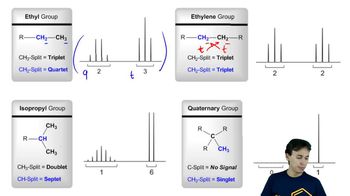
  • What splitting pattern combination in 1H NMR is characteristic of an ethyl group?

    A triplet and a quartet appearing together indicate the presence of an ethyl group (CH2-CH3).
  • What does a pair of triplets in a 1H NMR spectrum suggest about the molecular structure?

    Dual triplets suggest the presence of an ethylene group, where two CH2 groups split each other.
  • Which splitting pattern is highly indicative of an isopropyl group in 1H NMR?

    A doublet and a septet together strongly indicate an isopropyl group.
  • What does the presence of multiple singlets in a 1H NMR spectrum typically indicate?

    Multiple singlets suggest hydrogens not being split, often due to quaternary carbons or heteroatoms.
  • Why does an ethyl group produce both a triplet and a quartet in its NMR spectrum?

    The CH2 splits the CH3 into a triplet, and the CH3 splits the CH2 into a quartet due to the n+1 rule.
  • How many hydrogens split the central hydrogen in an isopropyl group, and what pattern does this create?

    Six hydrogens split the central hydrogen, resulting in a septet.
  • What is the n+1 rule in the context of NMR splitting patterns?

    The n+1 rule states that a hydrogen with n neighboring hydrogens will be split into n+1 peaks.
  • If you see a singlet in a spectrum and the molecule contains oxygen, what functional group might you suspect?

    You might suspect an alcohol group, as the singlet could be due to a hydrogen attached to oxygen.
  • What does the absence of splitting (singlet) suggest about the neighboring atoms to a hydrogen?

    It suggests there are no neighboring hydrogens to cause splitting, possibly due to quaternary carbons or heteroatoms.
  • How can recognizing common splitting patterns help in structure determination?

    Recognizing these patterns provides clues about the presence of specific groups, aiding in deducing molecular structure.
  • What splitting pattern would you expect for the hydrogens in a CH2 group next to another CH2 group?

    Each CH2 group would appear as a triplet due to splitting by the two hydrogens on the adjacent CH2.
  • Why might a carbon with four non-hydrogen substituents show a singlet in 1H NMR?

    Because there are no hydrogens on the adjacent carbon to cause splitting, resulting in a singlet.
  • What is the significance of seeing both a quartet and a triplet in the same NMR spectrum?

    It is a strong indication of an ethyl group being present in the molecule.
  • How does the presence of heteroatoms like oxygen or nitrogen affect splitting patterns?

    Heteroatoms can cause singlets because they do not split neighboring hydrogens in the same way as other hydrogens.
  • Can splitting patterns alone determine the exact structure of a molecule?

    No, but they provide significant clues that, combined with other data, help deduce the structure.