Back

Acetoacetic Ester Synthesis quiz

Control buttons has been changed to "navigation" mode.
1/15
  • What is the first step in all acetoacetic ester synthesis reactions?

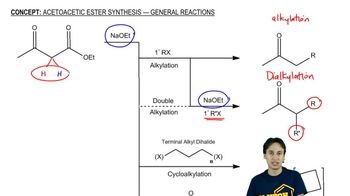
    The first step is deprotonation to form an enolate at the most acidic hydrogen.
  • Why is the enolate formed at the methylene carbon in acetoacetic ester synthesis?

    Because the hydrogens on the methylene carbon are the most acidic and easiest to remove.
  • What happens when an enolate reacts with an alkyl halide in acetoacetic ester synthesis?

    The enolate undergoes alkylation, attaching an alkyl group to the alpha carbon.
  • How can you achieve dialkylation in acetoacetic ester synthesis?

    By sequentially adding base and alkyl halide twice, removing both alpha hydrogens and adding two alkyl groups.
  • Why can't you add two equivalents of base at the same time for dialkylation?

    Because the process requires sequential deprotonation and alkylation, not simultaneous reactions.
  • What two steps are always assumed at the end of acetoacetic ester synthesis reactions?

    Hydrolysis (with H3O+) and decarboxylation (with heat) are always performed at the end.
  • Why are hydrolysis and decarboxylation steps often not shown in reaction schemes?

    Because they are standard steps that occur in every reaction, so they are assumed to save space.
  • What is cycloalkylation in the context of acetoacetic ester synthesis?

    Cycloalkylation is the formation of a ring structure by reacting with a terminal alkyl dihalide.
  • How do you determine the size of the ring formed during cycloalkylation?

    The ring size is n+1, where n is the number of carbons in the dihalide chain.
  • What product results from reacting acetoacetic ester with a 3-carbon dihalide?

    A four-membered ring is formed, with three carbons from the dihalide and one from the alpha carbon.
  • What is the outcome of reacting an enolate with an acyl chloride in acetoacetic ester synthesis?

    The enolate attacks the acyl chloride, forming an acyl group after hydrolysis and heating.
  • What is the role of H3O+ and heat in the final steps of acetoacetic ester synthesis?

    H3O+ hydrolyzes the ester, and heat causes decarboxylation, removing a CO2 group.
  • Why is it important to practice problems in acetoacetic ester synthesis?

    Because applying the concepts helps reinforce understanding and reveals how the reactions work in sequence.
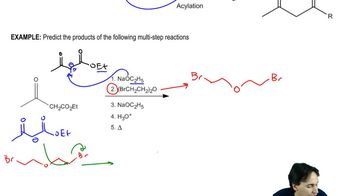
  • What is the structure of the molecule BrCH2CH2OCH2CH2Br as described in the lesson?

    It is an ether with two bromoethyl groups attached to an oxygen atom in the middle.
  • What general strategy should you use to solve multi-step acetoacetic ester synthesis problems?

    Focus on the sequence of deprotonation, alkylation, and the standard hydrolysis and decarboxylation steps, rather than detailed mechanisms.