Acid-Catalyzed Hydration quiz #1 Flashcards

Acid-Catalyzed Hydration quiz #1
Control buttons has been changed to "navigation" mode.
1/10
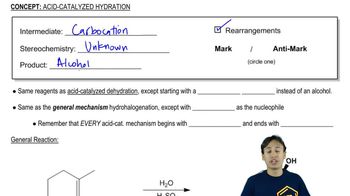
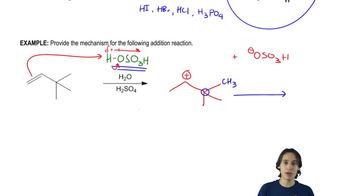
  • Describe the expected product and key mechanistic features of the acid-catalyzed hydration of 3-methyl-1-butene.
    The acid-catalyzed hydration of 3-methyl-1-butene involves adding water (in the presence of an acid like H2SO4) across the double bond to form an alcohol. The reaction proceeds via a carbocation intermediate, which may rearrange to form a more stable carbocation if possible. The product is a Markovnikov alcohol, meaning the OH group attaches to the more substituted carbon of the double bond, while the H attaches to the less substituted carbon. Due to the planar nature of the carbocation intermediate, the stereochemistry of the product is unknown, and a mixture of chiral products may result.
  • What is the key intermediate formed during acid-catalyzed hydration of alkenes?
    The key intermediate is a carbocation. This carbocation can undergo rearrangements to form a more stable species.
  • How can you distinguish between acid-catalyzed hydration and dehydration reactions when the reagents are the same?
    You look at the starting molecule: a double bond indicates hydration, while an alcohol indicates dehydration. The reagents (H2O and acid) are identical for both reactions.
  • Why is the stereochemistry of the product in acid-catalyzed hydration considered unknown?
    The carbocation intermediate is trigonal planar, allowing nucleophilic attack from either side. This leads to a mixture of possible chiral products.
  • What does a squiggly line represent in the structural depiction of acid-catalyzed hydration products?
    A squiggly line indicates unknown stereochemistry at that position. It shows that the product could have multiple stereoisomers.
  • What is the role of water in the acid-catalyzed hydration mechanism?
    Water acts as the nucleophile that attacks the carbocation intermediate. This leads to the formation of an alcohol after deprotonation.
  • Why is acid-catalyzed hydration classified as a Markovnikov addition reaction?
    The OH group attaches to the more substituted carbon due to carbocation stability. This follows Markovnikov's rule for addition reactions.
  • What are the typical reagents used in acid-catalyzed hydration?
    The typical reagents are water (H2O) and a strong acid such as H2SO4. These facilitate the addition of water across the double bond.
  • What predictable steps occur at the beginning and end of any acid-catalyzed mechanism?
    The mechanism always begins with protonation and ends with deprotonation. This ensures regeneration of the acid catalyst.
  • How does the mechanism of acid-catalyzed hydration compare to hydrohalogenation?
    Both mechanisms proceed through a carbocation intermediate and follow similar steps. The main difference is that water acts as the nucleophile in hydration, while a halide ion does in hydrohalogenation.