Back

Addition Reaction definitions

Control buttons has been changed to "navigation" mode.
1/15
  • Addition Reaction

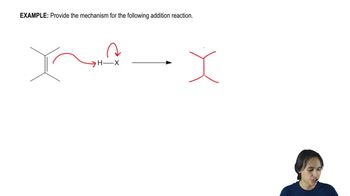
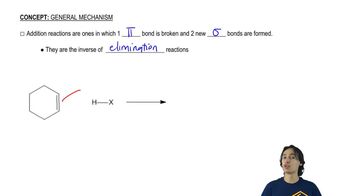
    A process where a pi bond is broken and two new sigma bonds are formed, increasing the total number of bonds in a molecule.
  • Pi Bond

    An electron-rich bond formed by sideways overlap of p orbitals, often acting as a nucleophile in organic mechanisms.
  • Sigma Bond

    A single covalent bond formed by head-on overlap of orbitals, resulting from the breaking of a pi bond in addition reactions.
  • Nucleophile

    An electron-rich species that donates electrons to an electron-poor site, often initiating addition reactions.
  • Electrophile

    An electron-deficient atom or group that accepts electrons from a nucleophile during a reaction.
  • Carbocation

    A positively charged carbon atom with only three bonds, formed as an intermediate during addition reactions.
  • Halide Ion

    A negatively charged halogen atom, such as X-, that attacks carbocations to complete the octet in addition products.
  • Dipole

    A separation of charge within a molecule, used to predict electron flow and identify electrophilic sites.
  • Elimination Reaction

    A process where two sigma bonds are converted into one pi bond, the reverse of an addition reaction.
  • Octet

    A stable electron configuration where an atom has eight electrons in its valence shell, often achieved in reaction products.
  • Mechanism

    A stepwise sequence showing electron movement, bond formation, and bond breaking during a chemical reaction.
  • Electron Flow

    The movement of electrons from electron-rich to electron-poor regions, depicted by curved arrows in mechanisms.
  • Hydrogen

    A common electrophilic atom in addition reactions, often bonded to a halogen and targeted by nucleophilic attack.
  • Halogen

    A highly electronegative element, such as X, that forms a bond with carbon after the pi bond is broken.
  • Product

    The final molecule formed after the addition reaction, characterized by two new sigma bonds replacing a pi bond.