Back

Aldol Condensation definitions

Control buttons has been changed to "navigation" mode.
1/15
  • Aldol Condensation

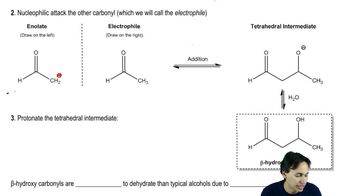
    A reaction where enolates combine with carbonyls to yield beta-hydroxy carbonyls, often followed by dehydration to form enones.
  • Enolate

    A resonance-stabilized anion formed by deprotonating a carbonyl compound, serving as a nucleophile in condensation reactions.
  • Beta-Hydroxy Carbonyl

    A molecule featuring a hydroxyl group on the beta carbon relative to a carbonyl, produced as the initial aldol condensation product.
  • Aldol

    A compound containing both aldehyde and alcohol functional groups, resulting from the self-condensation of enolizable carbonyls.
  • Base

    A substance, often hydroxide, used to deprotonate a carbonyl compound and generate an enolate for nucleophilic attack.
  • Electrophile

    A carbonyl-containing molecule with a partial positive charge, targeted by enolates during the condensation process.
  • Nucleophilic Addition

    A mechanism where a nucleophile attacks an electrophilic carbon, forming a tetrahedral intermediate before protonation.
  • Tetrahedral Intermediate

    A transient structure formed when a nucleophile adds to a carbonyl carbon, disrupting planarity and introducing four substituents.
  • Dehydration

    A process where water is eliminated from a beta-hydroxy carbonyl, leading to the formation of a double bond.
  • Alpha-Beta Unsaturated Carbonyl

    A stable product with a double bond between the alpha and beta carbons adjacent to a carbonyl, formed after dehydration.
  • Enone

    A conjugated molecule containing both an alkene and a ketone or aldehyde, resulting from aldol product dehydration.
  • Conjugation

    A stabilizing interaction where alternating double and single bonds allow electron delocalization, enhancing product stability.
  • Resonance Structure

    An alternative Lewis structure showing electron delocalization, important for understanding enolate stability.
  • Self-Condensation

    A reaction where identical carbonyl compounds react with each other, typical in aldol condensation without external electrophiles.
  • E1 Mechanism

    A pathway for dehydration under acidic conditions involving carbocation formation and subsequent elimination.