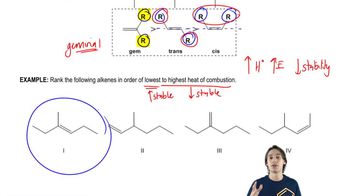
How can you distinguish an E (trans) alkene from other types of alkenes based on their structure?
An E (trans) alkene has its two highest-priority substituents on opposite sides of the double bond, resulting in less steric interference and greater stability compared to the Z (cis) isomer, where the substituents are on the same side.
What structural features make an alkene react fastest with HCl?
Alkenes with more alkyl substituents around the double bond (higher substitution) react faster with HCl because the resulting carbocation intermediate is stabilized by hyperconjugation. Thus, more substituted alkenes are more reactive toward HCl addition.
Which type of alkene is the least stable (highest in energy) based on substitution?
The least stable alkene is the unsubstituted alkene, which has no alkyl groups attached to the double bond. It lacks hyperconjugation stabilization and is highest in energy.
How do the vapor pressure and boiling point of alkynes change as the carbon chain length increases?
As the carbon chain length of alkynes increases, their boiling point increases and their vapor pressure decreases, due to stronger van der Waals forces with longer chains.
How should alkenes be ranked in order of increasing reactivity to hydrogenation based on their substitution?
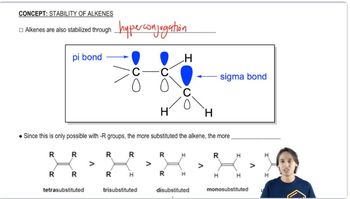
Alkenes should be ranked in order of increasing reactivity to hydrogenation as follows: tetra-substituted < tri-substituted < di-substituted < mono-substituted < unsubstituted. Less substituted alkenes are more reactive to hydrogenation.
Which type of alkene is the most stable according to hyperconjugation and substitution?
The most stable alkene is the tetra-substituted alkene, which has four alkyl groups attached to the double bond, maximizing hyperconjugation stabilization.
What is the role of adjacent sigma bonds in stabilizing the pi bond of an alkene?
Adjacent sigma bonds can share electron density with the pi bond through hyperconjugation, increasing the stability of the alkene. The more such sigma bonds present, the greater the stabilization.
How does the number of R groups around a double bond affect the ability of an alkene to undergo hyperconjugation?
The more R groups around a double bond, the more opportunities there are for hyperconjugation to occur. This results in increased stability for more substituted alkenes.
What does the term 'geminal' mean in the context of alkene substitution?
Geminal refers to two substituents attached to the same carbon of a double bond. This arrangement is called geminal because the groups are like 'twins' on the same carbon.
Why is the cis configuration of a disubstituted alkene less stable than the trans configuration?
In the cis configuration, the substituents are on the same side and experience steric interference, making the alkene less stable. The trans configuration has substituents on opposite sides, reducing steric hindrance and increasing stability.