What are the common dihalide precursors that can be used to prepare alkynes, and how are they related to alkyl group nomenclature?
Common dihalide precursors for preparing alkynes are vicinal or geminal dihalides, where two halogen atoms are attached to adjacent or the same carbon atoms, respectively. These dihalides can be derived from alkanes with various alkyl substituents, such as propyl or butyl groups, and their isomers (isopropyl, isobutyl, sec-butyl, tert-butyl). Recognizing the structure and naming of these alkyl groups helps identify possible dihalide precursors for alkyne synthesis.
How do you determine the number of unique alpha (α) carbons in an alkyl halide, and what role do common alkyl group structures play in this determination?
To determine the number of unique alpha (α) carbons in an alkyl halide, identify all carbons directly bonded to the halogen atom. The uniqueness depends on the structure of the alkyl group (e.g., straight-chain, branched, isopropyl, isobutyl, sec-butyl, tert-butyl). Each distinct environment for a carbon attached to the halogen counts as a unique α carbon. Recognizing common alkyl group structures is essential for accurately counting unique α carbons.
What is the structural difference between isopropyl and propyl substituents?
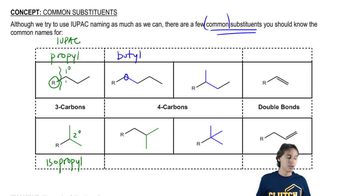
Isopropyl is a three-carbon group attached at the middle (secondary) carbon, forming a Y shape, while propyl is a straight three-carbon chain attached at the end (primary) carbon. This difference makes isopropyl an isomer of propyl.
How does the attachment position of the R group affect the naming of butyl substituents?
The attachment position determines whether the group is called butyl (primary), sec-butyl (secondary), tert-butyl (tertiary), or isobutyl (branched with a terminal methyl). Each position creates a unique structural isomer with its own common name.
What does the 'n' prefix indicate in names like n-butyl or n-propyl?
The 'n' prefix stands for 'normal' and indicates a straight-chain structure for the alkyl group. It distinguishes the unbranched form from its branched isomers.
Why are names like isopropyl and isobutyl considered common rather than IUPAC names?
These names predate the IUPAC system and have been retained due to their long-standing use in organic chemistry. They do not follow systematic IUPAC naming conventions but are widely recognized.
What is the key structural feature of a vinyl group as a substituent?
A vinyl group consists of a two-carbon unit with a double bond directly attached to the main chain. It is represented as –CH=CH2.
How does an allyl group differ from a vinyl group in its structure?
An allyl group has a –CH2– group between the main chain and the double bond, making it –CH2–CH=CH2. In contrast, a vinyl group is directly attached to the double bond.
Why is it important to memorize the structures and names of common alkyl substituents?
These names frequently appear in exams and advanced organic chemistry courses. Recognizing them quickly aids in naming and understanding organic molecules.
What mnemonic or visual cue can help you recognize an isopropyl group in a structure?
The isopropyl group often looks like a 'Y' shape in skeletal structures. This visual cue helps distinguish it from other three-carbon substituents.