Back

Alkyne Hydrohalogenation definitions

Control buttons has been changed to "navigation" mode.
1/15
  • Alkyne

    A molecule featuring a carbon-carbon triple bond, allowing for two sequential additions in certain reactions.
  • Hydrohalogenation

    A reaction where a hydrogen halide adds across a multiple bond, often following Markovnikov's rule.
  • Halogen

    A group 17 element that can add to unsaturated carbons, often forming dihalide products in organic reactions.
  • Pi Bond

    A type of covalent bond formed from side-by-side orbital overlap, present in double and triple bonds.
  • Double Addition

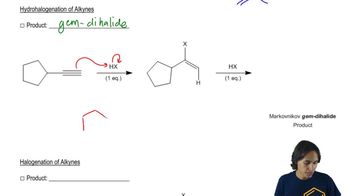
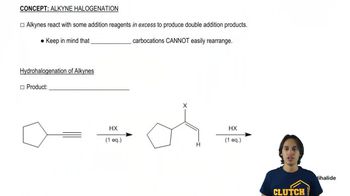
    A process where two equivalents of a reagent add across both pi bonds of a triple bond.
  • Vinyl Carbocation

    A positively charged intermediate with the charge directly on a carbon of a double bond, resistant to rearrangement.
  • Markovnikov Position

    The location on a molecule where an electrophile adds to the more substituted carbon during addition reactions.
  • Geminal Dihalide

    A compound where two halogen atoms are bonded to the same carbon atom, often formed from double addition.
  • Intermediate

    A transient species formed during a reaction pathway, existing between reactants and final products.
  • Equivalent

    A stoichiometric amount of a reagent relative to the amount of substrate present in a reaction.
  • Triple Bond

    A bond consisting of one sigma and two pi bonds, characteristic of alkynes and enabling multiple additions.
  • Addition Reaction

    A process where atoms or groups are incorporated into a molecule, typically across multiple bonds.
  • Carbocation

    A positively charged carbon species, often an intermediate in electrophilic addition mechanisms.
  • Substituted Carbon

    A carbon atom bonded to groups other than hydrogen, influencing regioselectivity in addition reactions.
  • Product

    The final compound(s) formed after completion of a chemical reaction, reflecting all additions and changes.