Back

Alkyne Hydrohalogenation quiz

Control buttons has been changed to "navigation" mode.
1/15
  • What is the main difference between the reactivity of alkynes and alkenes with halogens?

    Alkynes have two pi bonds and can undergo double addition, while alkenes have one pi bond and undergo single addition.
  • What does 'double addition product' mean in the context of alkyne reactions?

    It means that reagents can add twice to the alkyne, resulting in two equivalents of addition products.
  • What is a vinyl carbocation?

    A vinyl carbocation is a carbocation directly attached to a double bond.
  • Do vinyl carbocations easily rearrange during alkyne hydrohalogenation?

    No, vinyl carbocations do not easily rearrange, so shifts in the mechanism are unlikely.
  • What is hydrohalogenation of an alkyne?

    It is the reaction of an alkyne with HX (where X is a halogen), leading to the addition of hydrogen and halogen across the triple bond.
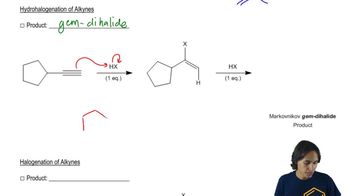
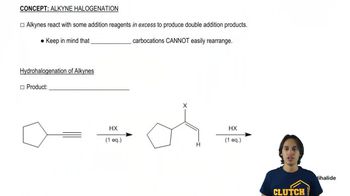
  • What product is formed when an alkyne reacts with one equivalent of HX?

    A Markovnikov addition product is formed, where the halogen adds to the more substituted carbon.
  • What happens when an alkyne reacts with two equivalents of HX?

    A geminal dihalide is formed, where both halogens add to the same carbon.
  • What does 'geminal' mean in the term 'geminal dihalide'?

    Geminal means that both halogen atoms are attached to the same carbon atom.
  • Describe the mechanism of the first addition of HX to an alkyne.

    The alkyne attacks the hydrogen of HX, forming a vinyl carbocation, which is then attacked by the halide ion to give the first addition product.
  • What is the Markovnikov rule in the context of alkyne hydrohalogenation?

    The halogen adds to the more substituted carbon, following Markovnikov's rule.
  • How many hydrogens and halogens are added to the original alkyne after double hydrohalogenation?

    Two hydrogens and two halogens are added to the original alkyne.
  • Does the original hydrogen on the alkyne carbon remain after hydrohalogenation?

    Yes, the original hydrogen on the carbon remains after the reaction.
  • What is the final product called when both halogens add to the same carbon in alkyne hydrohalogenation?

    The final product is called a geminal dihalide.
  • Why should you not expect carbocation rearrangements in alkyne hydrohalogenation?

    Because vinyl carbocations do not easily rearrange, so shifts are unlikely.
  • What is the key to predicting the product of alkyne hydrohalogenation?

    Knowing that hydrohalogenation adds HX in a Markovnikov fashion and can occur twice to give a geminal dihalide.