Back

Alkyne Oxidative Cleavage definitions

Control buttons has been changed to "navigation" mode.
1/14
  • Triple Bond

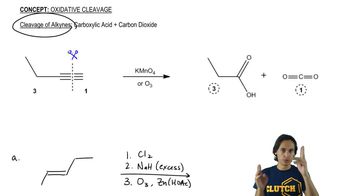
    A region in a molecule where two atoms share three pairs of electrons, making it highly reactive to oxidation.
  • Cleavage

    A process where a chemical bond is split, resulting in two separate molecular fragments.
  • Oxidizing Agent

    A substance that facilitates the addition of oxygen or removal of hydrogen, causing another species to be oxidized.
  • Potassium Permanganate

    A strong oxidizer commonly used to break multiple bonds, especially effective in transforming alkynes.
  • Ozone

    A triatomic molecule used as a powerful oxidant to cleave unsaturated carbon bonds.
  • Carboxylic Acid

    A functional group formed when a carbon chain longer than one carbon is oxidized during alkyne cleavage.
  • Carbon Dioxide

    A gaseous product formed when a single carbon fragment is fully oxidized during alkyne cleavage.
  • Multi-step Synthesis

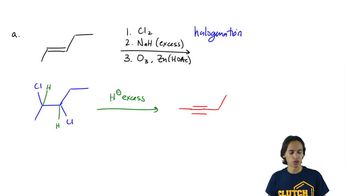
    A sequence of chemical reactions designed to transform a starting material into a desired product.
  • Product Prediction

    The process of determining the outcome of a reaction based on the structure of reactants and reagents used.
  • Scissors Analogy

    A visual tool for understanding how a bond is split into two parts, similar to cutting with scissors.
  • Reagent

    A chemical substance added to cause a reaction or test for the presence of another substance.
  • Single Carbon Chain

    A fragment consisting of only one carbon atom, which is fully oxidized to carbon dioxide in cleavage reactions.
  • Three-carbon Chain

    A molecular fragment with three carbon atoms, often converted to a carboxylic acid after oxidative cleavage.
  • Double Bond

    A region where two atoms share two pairs of electrons, also susceptible to cleavage by strong oxidizers.