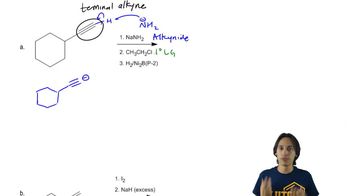
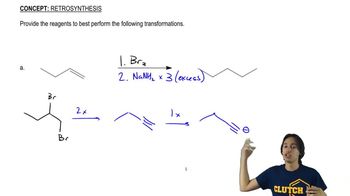
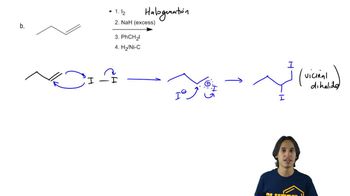
How can a terminal alkyne be used to synthesize a longer alkyne using an acetylide anion and an alkyl chloride? Describe the general reactants and the reaction mechanism involved.
A terminal alkyne can be deprotonated with a strong base such as NH2- to form an acetylide anion. This acetylide anion then acts as a nucleophile and undergoes an SN2 reaction with a primary alkyl chloride (or other primary alkyl halide), resulting in the formation of a new carbon-carbon bond and a longer alkyne. The general reactants are the terminal alkyne (to form the acetylide anion) and a primary alkyl chloride (as the electrophile).
What is the role of NH2- in the first step of alkynide synthesis starting from a terminal alkyne?
NH2- acts as a strong base to deprotonate the terminal alkyne, generating an alkynide ion. This ion is a key nucleophile for subsequent reactions.
Why is a primary alkyl halide preferred in the SN2 reaction with an alkynide ion?
A primary alkyl halide is less hindered, allowing efficient backside attack by the alkynide ion. This leads to successful carbon chain extension via SN2 mechanism.
What type of mechanism occurs when an alkynide ion reacts with a primary leaving group?
The reaction proceeds via an SN2 mechanism. This involves a single-step backside attack by the nucleophile.
How does Lindlar’s catalyst affect the product of an alkynide synthesis?
Lindlar’s catalyst selectively hydrogenates the triple bond to a cis double bond. This results in stereoselective formation of a cis-alkene.
What visual change occurs in the molecule after treatment with Lindlar’s catalyst?
The triple bond is converted to a double bond, and both large groups are positioned on the same side of the double bond. This indicates the formation of a cis-alkene.
Why is the flowchart mentioned in the lesson useful for predicting reaction mechanisms?
The flowchart helps determine the correct mechanism based on nucleophile strength and leaving group type. It guides students to identify SN2 reactions in alkynide synthesis.
What is the significance of the negative charge on the alkynide ion in synthesis reactions?
The negative charge makes the alkynide ion a strong nucleophile. This enables it to attack electrophilic carbon atoms in alkyl halides.
What happens to the size of the molecule after the SN2 reaction with an alkynide ion?
The molecule becomes larger due to the formation of a new carbon-carbon bond. This extends the carbon chain of the original alkyne.
What is the outcome if a bulky base is used instead of a strong nucleophile in the flowchart analysis?
A bulky base would favor elimination over substitution. This would prevent the desired SN2 reaction and chain extension.