Skip to main content
Organic Chemistry
My Course
Learn
Exam Prep
AI Tutor
Study Guides
Textbook Solutions
Flashcards
Explore
Try the app
My Course
Learn
Exam Prep
AI Tutor
Study Guides
Textbook Solutions
Flashcards
Explore
Try the app
Back
Amines by Reduction definitions
You can tap to flip the card.
Primary Amine
You can tap to flip the card.
👆
Primary Amine
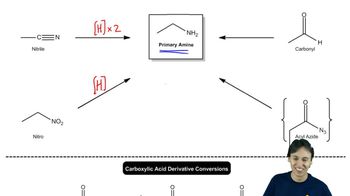
A nitrogen-containing compound formed by reduction, featuring one alkyl or aryl group attached to the nitrogen atom.
Track progress
Control buttons has been changed to "navigation" mode.
1/15
Related flashcards
Related practice
Recommended videos
Amines by Reduction quiz
Amines by Reduction
15 Terms
Amines by Reduction
26. Amines
7 problems
Topic
Johnny
Nitrogenous Nucleophiles
26. Amines
3 problems
Topic
Johnny
23. Amines - Part 1 of 3
4 topics
11 problems
Chapter
Nicole
23. Amines - Part 2 of 3
5 topics
13 problems
Chapter
Nicole
26. Amines - Part 3 of 3
1 topic
3 problems
Chapter
09:12
The Primary Amines Flowchart
2692
views
10
rank
8
comments
03:22
Making Amine Precursors
1737
views
9
rank
1
comments
Terms in this set (15)
Hide definitions
Primary Amine
A nitrogen-containing compound formed by reduction, featuring one alkyl or aryl group attached to the nitrogen atom.
Reduction
A process involving the addition of hydrogen or removal of oxygen, commonly used to convert oxidized nitrogen compounds to amines.
Lithium Aluminum Hydride
A strong reducing agent frequently used to convert amides, nitriles, and nitro groups into primary amines.
Catalytic Hydrogenation
A reduction method using hydrogen gas and a metal catalyst such as palladium, nickel, or platinum to add hydrogen atoms.
Iron and HCl
A combination serving as a common reducing system for transforming nitro groups and other oxidized nitrogen compounds into amines.
Stannous Chloride
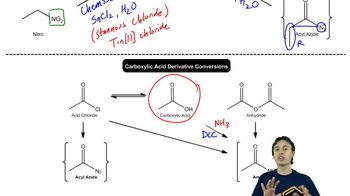
A chemoselective reducing agent, also known as SnCl2, that specifically reduces nitro groups without affecting other functional groups.
Reductive Amination
A two-step process converting carbonyl compounds to amines using a nitrogen source and a mild reducing agent like NaBH3CN.
Curtius Rearrangement
A reaction where acyl azides are heated with water to yield primary amines, involving migration and loss of nitrogen gas.
Amide
A functional group derived from carboxylic acids by replacing the hydroxyl group with an amino group, serving as a precursor to amines.
Nitrile
A functional group containing a carbon triple-bonded to nitrogen, reducible to primary amines using common reducing agents.
Nitro Group
A functional group with the structure NO2, which can be selectively reduced to a primary amine using stannous chloride.
Acyl Azide
A reactive intermediate formed from acid chlorides and azide ions, convertible to primary amines via Curtius rearrangement.
Carboxylic Acid
A parent structure for amides and acyl azides, featuring a carbonyl and hydroxyl group, and convertible to various derivatives.
Acid Chloride
A derivative of carboxylic acids where the hydroxyl group is replaced by chlorine, used to synthesize amides and acyl azides.
Anhydride
A functional group formed from two carboxylic acids, which can react with ammonia to yield amides.
 BackBack

 09:12
09:12