Back

Amines by Reduction quiz

Control buttons has been changed to "navigation" mode.
1/15
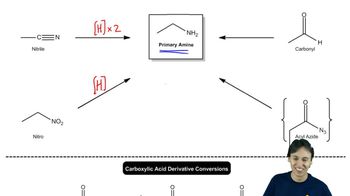
  • What are the three most common reducing agents used to synthesize primary amines from oxidized nitrogen compounds?

    Lithium aluminum hydride, catalytic hydrogenation (H2 with palladium, nickel, or platinum), and iron with HCl are the most common reducing agents.
  • Which nitrogen-containing functional groups can be reduced to primary amines using common reducing agents?

    Amides, nitriles, and nitro groups can all be reduced to primary amines using the common reducing agents.
  • What is the chemoselective reducing agent for nitro groups, and why is it preferred?

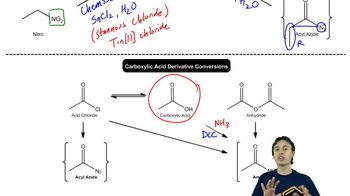
    Stannous chloride (SnCl2) in water is chemoselective for nitro groups, as it only reduces NO2 groups and avoids other functional groups.
  • What reagent is used to reduce azides to primary amines?

    Triphenylphosphine (Ph3P) and water are used to reduce azides to primary amines.
  • Why can't common reducing agents convert aldehydes directly to primary amines?

    Common reducing agents convert aldehydes to alcohols, not amines; reductive amination is required to make primary amines from aldehydes.
  • What is the process called that converts aldehydes to primary amines, and what reagents are used?

    Reductive amination converts aldehydes to primary amines using a nitrogen source (like NH3) and NaBH3CN as the reducing agent.
  • What reaction converts acyl azides to primary amines, and what are its reagents?

    The Curtius rearrangement converts acyl azides to primary amines using heat and water.
  • How can carboxylic acids be converted to amides?

    Carboxylic acids can be converted to amides by reacting with NH3, sometimes with DCC to improve yield.
  • What reagents convert carboxylic acids to acid chlorides?

    SOCl2, PCl3, or PCl5 can convert carboxylic acids to acid chlorides by replacing the OH group with Cl.
  • How is an acid chloride converted to an acyl azide?

    Acid chloride is converted to acyl azide by nucleophilic substitution with N3− (azide ion).
  • What is the outcome of reducing a nitrile with common reducing agents?

    Reducing a nitrile with common reducing agents yields a primary amine, requiring two equivalents due to the triple bond.
  • How can anhydrides be converted to amides?

    Anhydrides can be converted to amides by reacting with NH3.
  • What is the main product of all the reduction reactions discussed in the lesson?

    All the reduction reactions discussed yield primary amines as the main product.
  • Why is DCC sometimes used in the conversion of carboxylic acids to amides?

    DCC is used as a dehydration agent to improve the yield when converting carboxylic acids to amides.
  • What does 'H in brackets' represent in the context of these reduction reactions?

    'H in brackets' is a general notation for reduction, representing any of the common reducing agents used.