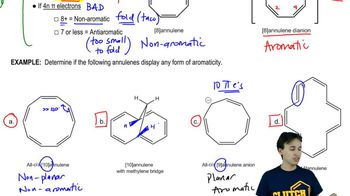
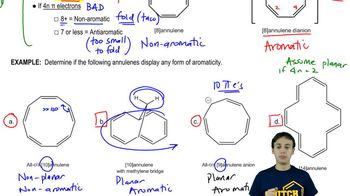
An annulene is a monocyclic compound with alternating single and double bonds, named by the number of carbons in the ring followed by 'annulene.'
How is benzene classified in terms of annulenes?
Benzene is a 6-annulene because it has six carbons in a ring with alternating single and double bonds.
Why do larger annulenes tend to be non-planar?
Larger annulenes become non-planar due to bond strain, which prevents them from maintaining a flat, planar structure.
What shape does cyclooctatetraene (8-annulene) typically adopt and why?
Cyclooctatetraene adopts a non-planar 'taco' shape to avoid antiaromaticity, making it non-aromatic.
What happens to cyclooctatetraene when it gains two negative charges?
When cyclooctatetraene becomes an 8-annulenedianion, it flattens out, becomes planar, and is aromatic due to having 10 pi electrons.
What is Huckel's rule for aromaticity?
Huckel's rule states that a planar, cyclic molecule is aromatic if it has 4n+2 pi electrons, where n is a non-negative integer.
What is the aromaticity of a planar 8-annulene?
A planar 8-annulene would be antiaromatic, but it avoids this by folding and becoming non-aromatic.
How does the number of carbons in an annulene affect its planarity and aromaticity?
Annulenes with 9 carbons or fewer can be planar and aromatic if they have a Huckel's rule number of pi electrons; those with 10 or more carbons are usually non-planar and non-aromatic due to strain.
What happens to annulenes with 8 or more carbons and a non-Huckel number of pi electrons?
They fold to avoid antiaromaticity and become non-aromatic.
Why are annulenes with 7 or fewer carbons antiaromatic if they have a non-Huckel number of pi electrons?
They are too small to fold, so they remain planar and are forced to be antiaromatic.
What is meant by an 'all-cis' annulene?
An all-cis annulene has all double bonds with adjacent single bonds oriented toward the inside of the ring.
Why might the rules for annulene aromaticity differ between professors?
Some professors may use advanced techniques like x-ray crystallography to determine planarity, leading to different interpretations of aromaticity.
What motivates an annulene to become planar and aromatic?
Annulenes are motivated to become planar and aromatic if they have a Huckel's rule number of pi electrons because aromaticity provides extra stability.
What should you do if your professor's rules for annulene aromaticity differ from textbook rules?
You should follow your professor's guidelines, as they determine your grading.
What is the general trend for planarity in annulenes with increasing ring size?
As ring size increases, annulenes are more likely to become non-planar due to increased bond strain.
 Back
Back

![[6]annulene vs. [8]annulene](https://static.studychannel.pearsonprd.tech/courses/organic-chemistry/thumbnails/717391c0_small)
 04:28
04:28