Skip to main content
Organic Chemistry
My Course
Learn
Exam Prep
AI Tutor
Study Guides
Textbook Solutions
Flashcards
Explore
Try the app
My Course
Learn
Exam Prep
AI Tutor
Study Guides
Textbook Solutions
Flashcards
Explore
Try the app
Back
Aromatic Heterocycles definitions
You can tap to flip the card.
Heterocycle
You can tap to flip the card.
👆
Heterocycle
A ring structure containing at least one non-carbon atom, often found in organic molecules with unique reactivity.
Track progress
Control buttons has been changed to "navigation" mode.
1/12
Related flashcards
Related practice
Recommended videos
Aromatic Heterocycles quiz #1
Aromaticity of Heterocycles
10 Terms
Aromatic Heterocycles
18. Aromaticity
5 problems
Topic
Johnny
Frost Circle
18. Aromaticity
4 problems
Topic
Johnny
17. Aromaticity - Part 1 of 3
6 topics
13 problems
Chapter
Johnny
17. Aromaticity - Part 2 of 3
5 topics
12 problems
Chapter
Ernest
18. Aromaticity - Part 3 of 3
1 topic
3 problems
Chapter
03:21
Determine heterocycle aromaticity
2752
views
21
rank
29
comments
03:21
Heteroatoms
3426
views
22
rank
6
comments
00:56
Determine heterocycle aromaticity
2367
views
19
rank
5
comments
Terms in this set (12)
Hide definitions
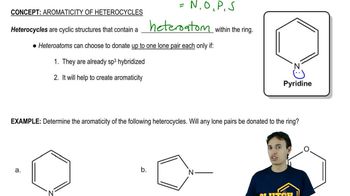
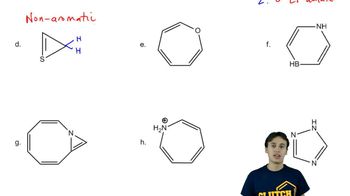
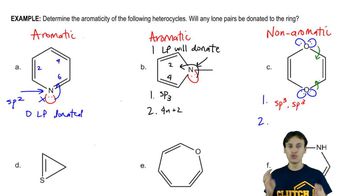
Heterocycle
A ring structure containing at least one non-carbon atom, often found in organic molecules with unique reactivity.
Heteroatom
A non-carbon atom, such as nitrogen, oxygen, phosphorus, or sulfur, present within a ring structure.
Pyridine
A six-membered aromatic ring with one nitrogen atom, notable for its basic lone pair and frequent use in acid-base reactions.
Lone Pair
A pair of valence electrons on a heteroatom not involved in bonding, which may influence aromaticity.
Aromaticity
A property of cyclic molecules with delocalized pi electrons, resulting in unusual stability and specific electron counts.
Pi Conjugated System
A network of overlapping p orbitals in a ring, allowing delocalization of electrons and potential aromatic stabilization.
Huckel's Rule
A guideline stating that a planar ring is aromatic if it contains 4n+2 pi electrons, where n is a non-negative integer.
Acid-Base Reaction
A chemical process where a base accepts a proton from an acid, often involving lone pairs on heteroatoms.
sp3 Hybridization
A state where an atom forms four sigma bonds or holds lone pairs in a tetrahedral geometry, affecting electron donation.
Anti-aromaticity
A destabilizing property of rings with 4n pi electrons, leading to increased reactivity and lack of aromatic stabilization.
Non-aromaticity
A condition where a ring lacks the continuous pi system or electron count needed for aromatic stabilization.
Electron Donation
The process by which a heteroatom's lone pair enters the pi system, potentially altering aromaticity.
 BackBack

 03:21
03:21