ATP and Energy quiz #2 Flashcards

ATP and Energy quiz #2
Control buttons has been changed to "navigation" mode.
1/40
  • Which part of a molecule provides energy for life processes?
    The phosphate groups in ATP provide energy for life processes.
  • Which of the following mechanisms generate ATP using an electron transport chain?
    Oxidative phosphorylation generates ATP using an electron transport chain.
  • What are the parts of an ATP molecule?
    The parts of an ATP molecule are adenine, ribose sugar, and three phosphate groups.
  • What evidence suggests that the hydrolysis of ATP is exergonic?
    The release of energy when the terminal phosphate bond is broken suggests that ATP hydrolysis is exergonic.
  • How is ATP made during the process of photosynthesis?
    ATP is made during photosynthesis through photophosphorylation in the light-dependent reactions.
  • How does cyanide poisoning result in the decrease of ATP production?
    Cyanide poisoning inhibits the electron transport chain, reducing ATP production by blocking oxidative phosphorylation.
  • Based on a total yield of 32 ATP from one glucose, what is the net gain?
    The net gain of ATP from one glucose molecule is approximately 30-32 ATP, accounting for energy used in the process.
  • Which of the following is not a part of an ATP molecule?
    A fatty acid is not a part of an ATP molecule.
  • Which process provides the energy used to make ATP from ADP?
    Cellular respiration provides the energy used to make ATP from ADP.
  • What roles do ADP and ATP play in the light-dependent and light-independent reactions?
    ATP provides energy for the Calvin cycle, while ADP is recycled back to ATP in the light-dependent reactions.
  • Hydrolysis of which covalent bonds in ATP releases a considerable amount of energy?
    Hydrolysis of the terminal phosphate bond in ATP releases a considerable amount of energy.
  • What molecule carries chemical energy that cells use for their functions?
    ATP carries chemical energy that cells use for their functions.
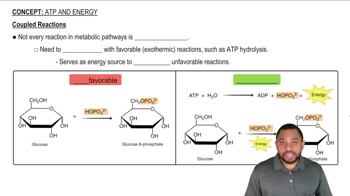
  • What happens when a phosphate group is removed from ATP?
    When a phosphate group is removed from ATP, energy is released, and ATP is converted to ADP.
  • What is the energy molecule that is used during photosynthesis?
    ATP is the energy molecule used during photosynthesis.
  • How many phosphate groups are in ATP?
    ATP contains three phosphate groups.
  • How many phosphate groups does ATP contain?
    ATP contains three phosphate groups.
  • What molecule carries energy in a form that a cell can use?
    ATP carries energy in a form that a cell can use.
  • What poison blocks ATP production?
    Cyanide is a poison that blocks ATP production.
  • Which three components make up both ADP and ATP?
    Adenine, ribose sugar, and phosphate groups make up both ADP and ATP.
  • Which molecule is the primary energy currency of all cells?
    ATP is the primary energy currency of all cells.
  • Which of the following is true of high-energy bonds in ATP?
    High-energy bonds in ATP are found between the phosphate groups.
  • Which of the following processes is driven by chemiosmosis?
    ATP synthesis in mitochondria and chloroplasts is driven by chemiosmosis.
  • What type of high energy bond is created between phosphates in ATP?
    Phosphoanhydride bonds are the high-energy bonds created between phosphates in ATP.
  • Which of the following molecules is similar in structure to ATP?
    GTP (Guanosine Triphosphate) is similar in structure to ATP.
  • What happens to the ATP produced during stage 1 of photosynthesis?
    The ATP produced during stage 1 of photosynthesis is used in the Calvin cycle to synthesize glucose.
  • How is ATP produced during the light reaction?
    ATP is produced during the light reaction through photophosphorylation.
  • What high energy molecules are formed by the electron transport chain?
    ATP and NADH are high energy molecules formed by the electron transport chain.
  • Which best describes what happens to ATP during photosynthesis?
    During photosynthesis, ATP is produced in the light-dependent reactions and used in the Calvin cycle.
  • How many ATP are needed to make a complete glucose molecule?
    The Calvin cycle uses 18 ATP molecules to make one glucose molecule.
  • During which part of photosynthesis is ATP produced?
    ATP is produced during the light-dependent reactions of photosynthesis.
  • Where is the chemical energy stored in ATP?
    Chemical energy in ATP is stored in the high-energy phosphate bonds.
  • Which components are part of an ATP molecule?
    Adenine, ribose sugar, and three phosphate groups are part of an ATP molecule.
  • The molecule ATP contains how many phosphate groups?
    The molecule ATP contains three phosphate groups.
  • What is the name of the most important energy molecule?
    ATP (Adenosine Triphosphate) is the most important energy molecule.
  • What are the three components of an ATP molecule?
    The three components of an ATP molecule are adenine, ribose sugar, and three phosphate groups.
  • What are the components of an ATP molecule?
    The components of an ATP molecule are adenine, ribose sugar, and three phosphate groups.
  • What are the three parts of ATP?
    The three parts of ATP are adenine, ribose sugar, and three phosphate groups.
  • What are the three molecules that make up ATP?
    The three molecules that make up ATP are adenine, ribose sugar, and phosphate groups.
  • What is the theoretical yield of ATP from the cellular respiration of one glucose molecule?
    The theoretical yield of ATP from the cellular respiration of one glucose molecule is 36-38 ATP.
  • ATP releases energy when a bond is broken between which of the following?
    ATP releases energy when the bond between the second and third phosphate group is broken.