Axial vs Equatorial quiz #1 Flashcards

Axial vs Equatorial quiz #1
Control buttons has been changed to "navigation" mode.
1/10
  • In the lowest energy chair conformation of cyclohexane with alkyl substituents, how many alkyl substituents occupy axial positions?
    In the lowest energy chair conformation of cyclohexane, alkyl substituents prefer to occupy equatorial positions to minimize steric interactions. The number of alkyl substituents in axial positions depends on the specific arrangement of substituents, but in the most stable (lowest energy) conformation, as few alkyl substituents as possible will be axial, with the remainder occupying equatorial positions.
  • How can you identify axial bonds in a cyclohexane chair conformation?
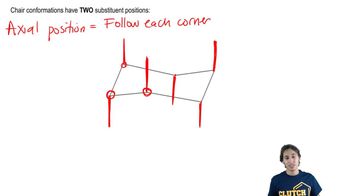
    Axial bonds in a cyclohexane chair conformation are those that point straight up or straight down from each carbon atom, following the direction of the carbon's corner. Each carbon has one axial bond, and these alternate up and down around the ring. Axial positions are easiest to draw and should be identified first when analyzing the chair conformation.
  • Why does cyclohexane adopt a chair conformation instead of remaining planar?
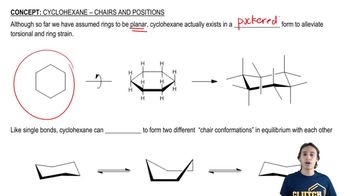
    Cyclohexane adopts a chair conformation to minimize both torsional and ring strain. In a planar form, hydrogens would eclipse and bond angles would be 120°, which is unfavorable compared to the ideal 109.5°.
  • What is the main reason the boat conformation of cyclohexane is unstable?
    The boat conformation is unstable due to flagpole interactions, where hydrogens at the bow and stern are brought very close together. This creates significant steric strain.
  • How does a chair flip affect the positions of substituents on cyclohexane?
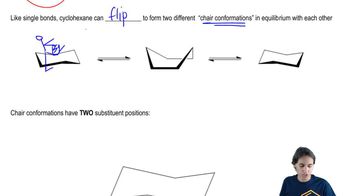
    A chair flip interchanges axial and equatorial positions for all substituents. This process does not change the molecule's connectivity, only its conformation.
  • What is the relationship between axial and equatorial positions on each carbon in cyclohexane?
    Each carbon in cyclohexane has one axial and one equatorial position. The equatorial position is oriented slightly opposite to the axial direction.
  • Why is it important to draw equatorial bonds slightly opposite to the axial direction in chair conformations?
    Drawing equatorial bonds slightly opposite to the axial direction helps maintain the ideal 109.5° bond angle. This is crucial for accurately representing the molecule and avoiding ring strain.
  • What happens to the bond angles in cyclohexane if the hydrogens are not drawn correctly in the chair conformation?
    Incorrectly drawn hydrogens can result in bond angles that deviate from 109.5°, introducing ring strain. This can lead to incorrect answers, especially in questions involving stereochemistry.
  • How are the two chair conformations of cyclohexane related to each other?
    The two chair conformations are in equilibrium and can interconvert through a chair flip. This interconversion passes through the less stable boat conformation.
  • Why is understanding the correct drawing of chair conformations important for cis and trans questions?
    Cis and trans designations depend on the relative positions of substituents, which are determined by the correct drawing of axial and equatorial bonds. Accurate drawings ensure correct identification of stereochemistry.