Birch Reduction quiz #1 Flashcards

Birch Reduction quiz #1
Control buttons has been changed to "navigation" mode.
1/10
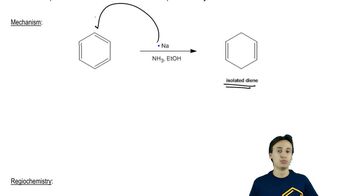
  • What is the correct mechanistic sequence of steps in the Birch reduction of benzene?
    The Birch reduction mechanism involves the following sequence: (1) Elemental sodium donates an electron to benzene, forming a radical anion intermediate; (2) the radical anion is protonated by an alcohol (such as ethanol), producing a cyclohexadienyl radical; (3) a second equivalent of sodium donates another electron, generating a cyclohexadienyl anion; (4) this anion is protonated by another equivalent of alcohol, yielding the isolated diene product. This sequence—electron donation, protonation, electron donation, protonation—completes the reduction.
  • What type of product is formed when benzene undergoes a Birch reduction?
    The product is an isolated diene, specifically a cyclohexadiene with two double bonds separated from each other. This occurs due to the specific sequence of electron donation and protonation steps.
  • Which reagents are required for the Birch reduction of benzene?
    Elemental sodium, an amine, and an alcohol are required for the Birch reduction. The alcohol serves as a proton source during the reaction.
  • How does the Birch reduction mechanism compare to the dissolving metal reduction of alkynes?
    The Birch reduction mechanism is essentially the same as the dissolving metal reduction, but it is applied to benzene instead of alkynes. Both mechanisms involve radical intermediates and electron transfers.
  • What role does the alcohol play in the Birch reduction mechanism?
    The alcohol acts as a protonating agent, donating protons to the anion intermediates formed during the reaction. It is not limited to ethanol; other alcohols like tert-butanol can also be used.
  • Why might a professor specify 'ethanol times 2' in the Birch reduction reaction?
    Two equivalents of ethanol are needed because the protonation step occurs twice during the mechanism. This ensures the reaction goes to completion and the isolated diene is formed.
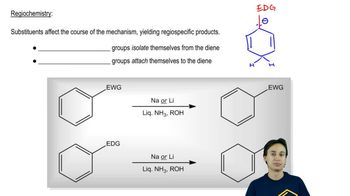
  • How do electron-withdrawing groups affect the regiochemistry of the Birch reduction?
    Electron-withdrawing groups stabilize the anion intermediate and are positioned away from the double bonds in the final product. This leads to the withdrawing group being isolated from the diene.
  • What is the effect of electron-donating groups on the location of double bonds in the Birch reduction product?
    Electron-donating groups destabilize the anion intermediate and end up attached directly to the diene in the product. This is because their presence near the negative charge is unfavorable.
  • Why does the Birch reduction mechanism involve both radical and anion intermediates?
    The mechanism starts with a radical anion intermediate after the first electron donation, followed by a carbanion after the second electron donation. These intermediates are key to the stepwise reduction of benzene.
  • How does the position of the negative charge in the intermediate influence the final product in Birch reduction?
    The negative charge is placed as far from the radical as possible in the intermediate, which affects where substituents and double bonds end up in the final product. This spatial arrangement helps determine the regiochemistry.