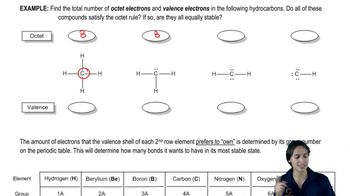
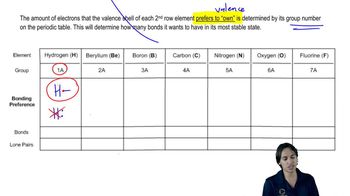
Why do carbon atoms tend to make 4 covalent bonds?
Carbon atoms tend to make 4 covalent bonds because this allows them to achieve a stable octet configuration, owning 4 valence electrons by forming 4 bonds, which satisfies the octet rule and leads to maximum stability.
What is the reason that carbon forms 4 bonds in most of its compounds?
Carbon forms 4 bonds in most of its compounds to fulfill the octet rule, allowing it to have 8 electrons in its valence shell and achieve maximum stability.
How many covalent bonds can a carbon atom typically form?
A carbon atom can typically form 4 covalent bonds.
How many hydrogen atoms can be attached to a single carbon atom if it forms only single bonds?
A single carbon atom can be attached to 4 hydrogen atoms if it forms only single bonds, as in methane (CH₄).
What is the bond order of the carbon-carbon bond in acetylene (ethyne)?
The bond order of the carbon-carbon bond in acetylene (ethyne) is 3, since the two carbon atoms are connected by a triple bond.
How can you determine if a molecule shows the appropriate number of bonds around each carbon atom?
A molecule shows the appropriate number of bonds around each carbon atom if each carbon forms 4 bonds (single, double, or triple), thereby satisfying the octet rule.
Each carbon atom can bond with as many as how many other atoms or molecules?
Each carbon atom can bond with as many as 4 other atoms or molecules.
How many covalent bonds can carbon and nitrogen typically form?
Carbon can form 4 covalent bonds and nitrogen can form 3 covalent bonds.
How do you determine the number of valence electrons an atom owns in a molecule?
You count one electron for each lone pair (dot) and one electron for each bond (stick) the atom has. This sum gives the atom's valence electron count.
Why can different carbon atoms in a molecule have varying stabilities even if they all satisfy the octet rule?
Different carbon atoms can have varying stabilities because they may own different numbers of valence electrons. The most stable configuration is determined by the optimal valence electron count for that atom.