Back

Carboxylation definitions

Control buttons has been changed to "navigation" mode.
1/12
  • Grignard Reagent

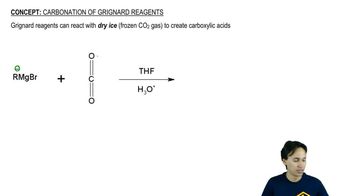
    A compound with a highly nucleophilic R group bearing a strong negative charge, commonly used to form new carbon-carbon bonds.
  • Nucleophile

    A species rich in electrons that seeks out and attacks electron-deficient centers, such as carbon in CO2.
  • Electrophile

    A species with an electron-deficient center, making it susceptible to attack by nucleophiles; CO2 is a prime example.
  • Dry Ice

    A solid form of carbon dioxide, used as a reactive electrophile in organic synthesis, especially with Grignard reagents.
  • Carboxylate

    An intermediate anion formed after a nucleophilic attack on CO2, featuring a negatively charged oxygen.
  • Protonation

    A step where a proton is added to a negatively charged intermediate, converting it into a neutral product.
  • Carboxylic Acid

    A functional group characterized by a carbonyl and hydroxyl on the same carbon, synthesized efficiently from Grignards and CO2.
  • Carbonyl

    A functional group with a carbon double-bonded to oxygen, present in both intermediates and products of carboxylation.
  • Dipole

    A separation of charge within a molecule, making CO2 a strong electrophile due to its two polar bonds.
  • Carboxylation

    A process where a carbon-containing group is introduced into a molecule, often using CO2 as the source.
  • Intermediate

    A transient species formed during a reaction, such as the carboxylate before protonation to carboxylic acid.
  • Synthesis

    A method or process for constructing complex molecules, exemplified by making carboxylic acids from Grignards and CO2.