Organic Chemistry
My Course
Learn
Exam Prep
AI Tutor
Study Guides
Textbook Solutions
Flashcards
Explore
Try the app
My Course
Learn
Exam Prep
AI Tutor
Study Guides
Textbook Solutions
Flashcards
Explore
Try the app
Back
Chain-Growth Polymers quiz
You can tap to flip the card.
What is another name for chain growth polymerization?
You can tap to flip the card.
👆
What is another name for chain growth polymerization?
Chain growth polymerization is also known as addition polymerization.
Track progress
Control buttons has been changed to "navigation" mode.
1/15
Related flashcards
Recommended videos
Chain-Growth Polymers definitions
Chain-Growth Polymers
15 Terms
4:17
Chain-Growth Polymers Concept 2
545
views
1:44
Chain-Growth Polymers Example 1
523
views
1:19
Chain-Growth Polymers Concept 1
548
views
Terms in this set (15)
Hide definitions
What is another name for chain growth polymerization?
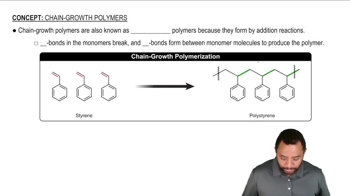
Chain growth polymerization is also known as addition polymerization.
What type of bond breaks in monomers during chain growth polymerization?
The pi bonds in monomers break during chain growth polymerization.
What type of bond forms between monomers to create a polymer in chain growth polymerization?
New sigma bonds form between monomers to create the polymer.
What is the repeating unit in polystyrene derived from?
The repeating unit in polystyrene is derived from styrene monomers.
What variable is used to represent the number of repeating units in a polymer?
The variable 'n' is used to represent the number of repeating units.
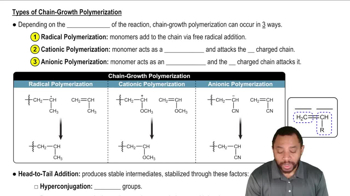
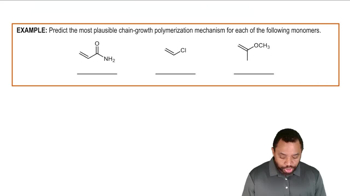
Name the three mechanisms by which chain growth polymerization can occur.
Chain growth polymerization can occur via radical, cationic, or anionic mechanisms.
What initiates radical polymerization?
Radical polymerization is initiated by free radicals.
In radical polymerization, what type of arrow is used to show electron movement?
A hook arrow is used to show electron movement in radical polymerization.
In cationic polymerization, what does the monomer act as?
The monomer acts as a nucleophile in cationic polymerization.
How is the carbocation intermediate stabilized in cationic polymerization?
The carbocation intermediate is stabilized by resonance, often involving lone pairs on oxygen.
In anionic polymerization, what does the monomer act as?
The monomer acts as an electrophile in anionic polymerization.
What stabilizes the negative charge in anionic polymerization?
Electron-withdrawing groups, such as nitrile (CN), stabilize the negative charge.
What is head-to-tail addition in chain growth polymerization?
Head-to-tail addition refers to the stable connection of monomers, producing stable intermediates.
What two factors stabilize intermediates in chain growth polymerization?
Intermediates are stabilized by hyperconjugation and resonance.
How does hyperconjugation stabilize intermediates in polymerization?
Hyperconjugation stabilizes intermediates through alkyl groups donating electron density.