Cis vs Trans Conformations quiz #1 Flashcards

Cis vs Trans Conformations quiz #1
Control buttons has been changed to "navigation" mode.
1/10
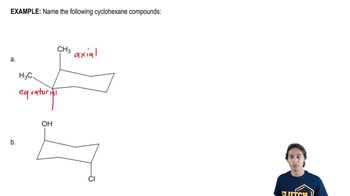
  • How can you determine whether a chair conformation of cyclohexane represents the trans-1,2-disubstituted isomer?
    A chair conformation represents the trans-1,2-disubstituted isomer if the two substituents are on opposite faces of the cyclohexane ring (one on the top and one on the bottom), regardless of whether they are axial or equatorial.
  • What is the most stable chair conformation for a cyclohexane derivative with substituents?
    The most stable chair conformation for a cyclohexane derivative is the one in which bulky substituents occupy equatorial positions, minimizing steric interactions.
  • Which conformations are considered standard for butane, and which are not?
    The standard conformations of butane are anti, gauche, and eclipsed. Any conformation not fitting these descriptions, such as a non-standard staggered or eclipsed arrangement, is not considered a standard conformation.
  • How do you choose the lowest energy conformation for a substituted cyclohexane compound?
    To choose the lowest energy conformation for a substituted cyclohexane, place the largest or bulkiest substituents in equatorial positions to reduce steric strain and achieve maximum stability.
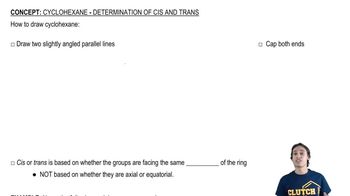
  • What is the first step in the simple method described for drawing a cyclohexane ring?
    The first step is to draw two slightly angled parallel lines. This forms the basic framework for the cyclohexane structure.
  • How do you complete the cyclohexane ring after drawing the two parallel lines?
    You cap off both ends of the parallel lines with opposite-facing caps, one up and one down. This creates the characteristic hexagonal ring shape.
  • Why does the instructor emphasize learning to draw cyclohexane correctly?
    Many students struggle with drawing cyclohexane due to its unusual shape. Mastering a reliable drawing method helps avoid confusion and is useful for exams.
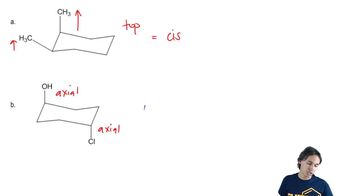
  • What common misconception about cis and trans configurations in cyclohexane does the instructor address?
    The misconception is that cis and trans are determined by whether substituents are axial or equatorial. The instructor clarifies that this is incorrect.
  • According to the instructor, what should you focus on to determine cis or trans in cyclohexane?
    You should focus on whether the substituent groups are on the same face (top or bottom) of the ring. The direction, not the position (axial/equatorial), is what matters.
  • Is the drawing method demonstrated by the instructor acceptable for use on tests?
    Yes, the instructor assures that the demonstrated method is totally legitimate for tests. It provides a quick and effective way to draw cyclohexane.